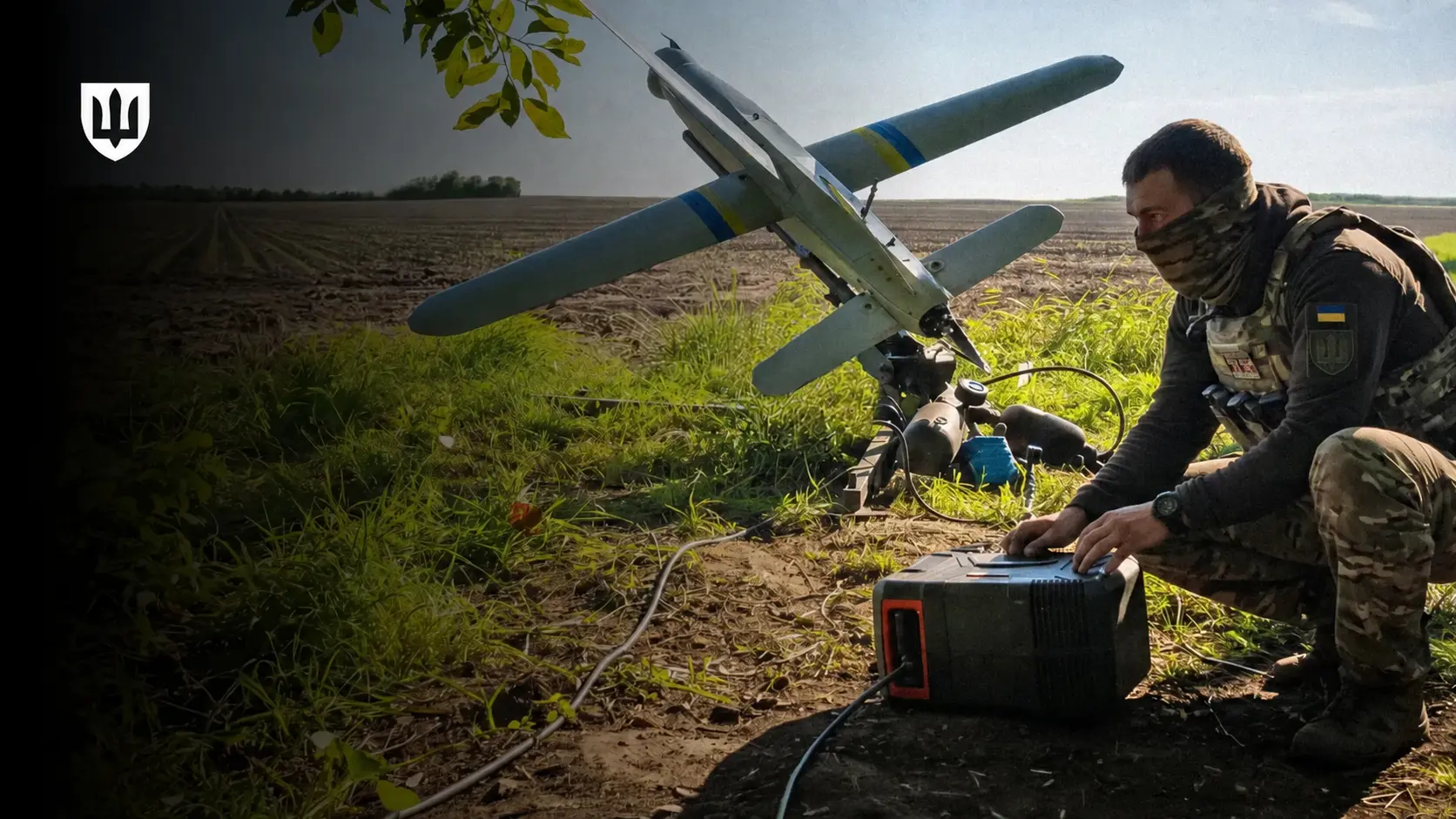
Ukraine’s Defense Procurement Agency (DPA) has contracted roughly 5.5 times as many drones in recent months as in the same period of 2025, the Ministry of Defense said on October 11, 2026. First-person-view (FPV) drone contracting for 2026 already exceeds the full-year 2025 total by 54%, and FPV deliveries have grown nearly 3.7 times.
The figures come less than two months after the Verkhovna Rada confirmed Yevhen Khmara as defense minister following Mykhailo Fedorov’s dismissal. They extend a midyear trend: the DPA signed UAH 333.6 billion, roughly $7.6 billion, in drone contracts during the first half of 2026, double the 2025 first-half value.
What the Ukraine Drone Procurement Figures Actually Measure
The ministry’s release blends three metrics that should not be read interchangeably. Its headline states that the DPA contracted 300% more unmanned aerial vehicles in 2026 than in the previous year, while the body applies the 5.5-fold rise to an unspecified window of recent months. The ministry did not say whether either figure counts airframes or contract value, and it published no absolute unit totals.
A doubling by value through June followed by a 5.5-fold rise in recent months points to sharp third-quarter acceleration, though mixed value and volume reporting rules out precise reconciliation.
The FPV data are firmer. Because the 54% figure compares 2026 contracting to date against all of 2025, the full-year gap is likely to widen before December 31. The 3.7-fold delivery increase carries more operational weight, since it measures hardware reaching brigades rather than signed commitments. Through the DOT-Chain Defence marketplace, where units choose systems with allocated budget funds and the agency handles contracts, payment, and logistics, in-stock items reached the front in an average of nine days as of midyear.
Since March 2026, drone purchases have followed a performance ranking built from battlefield data. The General Staff compiles procurement lists from that ranking and unit requests, and the DPA signs contracts for the listed systems. A price adjustment mechanism for fiber-optic FPV contracts, introduced after a global spike in optical fiber costs, has kept that category flowing.
Deep Strike, Middle Strike, and FPV: Drones Matched to Each Echelon
Khmara framed the buildup as a layered requirement, saying the ministry must give the army drones for effective work “at every level: tactical, operational and strategic.” He assigned deep strike systems to targets inside Russia and middle strike drones to destroying enemy drone crews, logistics, and command posts.
Middle strike is where the doctrinal shift is most visible. Ukrainian forces define it as engagements roughly 50 to 150 kilometers behind the line of contact, and President Volodymyr Zelensky said this spring that 2026 contracting for the category was already five times the 2025 level. In August alone, the ministry reported that middle strike assets hit 17 Russian air defense systems, more than 30 command posts, six bridges, and more than 20 depots.
Deep strike rests on domestic one-way attack drones. Publicly available specifications indicate Fire Point’s FP-1 carries a 105-kilogram warhead to 1,000 kilometers, while the FP-2 reaches up to 200 kilometers beyond the front with a warhead the manufacturer says will grow to 158 kilograms after modernization. Fire Point reported in March 2026 that it was producing about 200 long-range strike drones per day across both families.
At the tactical edge, radio-controlled and fiber-optic FPV drones remain the volume item; fiber-optic control links cannot be jammed by radio-frequency electronic warfare. The Basic Level of Supply program, launched in July, guarantees frontline units minimum monthly stocks of FPV, Mavic-type, bomber, fixed-wing reconnaissance, and light middle strike drones. Its second phase added heavy middle strike drones and ground robotic systems in August.
How EU Loans and German Funding Are Scaling Ukrainian Drone Output
The ministry credited partner support and the scaling of Ukraine’s defense industry for the surge. The industrial side is largely domestic: the ministry reported in June that Ukrainian-made systems account for 95% of the drones supplied through its procurement channels. The financing side is increasingly European.
On October 7, the European Commission disbursed €1.24 billion under the defense component of the €90 billion Ukraine Support Loan, covering drones, drone interceptors, drone ammunition, and missiles built by Ukrainian manufacturers. Of €28.3 billion planned for Ukrainian defense industrial capacity in 2026, €15.4 billion remains undisbursed, pending Kyiv’s submission of receipts for verification. Three days earlier in Kyiv, German Chancellor Friedrich Merz announced a package worth more than €1.3 billion, including about €1 billion in military aid and financing for Quantum Systems to build tens of thousands of interceptor drones in Ukraine against Russia’s jet-powered Geran variants, of which Ukraine was intercepting only about half, according to Zelensky.
The EU-Ukraine Drone Alliance, whose nine Ukrainian and nine European founding companies held their first board meeting in Brussels in September, is designed to turn that money into joint ventures and co-production. Khmara paired the volume push with a predictability argument, saying the ministry now synchronizes frontline requirements, procurement planning, and industrial capacity so that manufacturers can build production lines, plan logistics, and order components on predictable contracts.
Analysis: The figures suggest Ukraine’s binding constraint on drones has shifted from industrial capacity to funding cadence and delivery throughput. Domestic producers are absorbing larger orders; the open variables are how fast partner money arrives and converts into airframes at brigade level. That makes the €15.4 billion in undisbursed EU defense funds an operational issue as much as a fiscal one, particularly as winter raises demand for interceptors. For NATO planners, the transferable lesson is the architecture: performance-ranked purchasing, a unit-level marketplace, and guaranteed baseline allocations give brigades and producers a planning horizon that European drone procurement has yet to replicate.
Another EU defense disbursement is expected before the October 14 summit of EU leaders, according to EU officials. The ministry has yet to publish absolute unit counts, year-to-date contract values, or interceptor and deep strike volumes. Those figures, and full-year FPV totals, will show whether the delivery surge holds through winter.