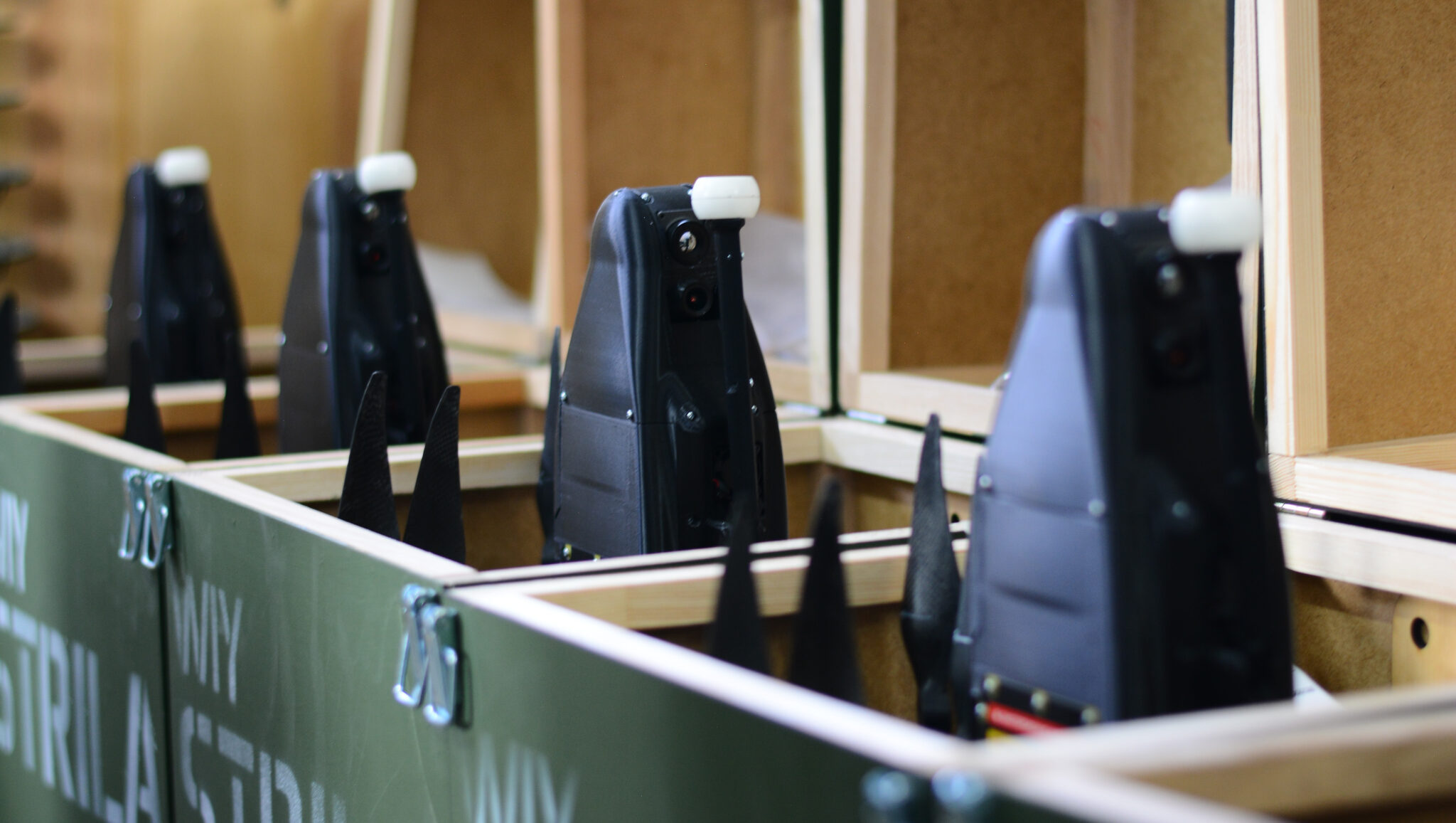
Germany will finance several tens of thousands of interceptor drones produced in Ukraine by Quantum Systems, Chancellor Friedrich Merz announced during a visit to Kyiv on October 4, 2026. The financing is part of a support package worth more than €1.3 billion ($1.46 billion) and targets Russia’s growing use of jet-powered Shahed-type attack drones ahead of the winter of 2026/2027.
The announcement comes as Russia escalates its air campaign against Ukrainian cities. President Volodymyr Zelensky said Russia used more than 1,900 attack drones, 1,700 aerial bombs and 25 missiles against Ukraine in the preceding week, with more than 800 of the drones jet-powered. Berlin already funds a program for some 15,000 STRILA interceptors, and in April 2026 Quantum Systems and Ukrainian manufacturer WIY Drones formed the Quantum WIY Industries (QWI) joint venture to scale interceptor output.
How Quantum Systems Interceptor Drones Will Be Built in Ukraine
According to the company, the order will scale production in Ukraine of interceptor systems already in operational use there. The drones were developed by QWI’s Ukrainian engineering team to protect cities, civilian facilities and critical infrastructure, and they integrate into MOSAIC UXS, the AI-enabled mission software that links Quantum Systems’ air, land and sea platforms into one operational network.
Ukraine’s Ministry of Defense also signed an agreement with the Munich-based firm covering the testing and procurement of interceptors designed specifically for jet-powered drones. Neither government nor the company has disclosed the exact unit count, the contract value within the aid package, or a delivery schedule, and the company did not name the airframe being financed.
“Ukraine needs interceptor drones at industrial scale,” said Sven Kruck, co-CEO of Quantum Systems. “By expanding production in Ukraine, we can respond faster to the immediate threat while building an industrial capability that will also strengthen Germany and its allies.”
The program sits within a German-Ukrainian production network that also includes Quantum Frontline Industries and Quantum Tencore Industries. Quantum Systems has kept a permanent presence in Ukraine since 2022 and employs several hundred people there, out of more than 1,700 across eight countries.
STRILA and SPYS: Speed, Range, and Guidance Against Jet Drones
Zelensky told the joint press conference that a new German-Ukrainian interceptor, SPYS, had just passed testing, and Merz said recent technical progress would allow serial production to start quickly. The two WIY designs show the trade-off the jet threat imposes.
STRILA, the propeller-driven interceptor Berlin already funds, has a 5.7 kg maximum takeoff weight, a 700 g payload, a 150 to 200 km/h cruise speed and a 415 km/h top speed, according to manufacturer specifications. It offers 15 minutes of flight time, a 34 km one-way range, a 6,000 m ceiling and a 50 m/s climb rate. Ground radar cues it toward targets detected at up to 10 km, after which the operator takes manual control for the terminal kinetic intercept using a gimbaled EO/IR sensor. Frequency switching and radio-beacon navigation sustain operations under jamming and GNSS denial, and the airframe can be recovered when no engagement occurs.
SPYS was built for the faster threat. Developer figures indicate a 600 km/h top speed and 250 km/h cruise, but only a 300 g payload, a 12 km operational range, five minutes of flight time and a 6 km ceiling. It pairs with the RADA radar and SkyMap software to fly autonomously into the engagement zone, while WIY is still refining head-on guidance to catch targets in their terminal dive. The first 50 units went to the military for combat evaluation in July 2026.
Publicly available reporting places jet-powered Geran variants at roughly twice the 185 km/h cruise speed of the propeller-driven Shahed-136, shrinking the time between radar detection and intercept.
IRIS-T Missiles, Fire Point MoU, and the Pending Drone Deal
The package splits into €1 billion ($1.13 billion) in military aid and about €350 million ($394 million) for generators and repairs to energy infrastructure damaged by Russian strikes. The defense tranche also covers thousands of missiles for IRIS-T air defense systems and additional IRIS-T fire units, with Diehl Defence and Hensoldt signing agreements on missiles and radar equipment.
“This will quickly and noticeably strengthen Ukraine’s air defense, and this reinforcement is urgently needed,” Merz said.
At an industry round table with Zelensky and Merz, Quantum Systems signed a memorandum of understanding with Fire Point, the Ukrainian maker of the FP-1 long-range drone and FP-5 Flamingo cruise missile, to jointly develop unmanned systems and technologies against advanced aerial threats.
The headline totals diverge. Zelensky valued the day’s agreements at more than €8.5 billion ($9.57 billion), including a dedicated counter-drone agreement, while German officials cited 14 agreements worth roughly €6.6 billion. The broader bilateral Drone Deal, proposed by Kyiv at the April 2026 intergovernmental consultations in Berlin and expected to cover joint development of drones, missiles and software, remains in final negotiation.
Analysis: Berlin is buying production capacity, not just inventory. Financing interceptor output inside Ukraine shortens the loop between combat data and design changes, which matters because Russia has already shifted to jet propulsion to outrun the first generation of low-cost interceptors. The SPYS profile shows the price of keeping pace: closing on jet targets meant giving up more than half of STRILA’s payload and two-thirds of its endurance, so effectiveness now hinges on dense radar coverage and forward-deployed launch teams rather than loiter time. For Germany and NATO, the program doubles as an industrial hedge, giving Europe a mass-producible counter-UAS layer that preserves Patriot and IRIS-T interceptors for missiles and aircraft.
Key unknowns remain the number of airframes, the share of the €1 billion allocated to Quantum Systems, and whether SPYS, STRILA or a mix will dominate output. German officials said thousands of interceptors should reach Ukrainian forces in the coming months, and Zelensky said first combat results from small missiles designed against jet drones are expected in the second half of October 2026. Both efforts will be tested against Russia’s jet-powered drone production through the winter.