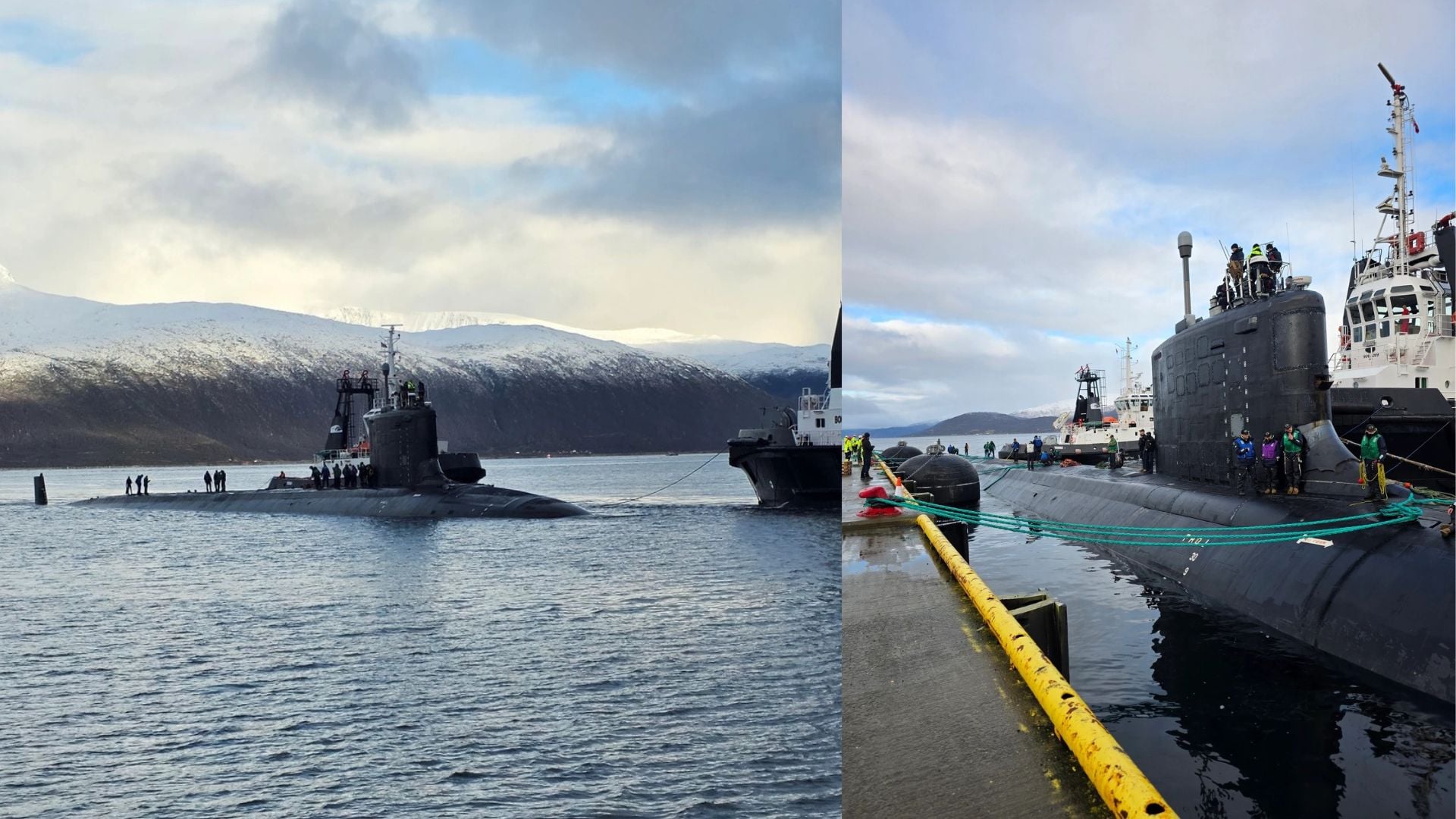
The Virginia-class fast-attack submarine USS Oregon (SSN 793) arrived at the Port of Grøtsund near Tromsø, Norway, on October 6, 2026, for a scheduled port visit, according to U.S. 6th Fleet. The stop covers crew rest, replenishment and routine maintenance, roughly 11 weeks after Oregon called at His Majesty’s Naval Base Clyde in Faslane, Scotland, on July 20, 2026.
The visit is the second Virginia-class call at Grøtsund in five weeks, after USS Delaware (SSN 791) berthed there from September 1 to 7, 2026. Norway designated Grøtsund in 2020 as its receiving port for allied nuclear-powered vessels, and USS New Mexico (SSN 779) made the first U.S. submarine call there on May 10, 2021. “Security and stability in the High North are critical to the collective defense of Europe and North America,” said Capt. David Beam, deputy commodore of Task Force 69, the 6th Fleet’s submarine command.
USS Oregon Block IV Design: Sensors, Payload and Sustainment
Oregon is the 20th Virginia-class boat and the second Block IV hull. Built by General Dynamics Electric Boat in Groton, Connecticut, it was commissioned on May 28, 2022, and shifted homeport to Naval Station Norfolk, Virginia, in March 2025.
Publicly available specifications put the boat at 377 feet (115 meters) long, with a 34-foot (10.4-meter) beam and a submerged displacement of about 7,800 tons. A single S9G pressurized-water reactor, fueled for the life of the hull, drives a pump-jet propulsor; the Navy lists submerged speed as greater than 25 knots.
Oregon inherits the Block III bow redesign. Two Virginia Payload Tubes, each holding six Tomahawk cruise missiles, replace the 12 vertical launch cells of Blocks I and II, and a water-backed Large Aperture Bow array replaces the legacy air-backed spherical sonar. Four 21-inch torpedo tubes handle Mk 48 Advanced Capability (ADCAP) heavyweight torpedoes, and photonics masts replace hull-penetrating periscopes. For anti-submarine work in the Norwegian Sea, the bow array is the key sensor: its passive performance largely sets detection range against quieter Russian designs.
Block IV changes target sustainment. Under the April 28, 2014, contract for 10 Block IV boats (SSN 792 to SSN 801), valued at $17.6 billion, the Navy reworked components to cut planned depot availabilities per hull from four to three and raise planned deployments from 14 to 15. For a fleet that cannot build submarines fast enough, one extra deployment per hull is capacity it does not have to buy.
Why Grøtsund Matters for Allied Submarine Operations in the High North
Grøtsund, at Tønsnes north of Tromsø, gives allied submarines a sheltered logistics stop close to the Norwegian Sea and the approaches to the Barents Sea. Crews can rest, resupply and complete routine maintenance without a multi-day transit back to the Clyde or across the Atlantic, which means more days on station for a small number of forward-deployed boats.
The port has seen steady use: at least 15 U.S. submarine calls between May 2021 and May 2024, and about eight allied submarine visits a year by Norwegian regional counts, most of them American. During Delaware’s September stop, Rear Adm. John W. Stafford, commander of Task Force 169, described the High North and Norwegian Sea gateways as central to the defense of both Europe and the U.S. homeland.
Task Force 69 boats train regularly with the Royal Norwegian Armed Forces, which field P-8A Poseidon maritime patrol aircraft at Evenes and Ula-class diesel-electric submarines. In August and September 2023, the guided-missile submarine USS Florida (SSGN 728) trained in Norwegian waters with HNoMS Uthaug, Royal Norwegian Air Force F-35 and P-8 aircraft, and Norwegian naval special forces.
Northern Fleet Modernization Raises the Stakes in the Norwegian Sea
The operational backdrop is Russia’s Northern Fleet on the Kola Peninsula, whose ballistic missile submarines rely on a protected Barents Sea bastion and whose attack submarines must cross the Norwegian Sea to reach the North Atlantic. As of July 2026, it operated three Project 885 and 885M Yasen-family boats from Zapadnaya Litsa: K-560 Severodvinsk, K-561 Kazan and K-564 Arkhangelsk.
Sevmash launched a further Yasen-M, K-563 Ulyanovsk, on July 28, 2026, with transfer to the Northern Fleet planned for December 2027. Publicly available specifications credit the class with eight vertical launch modules and ten 533 mm torpedo tubes, compatible with Kalibr and Oniks cruise missiles and, according to Russian statements, the 3M22 Tsirkon hypersonic missile.
Norway is rebuilding its own undersea arm. Oslo signed for two additional Type 212CD submarines with TKMS on January 30, 2026, raising its order to six, with the first Norwegian hull due in 2029. Until those boats replace the aging Ula class, allied nuclear-powered submarines calling at Grøtsund remain central to persistent undersea presence in the region.
Analysis: Two Virginia-class calls at Grøtsund in five weeks show the port working as intended: a forward logistics node that converts allied access into submarine availability. That matters because Virginia-class deliveries have run at roughly 1.1 to 1.3 boats a year against a goal of two, and the Chief of Naval Operations has projected reaching two per year around 2032. With attack submarines stretched between the Indo-Pacific and the North Atlantic, each day a boat avoids transiting to the Clyde or to Norfolk is a day added to coverage of Northern Fleet movements. Oregon’s Block IV design and Norway’s port infrastructure attack the same constraint from opposite ends.
The Navy has not disclosed how long Oregon will remain at Grøtsund or when its deployment, under way since at least July 2026, will end. Norway’s parliament has asked the government for an expanded needs assessment on the former naval base at Olavsvern, south of Tromsø, by spring 2027, which could add a second allied reception site. Ulyanovsk’s December 2027 entry into service and Norway’s first Type 212CD delivery in 2029 are the next markers in the undersea balance these port calls are meant to underwrite.