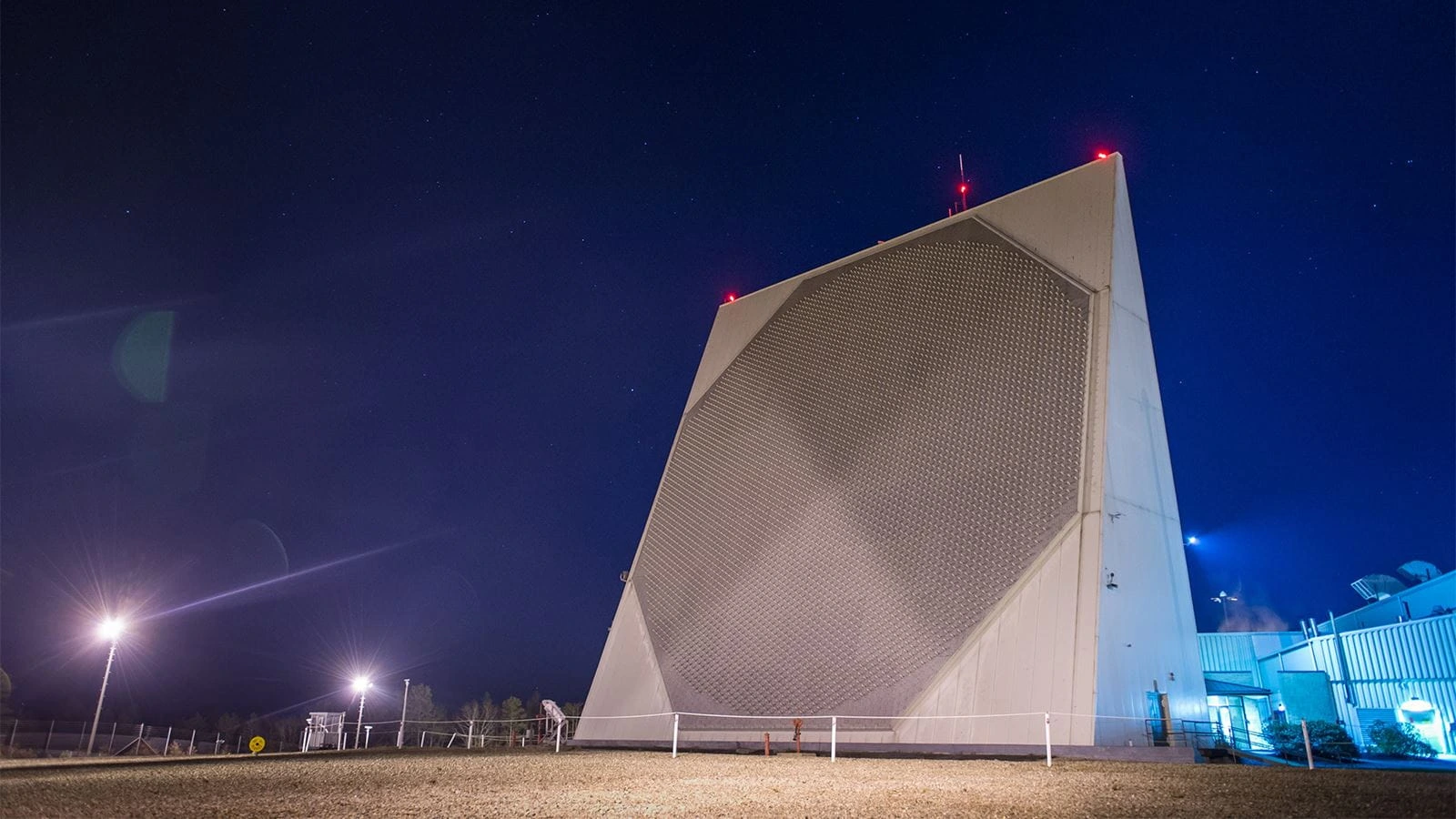
RTX’s Raytheon confirmed on October 15, 2026, that it will help digitize the U.S. Space Force’s strategic missile warning and space surveillance radars under the Ground-Based Radar Digitization (GBRD) program. The announcement follows a $309,472,660 prototype agreement that Space Systems Command (SSC) awarded the company on July 17, 2026, the largest of three issued.
These radars form the first ground-based tripwire of U.S. homeland missile defense. They cue the Missile Defense Agency’s (MDA) Ground-based Midcourse Defense (GMD) system, pass launch warning to North American Aerospace Defense Command (NORAD) and feed the Space Surveillance Network. SSC presents GBRD as the fix for obsolescence, high sustainment costs and limited automation. GBRD also intersects Golden Dome: the fiscal 2026 reconciliation package set aside $1.98 billion for improved ground-based missile defense radar, although SSC has declined to say whether any of that money will reach GBRD.
Inside the $423.4 Million Early Warning Radar Digitization Award
SSC’s Colorado Springs contracting office issued three firm-fixed-price other transaction agreements (OTAs) worth $423,403,621 combined after a competition that drew eight offers. Raytheon, performing in Woburn, Massachusetts, holds about 73% of that value. SciTec Innovations of Princeton, New Jersey, a Firefly Aerospace subsidiary, received $93,704,410, and WildStar LLC of Arlington, Texas, received $20,226,551. The government obligated $107,436,000 in fiscal 2025 research, development, test and evaluation funds at award, and all three agreements run through April 21, 2028.
GBRD follows the Middle Tier Acquisition rapid prototyping pathway and what SSC calls a “compete and collaborate” model, in which every vendor builds against a government-owned modular open systems architecture. Raytheon’s statement tracks that logic, presenting the common architecture as a way to cut sustainment costs, avoid vendor lock and simplify later upgrades, with prototypes delivered before rapid fielding at the remaining sites. Sam Deneke, president of Air & Space Defense Systems at Raytheon, argued that the sites must go digital to keep pace with a more complex threat picture.
Scope has grown since the first request for information in 2025. That plan covered six radars, five Upgraded Early Warning Radars (UEWR) and the Perimeter Acquisition Radar Attack Characterization System (PARCS), limited to back-end processing, with initial operational capability (IOC) in 2028 and 2029 and full operational capability (FOC) in 2030. A revised plan in early 2026 widened GBRD to eight radars, added digitization of the front-end arrays, and moved IOC at four rapid prototype sites to the first quarter of fiscal 2030, with FOC by the second quarter of fiscal 2031. MDA is a joint partner in the program.The Space Force has not said publicly how the July agreements map onto that wider scope, or which site will host the first prototype.
AN/FPS-132, PARCS and Cobra Dane: What Digitization Changes
The five UEWRs, designated AN/FPS-132, operate at Beale Air Force Base, California; Cape Cod Space Force Station, Massachusetts; Clear Space Force Station, Alaska; Pituffik Space Base, Greenland; and Royal Air Force Fylingdales, United Kingdom. All are solid-state phased arrays with fixed elements and electronically steered beams. Space Force fact sheets list 1,792 active elements on each of Cape Cod’s two faces and 3,589 elements per face at Pituffik, where each face draws up to 870 kilowatts. Fylingdales uses three faces for 360-degree coverage. Publicly available specifications indicate UHF operation and detection out to roughly 3,000 miles.
Raytheon, the incumbent, carried out earlier UEWR conversions and completed second-generation upgrades at Clear and Cape Cod that replaced data, signal, display and control processors. GBRD reaches deeper into the same chain: signal and data processing, command and control, signal generation and receivers. Those layers set how many objects a radar can hold in track and how well it separates warheads from debris and decoys, and SSC has said the aim is to handle smaller, faster and more numerous threats.
The other three radars are older and more specialized. PARCS, the AN/FPQ-16 at Cavalier Space Force Station, North Dakota, entered service in the 1970s as the Perimeter Acquisition Radar of the Army’s Safeguard antiballistic missile system. Cobra Dane, the AN/FPS-108 at Eareckson Air Station, Alaska, faces west into the Indo-Pacific Command area; Raytheon also holds its depot and sustainment contract. The AN/FPS-85 at Eglin Air Force Base, Florida, can track up to 200 satellites simultaneously. A common back end across all eight would let the Space Force push one software baseline fleetwide and fuse their tracks into a single space and missile picture.
Analysis: GBRD is designed to end single-vendor dependence on the sensors that anchor homeland missile warning, yet the incumbent took nearly three-quarters of the prototype funding. The decisive variable is the government-owned architecture. If SciTec and WildStar can deliver processing and software against it, the Space Force gains real competition for fielding and later upgrades. If the reference design drifts toward Raytheon’s existing baseline, the program risks recreating the lock-in it was built to break. For Golden Dome, the bigger prize is data fusion: turning eight independent legacy radars into one networked layer able to hand tracks to interceptors and other sensors.
Open questions remain: which UEWR site hosts the first prototype, whether the July agreements cover Cobra Dane and the AN/FPS-85 or only the original six radars, how the three vendors divide the work, and the size of the follow-on production award. Two UEWRs sit on allied territory, so fielding at Fylingdales and Pituffik will also require host-nation coordination. Fleetwide FOC remains targeted for fiscal 2031.