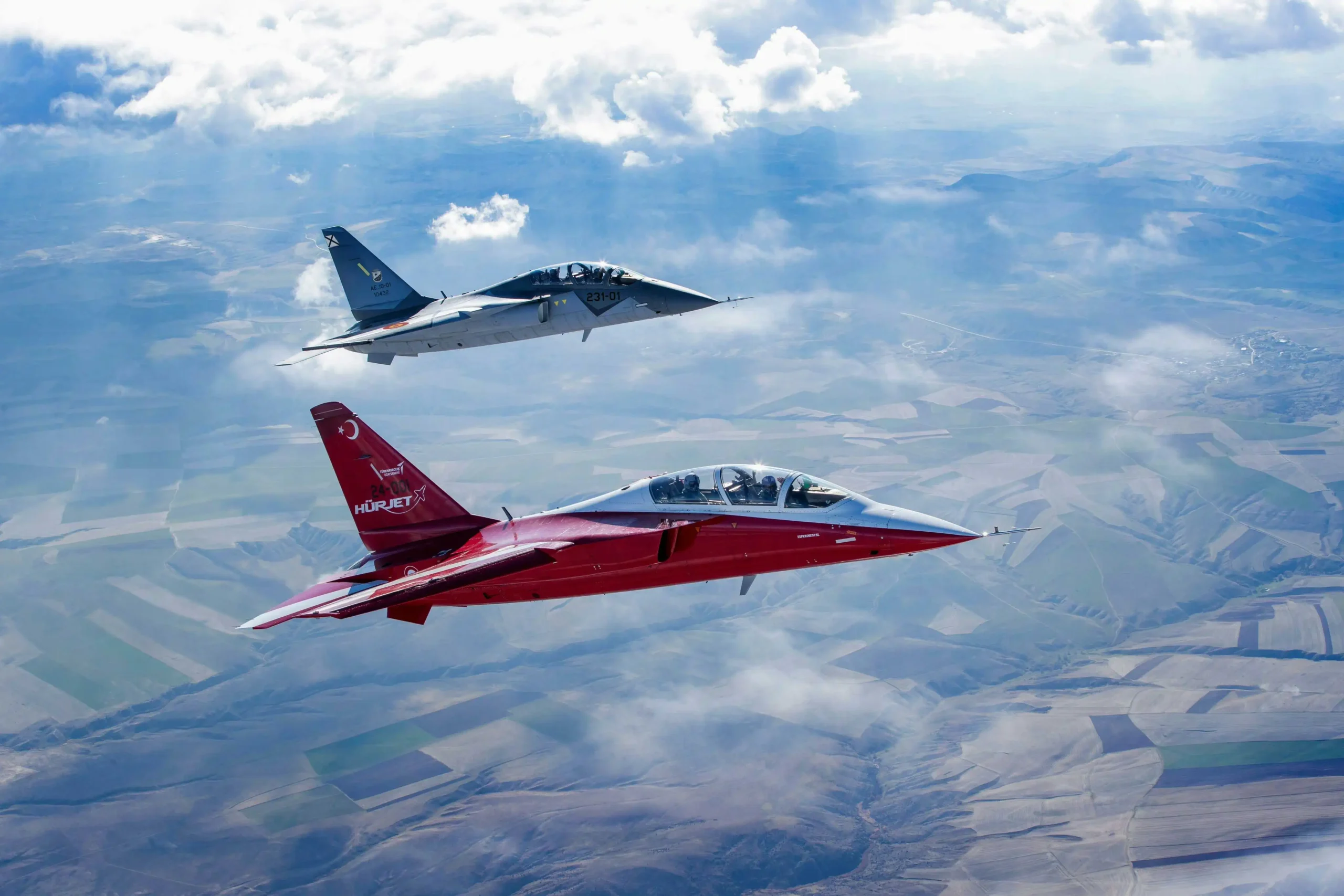
Türkiye and Spain will develop a joint version of the Hürjet supersonic jet trainer with Spanish subcontractor content and Spanish certification, Haluk Görgün, head of Türkiye’s Presidency of Defense Industries (SSB), said on October 14, 2026. Speaking in Ankara at the opening of the IDA Türkiye Defense and Aerospace Industrial Cooperation Days, Görgün said Turkish Aerospace Industries (TAI) will manufacture and deliver the first aircraft, after which the program would yield “a version that could become a joint platform for the two countries.” That configuration would first meet Spanish Air and Space Force requirements before being offered to other NATO members and friendly nations.
The statement recasts the Hürjet’s first export order as a co-development path. Spain’s Council of Ministers authorized the Integrated Training System-Combat (ITS-C) program on October 28, 2025, at an estimated value of €3.12 billion for up to 45 aircraft to replace the AE.9, the Spanish designation for the Northrop SF-5M trainers flown by Ala 23 at Talavera la Real Air Base in Badajoz. In December 2025, the Ministry of Defense’s Directorate General for Armament and Material (DGAM) awarded the first contract, covering 30 aircraft, to a temporary joint venture of Airbus Defence and Space España and TAI.
From ITS-C Contract to Joint Hürjet Jet Trainer Variant
Görgün’s remarks mirror the December 2025 contract structure. In the first phase, TAI builds 30 Hürjets in their initial configuration, which are certified in Spain and delivered through 2028 and 2029, according to Airbus. The fleet is then converted with Spanish content to national requirements at a dedicated Aircraft Conversion Centre to be established in Spain. The first two airframes will be converted at Airbus facilities in Getafe and the remaining 28 at the new center. The contract also covers refurbishment of the training center at the Fighter and Attack School at Talavera la Real, in Extremadura, and integrated operation and maintenance services at the base, with the stated aim of covering the full advanced training process for Spanish combat pilots.
Airbus serves as national coordinator, bringing more than a dozen Spanish aerospace firms into the program, among them Indra, GMV, Sener, CESA, Aernnova and Aciturri. The full workshare by company has not been published. Görgün’s reference to additional certification in Spain points to a Spanish type standard distinct from the Turkish Air Force baseline, but that configuration has not been published.
Spain’s procurement records list the winning offer at about €2.6 billion, the total project budget Görgün has cited, against an estimated contract value of €3.12 billion. The gap between the 45 aircraft authorized and the 30 on contract implies a follow-on tranche of 15 that Madrid has not confirmed.
Hürjet Performance Against the SF-5M and Rival Supersonic Trainers
The Hürjet is a single-engine, tandem-seat advanced jet trainer with a light combat derivative. Publicly available specifications indicate a General Electric F404 afterburning turbofan rated at about 17,700 lbf (78.7 kN) with afterburner, a design top speed of Mach 1.4, a 45,000 ft service ceiling, structural limits of +8/-3 g and a range of roughly 1,960 km. The airframe uses digital fly-by-wire controls, and published figures list seven external stations (four underwing, two wingtip and one centerline) for training pods, short-range air-to-air missiles and guided munitions on the armed variant.
The SF-5M, an upgraded variant of the Northrop F-5B Freedom Fighter, has been in Spanish service for more than five decades. A supersonic, fly-by-wire lead-in trainer narrows the handling and workload gap between Ala 23 and conversion onto the Eurofighter and EF-18 Hornet, letting instructors move demanding syllabus elements such as intercepts and weapons employment away from front-line fighters and their costly flight hours.
The Hürjet occupies a narrow supersonic niche. Korea Aerospace Industries’ T-50, also powered by the F404, reaches Mach 1.5 with a longer export record, the Boeing-Saab T-7A Red Hawk is rated at Mach 1.05+, and the Leonardo M-346 is a transonic design. The first prototype flew on April 25, 2023, and two development aircraft have since logged more than 500 test flights. The first production-standard aircraft for the Turkish Air Force made an 18-minute maiden flight on August 30, 2026, with deliveries now expected to begin in 2027 under an initial order for 12 aircraft.
What a Joint Hürjet Platform Means for NATO Trainer Buyers
Görgün cast the Spanish configuration as the export vehicle. A Hürjet certified in Spain and managed by Airbus would offer a supply and support chain anchored inside the European Union.
Felipe Javier Carrasco Torres, deputy industry minister of Spain’s Valencia region, said at the event that cooperation with Türkiye could help the region’s mainly civilian aerospace, photonics and drone firms move into defense. Görgün, for his part, said Türkiye’s defense and aerospace exports had passed $7.4 billion so far in 2026. Official figures put the sector’s 2025 exports above $10 billion.
Analysis: The joint-platform model matters less for the 30 aircraft Spain has ordered than for the credentials Türkiye cannot easily generate alone. A Spanish type standard, Airbus program management and Spanish-sourced subsystems give the Hürjet a European airworthiness and sustainment footprint that could ease procurement politics in capitals wary of single-source dependence on Ankara. It also gives Airbus a lead-in trainer offering without a clean-sheet program. One constraint does not change: every Hürjet flies on a U.S.-built F404, so third-country sales of the joint variant will still require U.S. re-export authorization.
TAI must begin Turkish Air Force deliveries in 2027, then produce Spain’s 30 initial-configuration airframes for delivery in 2028 and 2029, before converted aircraft return to the Spanish Air and Space Force from the second half of 2031 through 2035. Several questions remain open: the final Spanish workshare and subsystem list, the certification timeline for the joint configuration, whether Madrid orders the remaining 15 aircraft, and how marketing rights for the joint variant will be divided between Ankara, Airbus and Spanish industry.