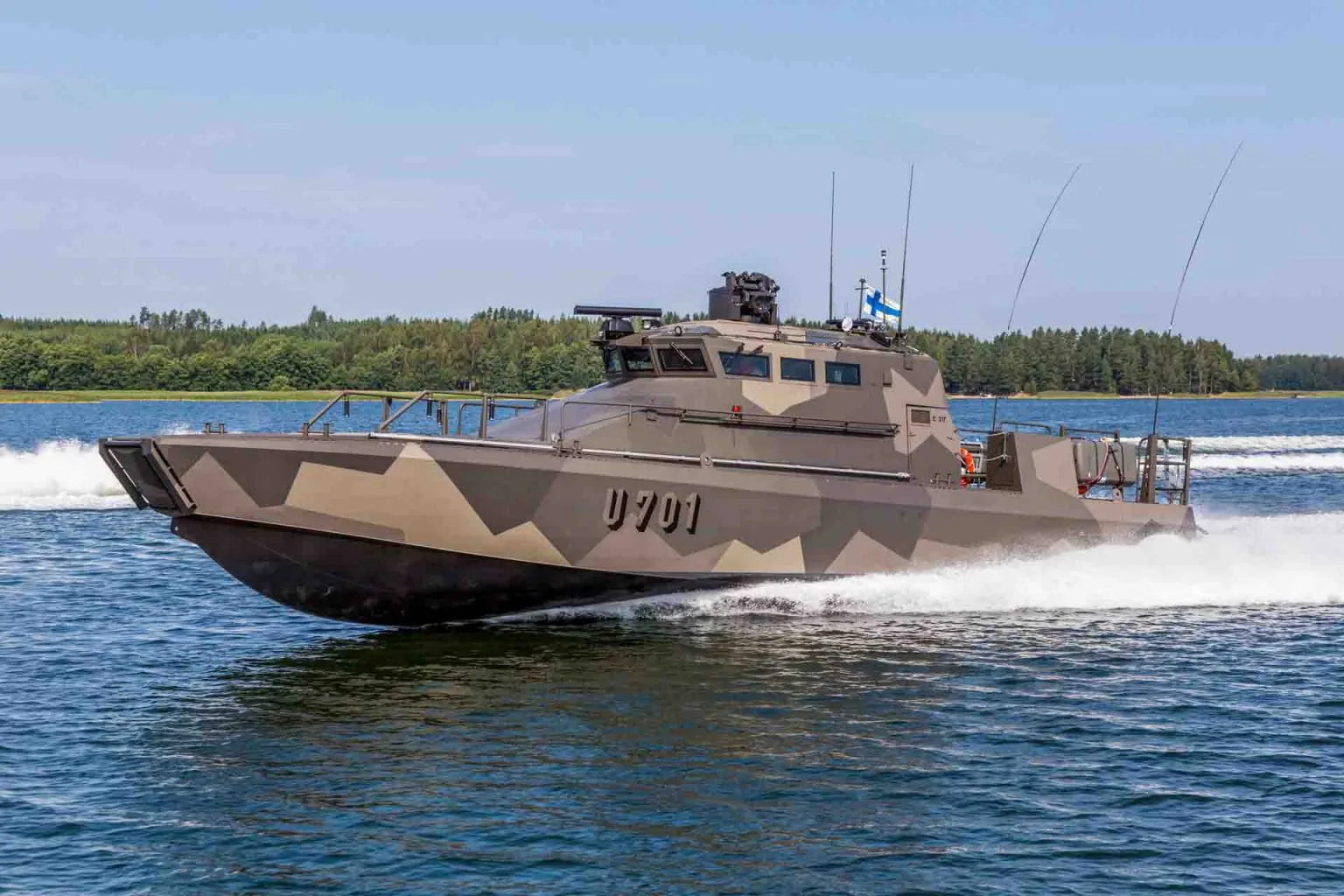
Germany’s Federal Office of Bundeswehr Equipment, Information Technology and In-Service Support (BAAINBw) signed a contract on October 12, 2026, with Finnish boatbuilder Marine Alutech Oy Ab for 15 Watercat M18 Armored Modular Craft (AMC) combat boats to equip the German Navy’s Seebataillon. The contract includes training, documentation and a life-cycle support package, with deliveries scheduled between 2029 and 2031.
The award closes a requirement that has been open for nearly a decade. The analysis phase for a multipurpose combat boat began in July 2017, but the competition for 15 off-the-shelf boats already in service with a NATO or partner navy only opened in June 2023, after financing through the Bundeswehr’s special fund became possible in September 2022. The Bundestag budget committee approved the project on September 23, 2026. The contract value has not been officially disclosed; German defense trade reporting places it at approximately €175 million, structured as ten firm orders plus five boats under an immediately exercised option. The Watercat M18 AMC reportedly prevailed over Saab’s CB90.
Inside the Watercat M18 AMC: Protection, Propulsion and Payload
The Bundeswehr is buying a mature platform rather than funding development. The Finnish Navy operates 12 Watercat M18 AMC boats, designated the Jehu class, and has used them since 2014 for combat, patrol, troop transport, evacuation and command tasks. Lithuania ordered two boats of the same type in 2022.
The craft measures 19.9 meters in length, with a beam of 4.3 meters, a draft of 1.1 meters and a full-load displacement of 32 tonnes. The aluminum hull integrates ballistic protection that open-source reporting describes as comparable to an armored personnel carrier, together with a CBRN protection system. The exact protection level has not been published.
Propulsion relies on twin Scania diesel engines rated at 660 kW each, driving two waterjets, Rolls-Royce 40A3 units on the Finnish boats, for a top speed in excess of 40 knots and a range of approximately 200 nautical miles. Waterjet propulsion keeps the draft shallow and the boat agile, the core requirement for beaching on undeveloped shorelines and transiting rocky archipelagos.
In Finnish service the boat operates with a crew of six. Published figures for the combat compartment range from at least 16 soldiers with personal equipment to seating for up to 25 fully equipped marines, who can be landed directly on the coast through a bow ramp. The platform can be configured with different mission systems, and all 12 Finnish boats carry a Saab Trackfire remote weapon station. The Bundeswehr has not disclosed the armament, sensor or communications fit selected for its boats.
How 15 Combat Boats Reshape Seebataillon Littoral Mobility
The Seebataillon, headquartered in Eckernförde under Einsatzflottille 1, numbers approximately 1,500 personnel. The German Navy intends it to operate as infantry able to move by land and by sea in coastal waters and along the shore, which requires organic tactical mobility on the water rather than reliance on borrowed craft.
The boats are intended for amphibious landings, military evacuation, escort, patrol and harbor protection. In the Baltic, where the littoral is defined by archipelagos, shallow approaches and short transit distances, a protected 40-knot craft allows a platoon-sized element to reposition between islands and coastal positions quickly while remaining shielded from small-arms fire and fragments. According to German defense trade reporting, the 15 boats will cover only part of the battalion’s overall requirement.
The award also carries a domestic industrial component. Part of the production and service work will reportedly be performed by Kiel-based shipyard Gebrüder Friedrich.
Analysis: The selection places Germany alongside Finland and Lithuania as Watercat M18 AMC operators, and next to the Netherlands, which ordered Marine Alutech’s Littoral Assault Craft in October 2025. That creates a cluster of Baltic and North Sea navies fielding Finnish-built armored littoral craft, which can simplify training, spares and cross-servicing among NATO’s northern littoral forces. The trade-off is time: by prioritizing a proven design, Berlin avoided development risk, yet first deliveries in 2029 still leave the Seebataillon without dedicated combat boats for roughly three more years, at a moment when Baltic Sea security has become a central NATO concern.
The next milestones are qualification of the boats within the Bundeswehr ahead of first delivery in 2029 and disclosure of the German configuration, particularly the remote weapon station and C4I suite. The Ministry of Defense has yet to confirm the contract value, and it remains unclear whether the battalion’s remaining requirement will produce follow-on orders beyond the initial 15 hulls.