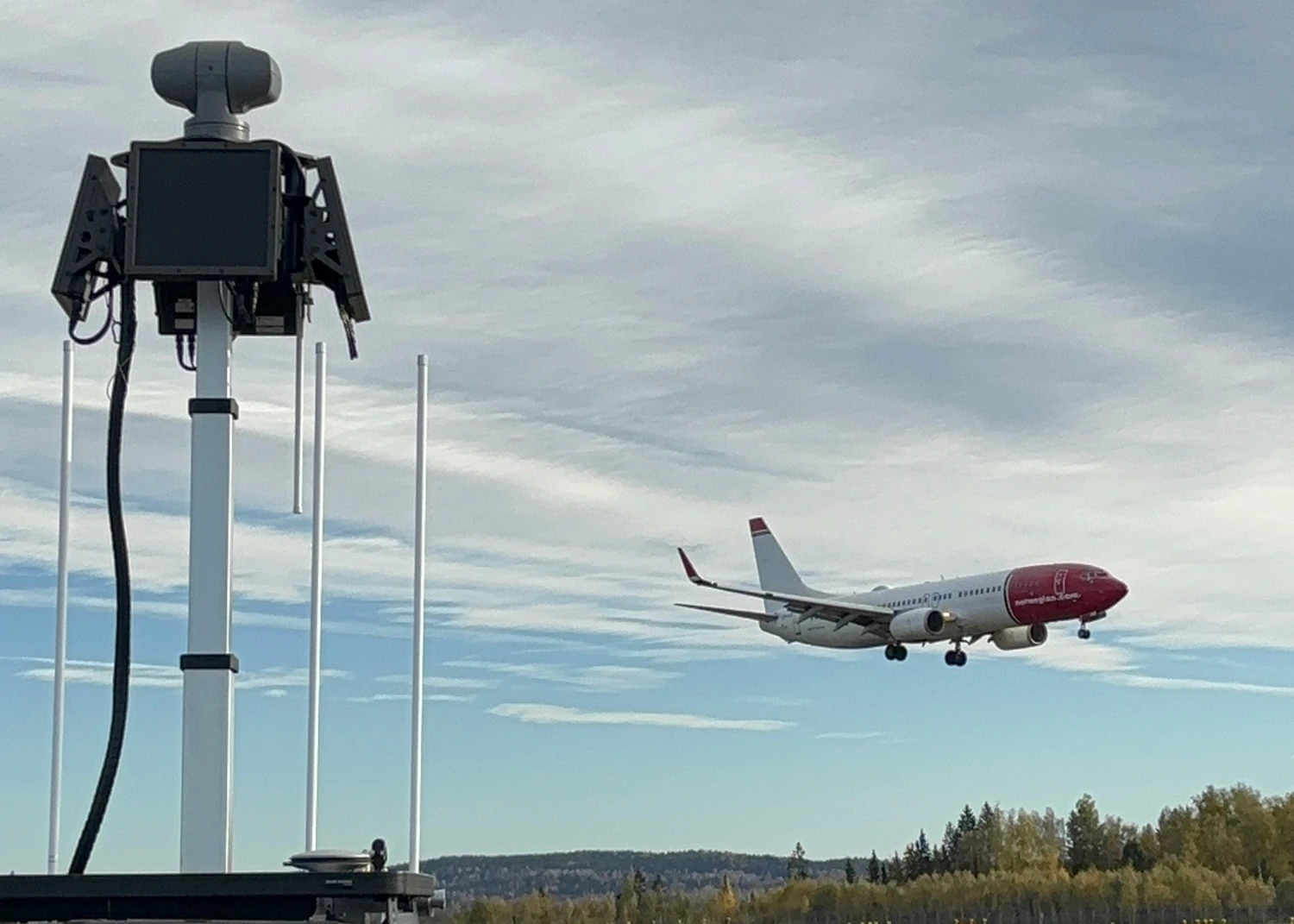
Kongsberg brought its DR 100 drone detection radar from arrival to full operation in five minutes during Interpol’s latest Counter-Unmanned Aircraft Systems (C-UAS) test at Oslo Gardermoen Airport in Norway, the Norwegian group said on October 16, 2026. Mounted in a four-panel configuration on a pickup truck, the radar was assigned an Area of Responsibility (AOR) by Interpol and streamed sensor data over a secure 5G link to the Control Centre set up at the airport, giving the exercise staff a real-time air picture.
The venue matters. On the night of September 22, 2025, Oslo Gardermoen briefly closed its airspace after a drone sighting, the same night reported drones suspended flights at Copenhagen Airport for nearly four hours. Norway’s Air Force has since begun fielding its first counter-drone system at Ørland, the home base of its F-35 fleet. Gardermoen also hosted an Interpol drone incursion exercise from September 28 to 30, 2021, when 17 counter-drone systems were assessed while the airport stayed open to traffic. Kongsberg has not disclosed the dates of the 2026 test, the number of participating vendors, or any Interpol scoring.
Kongsberg DR 100 Quad Configuration and Five-Minute Deployment
The DR 100 is a solid-state, non-rotating Frequency-Modulated Continuous Wave (FMCW) Doppler radar built by Kongsberg Discovery. Each panel measures 400 by 400 mm and weighs 9.9 kg with its bracket, according to the company’s February 2025 datasheet, and can be mounted on vehicles, tripods, or fixed installations. Power draw is 60 W in standard operation and up to 100 W on an 18 to 34 VDC supply.
One panel covers 90 degrees in azimuth and 50 degrees in elevation. That geometry explains the quad layout: four panels are needed to close the full 360-degree horizon. The radar can also be integrated with a pan-tilt-zoom (PTZ) camera; Kongsberg has not said whether one was fitted at Gardermoen.
“Several participants commented on how quickly we deployed the Quad DR 100 system,” said Stefan Blom Hansen, DR 100 product manager and leader of Kongsberg’s participation in the event. “DR 100 is designed with on-the-move capability, meaning we can detect, track and classify targets while operating from a moving platform.”
For on-the-move use, the datasheet lists support for Kongsberg’s MRU 5+ motion reference unit and MGC R2 and R3 motion gyro compasses, with third-party Inertial Measurement Units (IMU) available on request. All processing runs on an onboard Graphics Processing Unit (GPU), and fanless cooling removes fans from the maintenance list.
X-Band Detection Ranges Against Low-Flying Small Drones
The radar operates in the 9.45 to 9.55 GHz X-band. Instrumented range is 4.3 km, with a 5 to 10 Hz update rate, latency under 200 ms, and more than 100 simultaneous tracks, including individual drones in a swarm. Published accuracy is better than 0.5 m in range and 0.5 degrees in azimuth.
Performance scales sharply with target size. The datasheet lists tracking and classification ranges of 0.6 km and 0.45 km against nano-class drones with a 0.001 m² radar cross-section (RCS), 1.5 km and 1 km against 0.1 m² mini drones, and 4.3 km and 3.3 km against 20 m² strike-class targets. These are manufacturer figures, not independently verified.
The Gardermoen scenario focused exclusively on detection, tracking, and classification of airborne objects. Kongsberg stresses that the DR 100 does not filter out low-altitude targets, the low-flying drones that often challenge conventional radars. Classification draws on micro-Doppler processing to separate drones from birds, vehicles, and people, with a stated probability above 95 percent within the radar’s opening angle and a time to classification of 0.5 to 5 seconds.
Effector Integration and the Airport Counter-UAS Market
Kinetic and non-kinetic effectors were outside the scope of the Interpol test, but Kongsberg is positioning the DR 100 as an open sensor for third-party C-UAS architectures. The radar outputs target data over a 1 Gb Ethernet link using Kongsberg’s native protocol and the ASTERIX air surveillance format, with SAPIENT, the UK-developed C-UAS interoperability standard, still under implementation. Through collaborations with system integrators, the company says the radar supports response options including small-caliber weapon systems, interceptor drones, Radio Frequency (RF) jammers, and short-range missiles. It also feeds Kongsberg’s ProximityView situational awareness software and can be networked with other DR 100 units over IP to extend coverage.
“As drone activity around critical infrastructure continues to increase, airports represent an important and growing use case,” said Cato Giil Eliassen, Vice President of Business Development at Kongsberg Seatex.
Analysis: The five-minute figure is the operationally relevant number. On June 25, 2026, Danish police said they could neither confirm nor rule out drone activity over Copenhagen Airport on September 22, 2025, a result that shows the cost of lacking a persistent, classified sensor picture when a sighting is reported. A vehicle-mounted radar pushing tracks over a 5G network gives police a surge layer they can place where a report originates. The limit is range against the smallest targets: at 0.6 km against nano-class drones, one quad unit covers a sector, not an airfield, so wide-area protection still depends on networking several sites.
Interpol has not said when it will publish findings; the report on its 2021 exercise appeared in June 2022. Open questions include how the DR 100 scored against competing sensors, its false-alarm rate in a live airport environment, and whether any police service will buy the quad configuration. Completing SAPIENT integration is the next technical milestone.