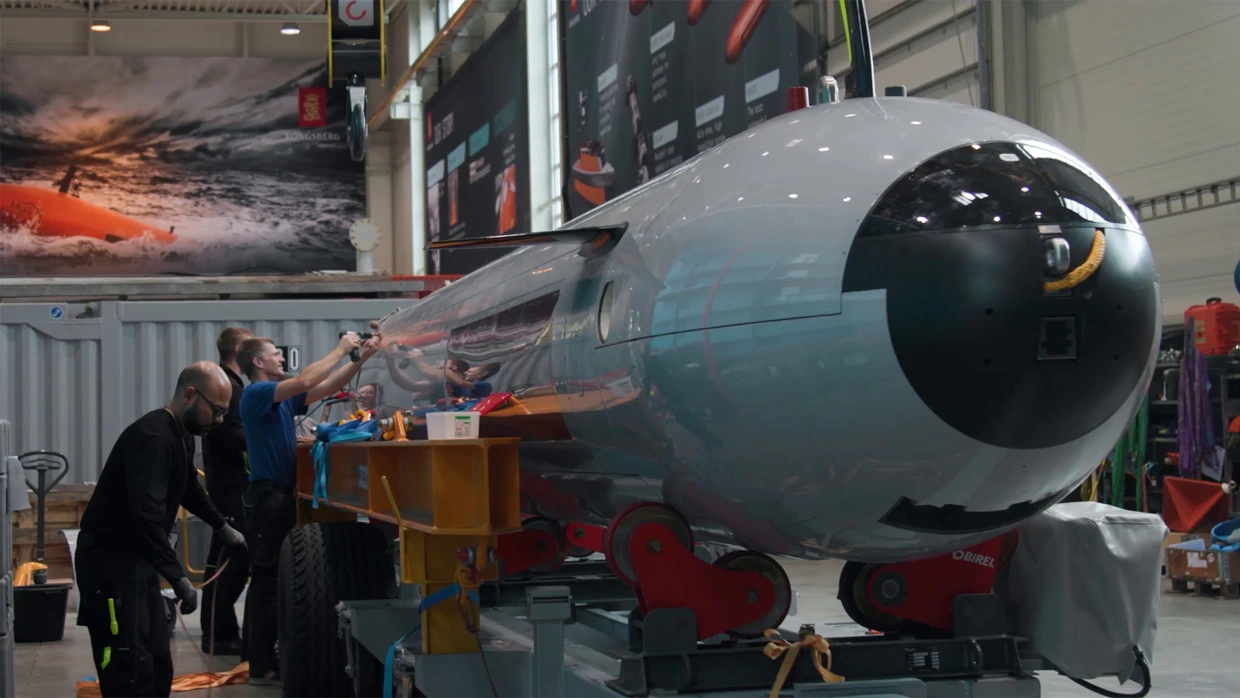
Kongsberg plans to open a volume-production facility for uncrewed underwater vehicles (UUVs) in the United States and is developing low-cost derivatives of its HUGIN family that it intends to build by the hundreds each year, according to Rich Patterson, the Norwegian group’s Vice President of Sales for Uncrewed Platforms. In remarks published on September 24, 2026, Patterson, a former US Navy submariner, said the company aims to be manufacturing UUVs on US soil in 2027, as the US Navy moves toward a hybrid fleet of crewed and uncrewed platforms in the early 2030s.
The timing tracks with Department of War (DoW) spending. Patterson pointed to a forecast of more than $2.4 billion in investment in uncrewed surface vessels (USVs) and UUVs between 2024 and 2029, driven by seabed cable protection in the North Atlantic, Indo-Pacific submarine competition and mine countermeasures (MCM) demand in the Middle East. In 2024, the Defense Innovation Unit (DIU) awarded Kongsberg Discovery a 24-month frame contract supporting the Navy’s Large Displacement Unmanned Underwater Vehicle (LDUUV) prototype effort, and the first HUGIN Superior cleared acceptance testing in early 2025. In July 2025, the company announced initial HUGIN production at its Lynnwood, Washington, facility. The planned volume plant follows the model Kongsberg used to localize Protector remote weapon station and Naval Strike Missile production.
Kongsberg HUGIN UUV Family: Endurance and Superior Specifications
The HUGIN line sits above the size class the Navy typically operates, and Patterson acknowledged a learning curve in deploying larger vehicles. HUGIN Endurance, launched in 2021, is the largest member: about 39 feet long, 47 inches in diameter and roughly 8 tonnes, with lithium-ion batteries supporting 15 days of endurance and a range of 1,200 nautical miles (2,200 kilometers). That envelope is sized for shore-to-shore missions with no host ship.
The sensor fit includes the HISAS 1032 Dual RX synthetic aperture sonar, an EM 2040 MkII multibeam echo sounder, a sub-bottom profiler, color camera, laser profiler, magnetometer and environmental sensors. A configurable volume trades battery capacity against custom payloads, which Kongsberg markets for covert seabed intelligence gathering. During a multi-week validation mission in 2024, the vehicle ran at depths from 50 to 3,400 meters over the full 1,200-nautical-mile range, took its last navigation fix from a pre-deployed transponder 10 hours into the dive, and returned with a position error of about 0.02% of distance travelled. That equates to roughly 440 meters of drift with no external aiding, preserving covertness on long transits into an Intelligence Preparation of the Operational Environment (IPOE) survey box.
HUGIN Superior, in service with commercial and military customers since 2019, is the workhorse: about 22 feet long, 35 inches in diameter, with more than 70 hours of endurance, a full-ocean-depth design and navigation accuracy better than 0.04% of distance travelled. Its mission set covers MCM, subsea and seabed warfare (SSW), IPOE and infrastructure inspection.
Low-Cost HUGIN Variants and Goal-Based Mission Planning
The more consequential disclosure is a second tier. Kongsberg is developing lower-cost UUVs aimed at the DoW’s interest in dispersed, swarming autonomous systems. “We expect to be able to produce hundreds of those variants a year,” Patterson said. The savings come from cheaper construction materials, while the proprietary autonomy and navigation software of the full-size HUGINs remains essentially unchanged. Kongsberg has not released dimensions, depth rating, endurance, payload or unit cost for this tier, and those parameters will determine whether it is genuinely attritable or a scaled-down survey vehicle.
The concept is distributed sensing at chokepoints: networks of uncrewed assets spread across contested waters to deny adversaries undetected passage. That model runs on numbers, making production rate the governing metric. Inheriting the HUGIN navigation stack matters: a node that cannot hold its position cannot reliably report what crossed a barrier line.
Kongsberg is also working on what Patterson called goal-based mission planning. Instead of scripting a linear track, an operator would define an operating area and a mission purpose, and the vehicle would generate its own plan. If it matures, it cuts the operator-to-vehicle ratio, a precondition for fielding hundreds of units. Patterson identified operator trust in autonomy as the largest remaining barrier.
Command and Control Gaps Facing the Navy Hybrid Fleet
Patterson argued that platform maturity is not the binding constraint. The DoW, he said, is struggling to integrate uncrewed systems into the crewed fleet, citing the difficulty of establishing and maintaining command and control over long distances in a system-of-systems architecture. He added that acquisition processes must keep pace with both technology cycles and adversary improvements.
On July 14, 2026, DIU selected Kongsberg and Oceaneering International to support the Combat Autonomous Maritime Platform (CAMP) program, an Extra-Large Uncrewed Undersea Vehicle (XLUUV) effort focused on concept definition, system architecture and design trade studies. In August 2026, Denmark selected Kongsberg Discovery as intended supplier of an autonomous underwater vehicle for the subsea-surveillance vessel Norwind Helm; the HUGIN variant is undisclosed. Kongsberg says 12 navies operate HUGIN.
Analysis: Kongsberg is building a two-tier undersea portfolio that mirrors the shift already under way in aerial drones: a small number of high-end, long-endurance vehicles for seabed IPOE and infrastructure surveillance, backed by a mass tier for distributed barrier sensing. Its edge is not hull design but an autonomy and navigation stack with three decades of operating history, now paired with domestic production that answers US industrial-base preferences. The risk sits on the buyer side. Without a networked command-and-control architecture and a program of record that converts DIU prototyping into sustained orders, a US line producing hundreds of low-cost UUVs a year would be capacity ahead of demand.
Markers to watch include the site of the US volume plant, the first specifications of the low-cost variants and the CAMP trade study results. Kongsberg has not disclosed follow-on orders beyond the 2024 DIU frame contract, and it remains unclear how the Navy will launch, recover and network 8-tonne vehicles such as HUGIN Endurance from fleet platforms. Those answers will decide whether the hybrid fleet buys at the scale Kongsberg is tooling for.