The US Department of War (DoW) and BAE Systems have signed a framework agreement for the procurement of up to 25,000 Advanced Precision Kill Weapon System (APKWS) guidance sections per year for up to seven years, pending congressional authorization and appropriations, the department announced on October 19, 2026. The framework also sets a pathway to surge output to 35,000 units per year for international allies, unlocked as partner nations submit Foreign Military Sales (FMS) Letters of Request. BAE Systems will negotiate a multi-year contract within the framework. No contract value has been disclosed.
The deal was finalized with the US Army, Navy, Air Force, and Marine Corps, and follows a March 2026 seven-year framework under which BAE Systems agreed to quadruple production of the Terminal High Altitude Area Defense (THAAD) interceptor seeker. Both sit under the department’s Acquisition Transformation Strategy. APKWS demand has climbed in parallel: BAE Systems delivered its 100,000th kit in February 2026, six months after Naval Air Systems Command (NAVAIR) awarded a $1.7 billion indefinite-delivery, indefinite-quantity (IDIQ) contract for up to 55,000 units across Full Rate Production Lots 13 through 17.
APKWS Production Framework: 25,000 Baseline and 35,000 Allied Surge
The 25,000-unit baseline matches the manufacturing capacity of at least 25,000 kits per year that BAE Systems advertises across its facilities in Hudson, New Hampshire, and Austin, Texas. The framework therefore commits US demand to existing lines running at full rate, while the additional 10,000 units depend on allied orders. Over seven years, the baseline alone would total up to 175,000 kits, well above the 100,000 delivered in the program’s history.
According to the department, the multi-year commitment gives BAE Systems the demand signal it needs to procure long-lead items and expand its skilled workforce. The surge mechanism is designed to use FMS demand to capitalize new domestic production lines, each of which the DoW says adds sovereign US surge capacity and keeps high-rate manufacturing warm.
“By securing multi-year demand, this agreement keeps production lines running at capacity, provides our forces with interceptor inventory, and flips the cost calculus in the taxpayer’s favor,” said Michael P. Duffey, Under Secretary of War for Acquisition and Sustainment. Neither party has disclosed the ramp schedule or the capital tied to the new lines.
How the WGU-59/B Guidance Kit Shapes the Counter-UAS Fight
The APKWS II, designated WGU-59/B, is a mid-body guidance section inserted between the warhead and the motor of a standard 2.75-inch (70 mm) Hydra 70 rocket. Its Distributed Aperture Semi-Active Laser Seeker (DASALS) places optical receivers in the leading edges of four deployable canards, allowing the round to home on a laser spot designated by the launch platform, another aircraft, or a ground team. Because the kit retains existing motors, warheads, and fuzes, it converts legacy rocket stocks without new launcher hardware.
Publicly available specifications indicate a range of roughly 1.1 to 5 km from helicopters and up to about 11 km from fixed-wing aircraft. BAE Systems claims a combat hit rate above 93%. More than 20 rotary- and fixed-wing platforms are qualified to fire the weapon, which is fielded by all four US services, with Foreign Military Sales customers including the United Kingdom, Australia, Poland, and the Czech Republic.
The counter-unmanned aircraft systems (C-UAS) mission drives much of the ramp, and the department now describes APKWS explicitly as an interceptor. In February 2026, the DoW awarded BAE Systems a $145 million IDIQ contract, including a $66.7 million initial delivery order, for C-UAS weapons built around APKWS kits with proximity fuzes to engage Class 2 and Class 3 drones. The US Air Force has also modified the F-15E Strike Eagle to employ APKWS against drones. Earlier contract data put the Lot 7 unit price at approximately $22,500, a fraction of the cost of the air-to-air missiles otherwise used against such targets.
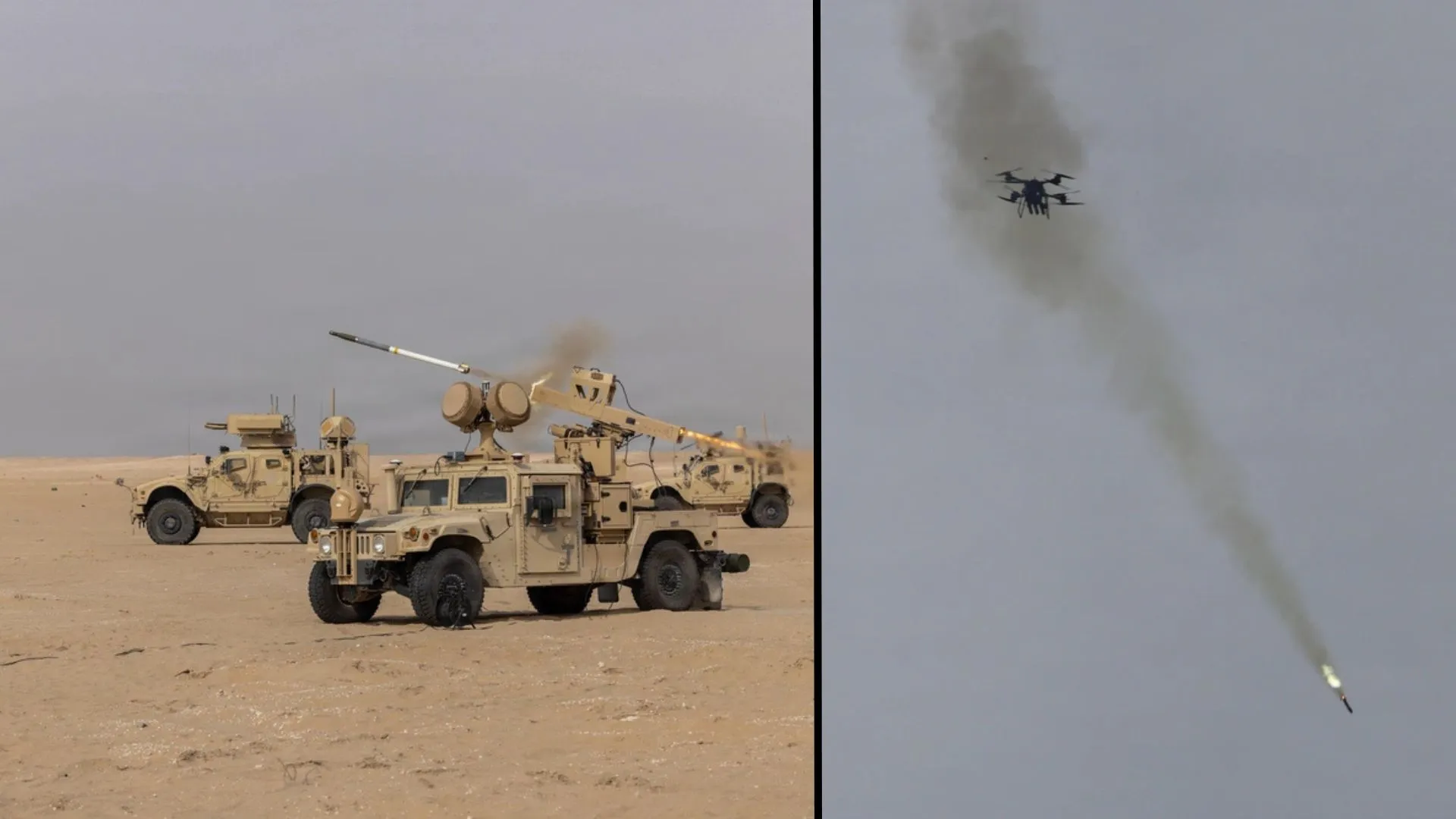
The weapon is also fired from the ground. On December 4, 2025, during Exercise Sky Shield, an air and missile defense and counter-UAS live-fire event in Kuwait, a US Army Electronic Advanced Ground Launcher System (EAGLS) fired an APKWS-guided Hydra 70 rocket in the counter-UAS role. BAE Systems says the kits are effective in air-to-surface, surface-to-surface, surface-to-air, and air-to-air engagements.
Analysis: The framework uses allied demand to finance US industrial depth. Washington commits to buying what existing lines can already produce, while FMS orders fund the capacity above that baseline, which remains available to US forces in a crisis. The model reduces the taxpayer’s capital exposure, but it makes the 35,000-unit figure contingent on partner decisions the DoW does not control. The baseline itself is not yet funded: it depends on Congress authorizing multi-year procurement and appropriating the money, and rocket motor and warhead supply must scale alongside the guidance kit.
The next milestones are the multi-year contract BAE Systems is negotiating inside the framework, which should set quantities, pricing, and the ramp timeline, and the congressional authorization required to execute it. On the export side, the pace of FMS Letters of Request will determine whether, and when, the surge lines are built.