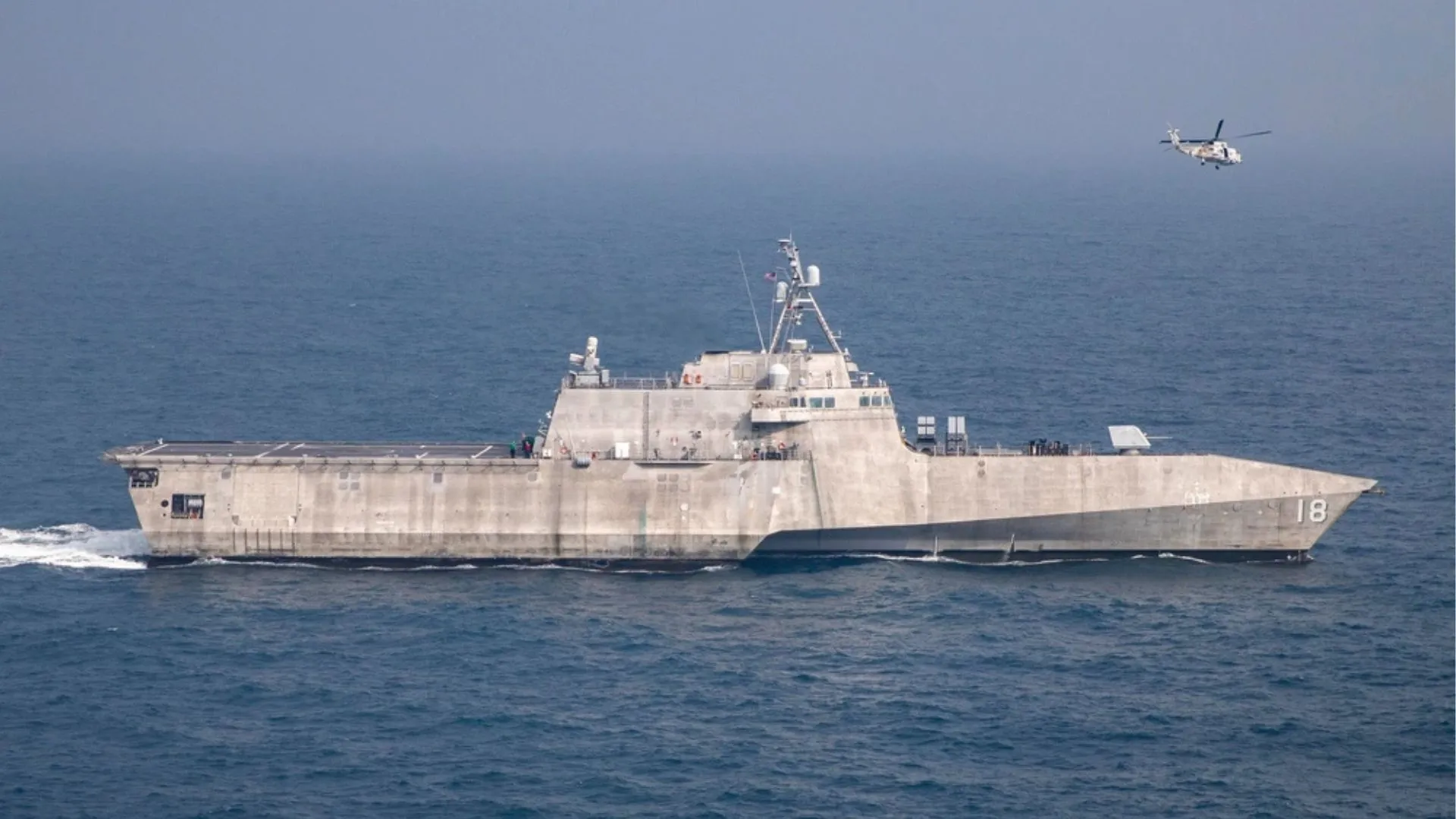
China’s People’s Liberation Army (PLA) Southern Theater Command said its naval forces tracked and monitored the U.S. Navy littoral combat ship USS Charleston (LCS 18) after it sailed near Sabina Shoal in the Spratly Islands in the early hours of October 20, 2026. The command said the ship had “illegally intruded” into waters adjacent to the reef, which Beijing calls Xianbin Jiao, without the Chinese government’s approval.
Sabina Shoal, known in Manila as Escoda Shoal, lies about 75 nautical miles (140 km) west of Palawan, inside the Philippines’ 200-nautical-mile exclusive economic zone (EEZ). The reef is a staging point for Philippine resupply missions to the BRP Sierra Madre outpost at Second Thomas Shoal. It became a flashpoint in 2024, when the Philippine Coast Guard kept the 97-meter cutter BRP Teresa Magbanua on station there for five months to monitor suspected Chinese reclamation; a China Coast Guard vessel rammed the cutter on August 31, 2024, during a series of collisions at the shoal.
What the PLA Statement on USS Charleston Says and Omits
The command said its navy dispatched forces to track and monitor the U.S. vessel “in accordance with laws and regulations.” It asserted Chinese sovereignty over the Spratlys, which Beijing calls Nansha Qundao, and their adjacent waters, said the transit infringed China’s sovereign rights and jeopardized maritime security, and demanded that Washington immediately cease such activities. Theater forces, it added, remain on high alert.
The statement omitted the details needed for independent assessment. It did not say how close Charleston came to the shoal, how many People’s Liberation Army Navy (PLAN) ships or aircraft took part, whether China Coast Guard units were involved, or how long the shadowing lasted. As of publication, neither the U.S. Navy nor U.S. 7th Fleet had commented, and it remains unconfirmed whether the transit was a formal freedom of navigation operation (FONOP) or a routine presence patrol.
The wording also departs from past PLA protests. When the destroyer USS Milius sailed near the Paracel Islands in March 2023, the same command said it had entered Chinese territorial waters. The October 20 statement refers only to adjacent waters. The distinction carries legal weight: the 2016 arbitral tribunal classified nearby Second Thomas Shoal and Mischief Reef as low-tide elevations that generate no territorial sea, although Sabina itself was not among the features submitted in that case.
Independence-Class Design and the Shallow-Water Presence Mission
Built by Austal USA in Mobile, Alabama, and commissioned on March 2, 2019, Charleston is an Independence-class aluminum trimaran. Publicly available specifications indicate a length of 127.4 meters (418 feet), a full-load displacement of about 3,100 metric tons and a draft of roughly 4.3 meters (14 feet), less than half that of an Arleigh Burke-class destroyer. Two General Electric LM2500 gas turbines and two MTU 20V 8000 diesels drive four Wärtsilä waterjets for sprint speeds above 40 knots.
Armament is limited to a BAE Systems Mk 110 57 mm gun and an 11-round SeaRAM launcher firing RIM-116 Rolling Airframe Missiles for point defense. The ship’s real asset is its aviation space: a large flight deck and hangar support MH-60 helicopters, extending surveillance well beyond the hull’s own sensors. During its 26-month maiden deployment, from April 2021 to June 2023, Charleston became the first littoral combat ship to conduct mine countermeasures training outside U.S. waters and logged 19 consecutive days in the South China Sea in early 2022. Details of its current deployment have not been disclosed.
That profile defines its role near Sabina. Shallow draft and organic aviation let the ship hold presence around reef complexes that deep-draft combatants approach cautiously, but it lacks the area air defense of a PLAN Type 052D destroyer and its 64 vertical launch cells. Charleston is a presence asset, not a sea control platform.
Analysis: Sending an LCS rather than a destroyer places a U.S. hull at the feature most central to Manila’s Second Thomas Shoal supply chain while keeping the operation’s profile modest. It reinforces the U.S. position that Article IV of the 1951 Mutual Defense Treaty covers armed attacks on Philippine armed forces, public vessels and aircraft, including the coast guard, anywhere in the South China Sea. Beijing’s reference to adjacent rather than territorial waters appears to anchor its protest in a claim to the Spratlys as a whole, avoiding a feature-specific 12-nautical-mile claim at a reef of contested legal status.
The next indicators are whether 7th Fleet characterizes the transit as a FONOP, how Manila responds, and whether China Coast Guard deployments at Sabina increase in the coming weeks. The incident also lands as the Philippines, holding the 2026 ASEAN chairmanship, presses to conclude a legally binding ASEAN-China Code of Conduct for the South China Sea by the end of its term.