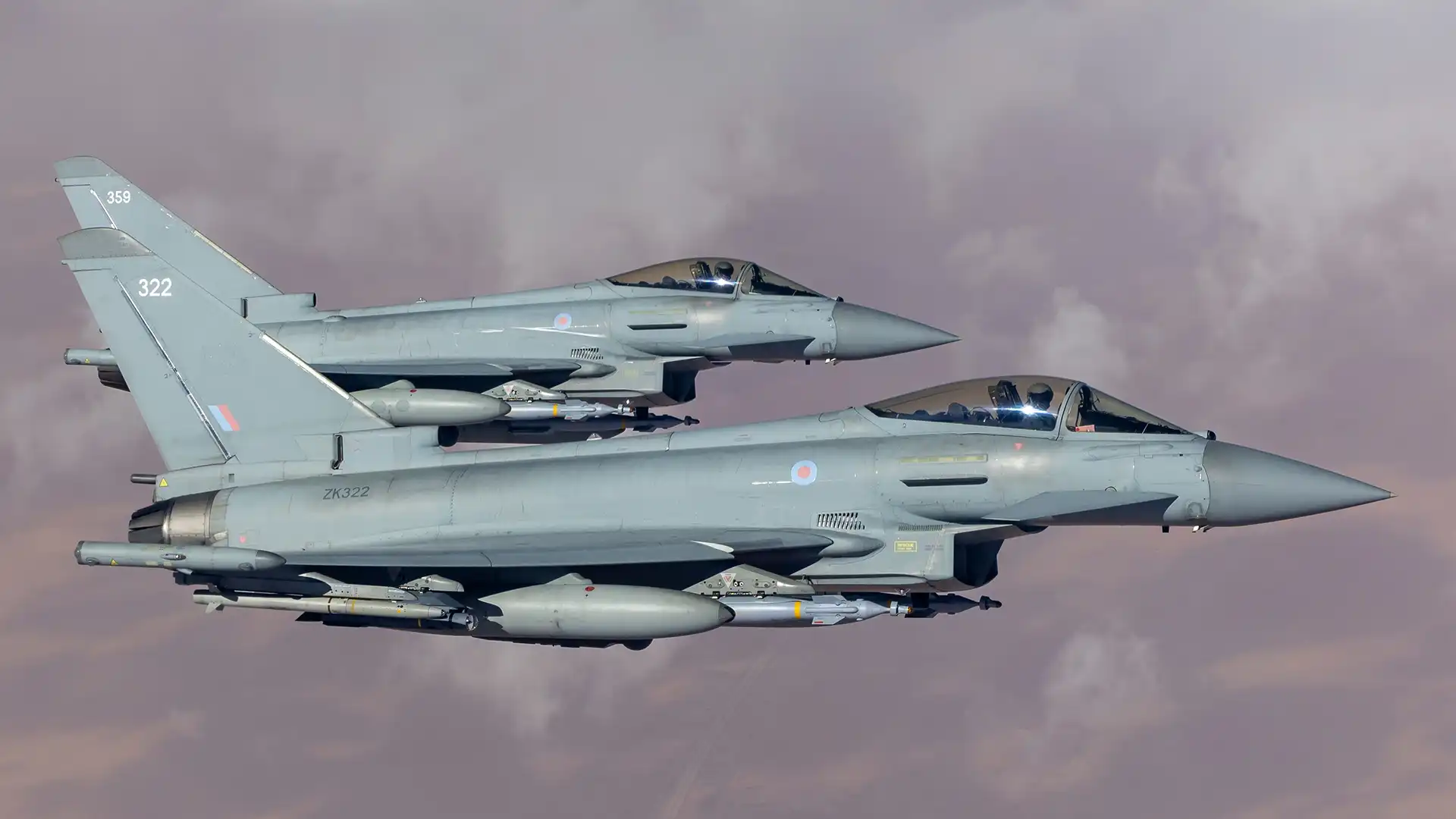
The United Kingdom will deploy Royal Air Force (RAF) Eurofighter Typhoon FGR4 fighters to fly defensive counter-air missions over Saudi Arabia, protecting Saudi cities and critical national infrastructure from Houthi drone and missile attacks, the Ministry of Defence (MoD) announced on October 20, 2026. Defence Secretary Wes Streeting said the jets will operate only in a defensive role and will not conduct offensive strikes against the Iran-aligned group. London is also sending an Airbus A400M Atlas transport aircraft and military advisers to support Saudi staff officers.
The package answers a formal request from Riyadh, which Prime Minister Andy Burnham said earlier this month Britain was prepared to consider. It is the deepest British military commitment to the kingdom since the Houthis opened their campaign against Saudi territory this summer. Houthi missiles and drones struck King Khalid International Airport in Riyadh repeatedly within a single week; the October 10 attack killed at least 12 people and wounded more than 300, according to Saudi authorities, the deadliest attack on the kingdom in more than a decade. Streeting called the strikes “absolutely despicable” and cited the targeting of the Riyadh airport as evidence of deliberate escalation. Inside Yemen, authorities said a Houthi strike on a training camp for Saudi-backed government security forces killed 58 people on October 19.
RAF Typhoon Deployment Builds on a Layered British Footprint
The Typhoons are the third tier of a British contribution assembled over seven months. On March 31, 2026, during Iranian missile and drone strikes on Gulf states, the MoD ordered a Sky Sabre ground-based air defense system to Saudi Arabia. Sky Sabre pairs MBDA’s Common Anti-Air Modular Missile (CAMM) with a Saab Giraffe radar and a Rafael command-and-control node. Operated by the 16th Regiment Royal Artillery, part of the 7th Air Defence Group, it was integrated into wider Saudi and regional air defenses, and then-Prime Minister Keir Starmer met 7th Air Defence Group personnel at King Fahd Air Base near Taif on April 8.
On September 22, London added a single RAF Voyager tanker, flying from Cyprus, to refuel Royal Saudi Air Force (RSAF) Typhoons on intercept missions. The MoD drew a firm line: the tanker would support missions to shoot down incoming missiles and drones, not strikes on ground targets in Yemen. On October 20, London extended that refueling support by a further 90 days. RAF Typhoons were also forward-deployed to Qatar earlier this year, including jets of No. 12 Squadron, the joint UK-Qatar Typhoon unit.
Key details remain undisclosed. The MoD has not stated how many Typhoons will deploy, where they will be based, or when the first sorties will fly. Basing carries real risk. Italy has operated four F-2000A Typhoons from King Fahd Air Base since March, and one was damaged in a Houthi strike on the base overnight on September 17 to 18, the first reported Houthi hit on a European air force fighter.
Typhoon FGR4 Against Drones and Cruise Missiles: Capability and Cost
The Typhoon FGR4 is the RAF’s Tranche 2 and Tranche 3 multirole standard. Publicly available specifications indicate two Eurojet EJ200 turbofans each producing about 90 kN with reheat, a top speed near Mach 2 and the ability to supercruise. For defensive counter-air work the jet carries the MBDA ASRAAM short-range infrared missile, the AIM-120 AMRAAM and the ramjet-powered MBDA Meteor beyond-visual-range missile, backed by a 27 mm Mauser BK-27 cannon. Current RAF jets fly with the mechanically scanned Captor-M radar; the ECRS Mk2 active electronically scanned array is still in development and testing.
The type has a counter-drone record. An RAF Typhoon scored its first air-to-air kill in December 2021, downing a small hostile drone over Syria with an ASRAAM, and RAF Typhoons destroyed Iranian one-way attack drones over Iraq and Syria in April 2024. Over Saudi Arabia, their value lies against slow, low-flying drones and cruise missiles that can exploit gaps below ground-based radar horizons. Ballistic missiles remain the business of ground-based interceptors such as Patriot. Combat air patrols over major cities and energy sites are long-endurance tasks, which is where the Voyager already in theater becomes a force multiplier.
The cost exchange is unfavorable. Publicly reported estimates place a single ASRAAM or AMRAAM between several hundred thousand and more than $1 million, against one-way attack drones typically costed in the tens of thousands of dollars. Flying over Saudi territory rather than Yemen should keep the RAF jets clear of Houthi surface-to-air missiles, which the group claims hit an RSAF Typhoon over Saada on October 14; Riyadh has not confirmed any loss.
Analysis: Britain is moving from enabler to shooter while preserving the defensive framing it set in September. Aircraft commonality makes the step cheaper than it looks: the RSAF operates around 70 Typhoons, sustained in the kingdom with substantial BAE Systems support, so an RAF detachment can draw on shared procedures, spares and training links already built into the bilateral relationship.
The risk is exposure. With British and Italian jets now sharing the Saudi air defense mission, European air forces are becoming direct participants in a conflict that is no longer only about Red Sea shipping, and a Houthi strike on a British jet or crew would turn a defensive deployment into a domestic political test.
The next markers are the MoD’s disclosure of aircraft numbers and basing and the first confirmed RAF intercepts. Riyadh is also due to host the 10th Future Investment Initiative this month, so the reinforced air defense umbrella will be judged by airport operations as much as by intercepts.