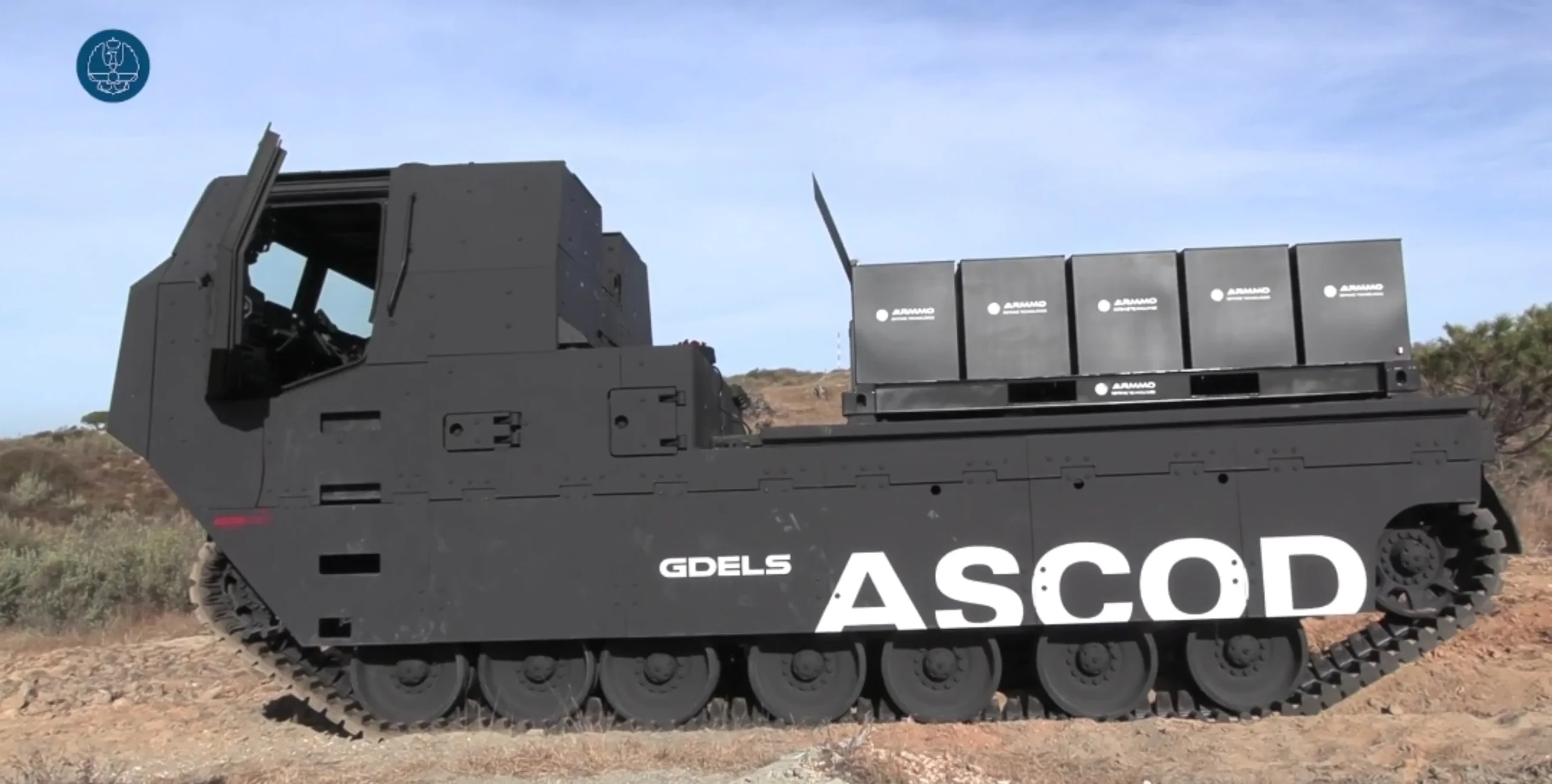
A tracked ASCOD cargo carrier fitted with launch containers for ARMMO Defense Technologies’ Bandit-X interceptor drones appeared at Spain’s Atlas 26 counter-drone exercise this week, pairing an armored logistics platform with a hard-kill effector designed to physically destroy hostile drones. Video shared on X by Spanish defense watcher ArmaduraXXI shows box-shaped launchers bearing ARMMO markings on the vehicle’s open rear deck, with one lid raised as if ready to launch.
Atlas 26 runs from October 19 to 23, 2026, at the Médano del Loro training range in Huelva, led by the Chief of the Defence Staff. The Spanish Army’s Anti-Aircraft Artillery Command directs the drill, and its commander, Brig. Gen. Manuel César Arienza Fernández, briefed on its goals on the second day. The exercise places the Army, Navy, Air and Space Force, Civil Guard and National Police under a single command to test joint tactics against small unmanned aircraft systems (UAS). It evaluates soft-kill systems that jam or spoof drones alongside hard-kill weapons that destroy them, and builds on Atlas 25, held at the same range in October 2025.
ASCOD Tracked Carrier Integration and the VAC Program
Mounting interceptor launchers on a tracked ASCOD chassis gives Bandit-X a protected, cross-country carrier able to keep pace with armored formations. Small drones have become one of the main threats to troops and vehicles near the front line, and mechanized units need counter-UAS cover that moves with them.
The open-deck layout appears consistent with the open-flatbed cargo configuration planned for the Vehículo de Apoyo de Cadenas (VAC) program. Neither the Spanish Army nor General Dynamics European Land Systems (GDELS) has confirmed the exact variant, the number of containers carried, or the sensor and fire-control chain that cues the interceptors.
The ASCOD family already forms the backbone of Spain’s tracked fleet through the Pizarro infantry fighting vehicle. Under the VAC program, the Ministry of Defense contracted the TESS Defence consortium, grouping GDELS-Santa Bárbara Sistemas, Indra, Escribano Mechanical and Engineering (EM&E) and SAPA, for an initial 349 multi-purpose tracked vehicles worth around €2 billion, expected to be based on the ASCOD 2. The family is set to replace roughly 1,200 M113 TOA carriers and includes command, 120 mm mortar, engineer, recovery and cargo versions. The VAC adopts NATO Generic Vehicle Architecture under STANAG 4754, intended to ease integration of new subsystems.
Bandit-X Interceptor Performance and NATO Validation Record
Bandit-X is a hard-kill interceptor built by ARMMO, a company based in Zafra, in Spain’s Extremadura region, and designed to physically destroy hostile drones rather than jam them. ARMMO’s current figures give a top speed above 360 km/h (224 mph), a payload of up to 0.8 kg (1.8 lb) and a range of 50 to 60 km (31 to 37 miles), with autonomous navigation, terminal guidance independent of satellite navigation and swarm operation. A planned upgrade targets 420 km/h and a 1 kg payload. Figures ARMMO gave in June 2026, around Eurosatory and the Slovakia trials, were lower: 350 km/h, 30 to 40 km and up to 15 minutes of endurance.
In June 2026, Bandit-X completed live trials before military operators in Slovakia under NATO’s Eastern Flank Deterrence Initiative, led by NATO’s Allied Land Command (LANDCOM), validating the full cycle of launch, interception and recovery. ARMMO has since obtained a NATO Stock Number for the system and has also shown it aboard its ARW39CAT-A uncrewed catamaran, unveiled at Eurosatory 2026.
Analysis: The Atlas 26 configuration reflects a cost-exchange logic Spain and other NATO armies are now pursuing: attritable, mass-producible interceptors against drones too cheap to justify missiles, carried on a chassis that shares logistics with the frontline fleet. The weak point is cueing. An interceptor with a limited flight window is only as effective as the radar and electro-optical network that hands it targets, and no organic sensor fit has been disclosed. Without that layer, the ASCOD functions as a mobile magazine rather than a self-contained counter-UAS system.
Key unknowns remain whether the configuration is an industry demonstrator or the basis of a Spanish Army requirement, and whether a counter-UAS role will join the VAC family. Atlas 26 results will be analyzed by university observers and the Army’s Training and Doctrine Command (MADOC). The next indicators will be a formal VAC counter-UAS configuration or a first Bandit-X order.