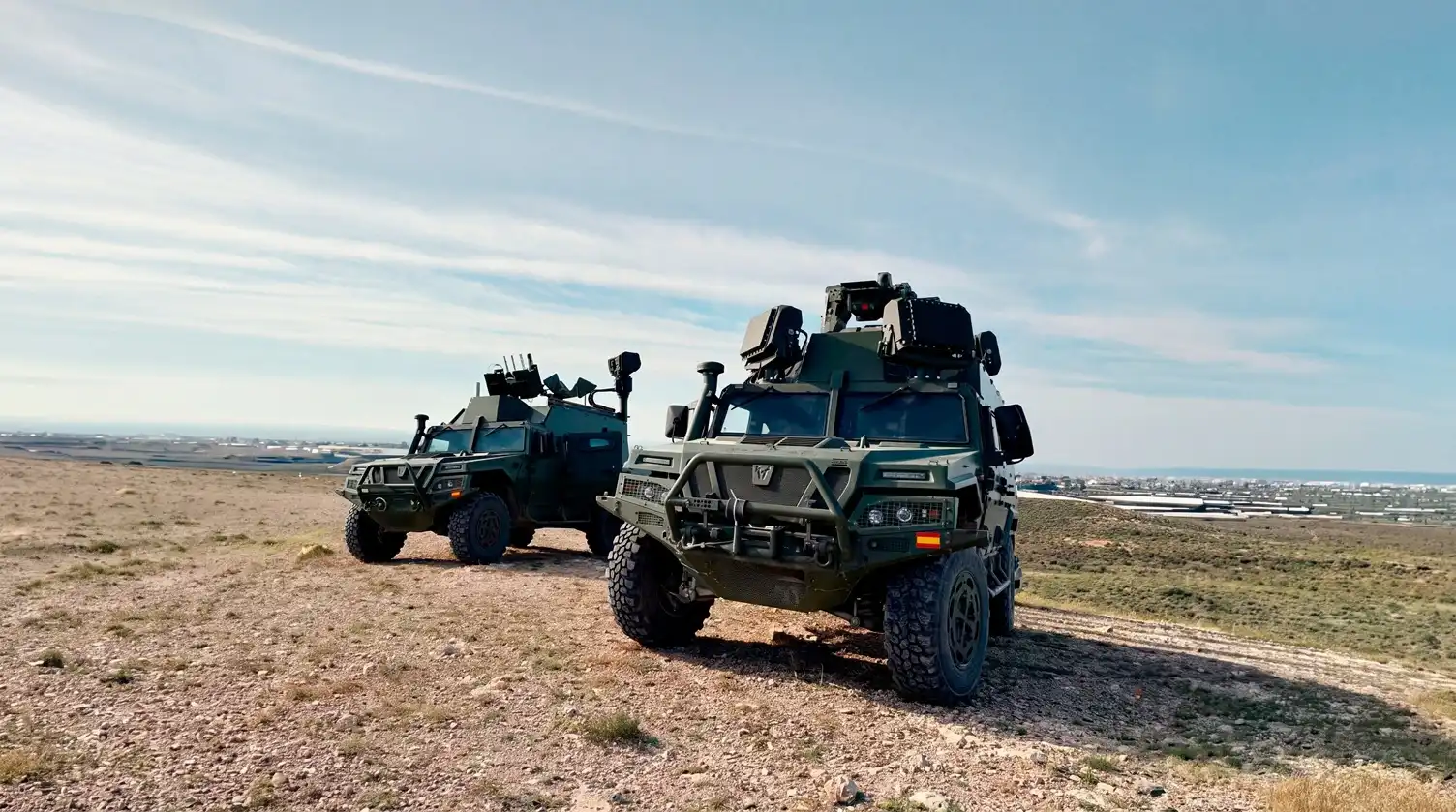
Indra and EM&E Group’s Aracne counter-drone system has been integrated into Spain’s national air defense architecture during the Atlas 26 joint exercise, held October 19 to 23, 2026, at the Médano del Loro training and firing range in Huelva. Indra announced the result on October 23, presenting Aracne as a counter-unmanned aircraft system (C-UAS) layer that operates inside the wider air defense network rather than alongside it.
The test closes a short development loop. Aracne was demonstrated in the field at Atlas 25 in October 2025, and the first mobile systems reached the Spanish Army’s 71st Anti-Aircraft Artillery Regiment, the service’s lead counter-drone training unit, earlier this month. The regiment had already completed the soft-kill evaluation, and Spanish outlet Infodefensa reported on October 18 that hard-kill testing had begun, with drones destroyed by direct impact. Spain is acquiring 14 systems for €30.24 million, split evenly between fixed and mobile configurations, and Indra says Aracne reached service in two years.
Aracne Air Defense Integration Through the COAAAS+ Operations Center
During Atlas 26, Aracne was connected to the air defense system of the Aerospace Operations Command (MOA) through COAAAS+, the Anti-Aircraft Artillery Operations Center that Indra also develops. The link placed C-UAS assets under the same coordination as conventional anti-aircraft artillery instead of leaving them to operate as isolated point defenses.
According to Indra, the architecture generates a common operational picture and compresses the detect, identify, classify and prioritize sequence. It then assigns the most suitable sensor and effector to each track according to target type, trajectory, risk level and rules of engagement. Indra describes the outcome as a “coordinated, scalable and multilayer” protection response designed to avoid duplicate engagements and optimize resources against massed attacks.
Above the tactical layer, Indra’s C4ARMS command and control system ties Aracne’s sensors and effectors to higher air defense echelons, so the response can be tailored to the mission and the tactical environment.
Atlas 26 placed Army, Navy and Air and Space Force units alongside the Civil Guard and National Police under a single command, led by the Chief of the Defence Staff and directed by the Army’s Anti-Aircraft Artillery Command. Participants validated joint procedures against Class I and Class II drones, the NATO categories covering platforms under 150 kg and from 150 kg to 600 kg.
Nemus, Brontes and Guardian: Inside the Mobile Aracne Configuration
The mobile Aracne variant rides on two VAMTAC ST5 tactical vehicles. The first carries the detection and electronic warfare suite: Indra’s Nemus radar, a SmartEar radio-frequency scanner and the Brontes jammer. The second is the hard-kill vehicle, fitted with EM&E’s Guardian 2.0 remote weapon station armed with a 40 mm Mk 19 automatic grenade launcher. EM&E’s Oteos electro-optical sensor handles positive identification and tracking.
Nemus is a compact active electronically scanned array (AESA) radar built for vehicle protection and tactical C-UAS work. Publicly available specifications indicate detection of a 0.01 m² micro-drone at about 4 km and a 1 m² target at 12.5 km, with four panels providing 360-degree coverage and more than 100 simultaneous tracks per panel. Open-source figures credit the jammer with denying satellite navigation at up to 15 km and drone control links at up to 5 km, while SmartEar monitors the 400 MHz to 6 GHz band out to roughly 6 km.
Indra singles out the “On The Move” capability as the differentiator. Nemus lets Aracne follow maneuvering units, extending coverage to command posts, logistics elements, convoys and combat formations without relying on fixed sites.
EM&E also fielded systems of its own: 4×4 vehicles with Guardian 2.0 stations, a FEROX 6×6 armored vehicle carrying the Guardian L-HIT remote station, and an AUNAV LINK unmanned ground vehicle with an electronic warfare package that jams drone control links. The company said the systems detected and shot down several drones, but released no figures on the number or type of targets engaged.
Analysis: The capability demonstrated at Atlas 26 lies less in any single sensor than in the connective layer. Indra frames the fluid integration of large numbers of sensors and effectors as one of the main challenges Europe faces in protecting its airspace against emerging threats. By routing Aracne through COAAAS+ into the MOA picture, Spain is building a tiered model in which jammers and 40 mm guns absorb Class I threats while higher-tier assets stay in reserve. That model maps directly onto the eastern flank drone wall initiative, where Indra is positioning Spanish industry.
Key unknowns remain. Neither company has disclosed engagement data from Atlas 26, and the delivery schedule for the rest of the 14-system program is not public. The next markers are published results from the Army’s hard-kill evaluation, fielding of the seven fixed sites, and whether Madrid offers Aracne for allied deployments on NATO’s eastern flank.