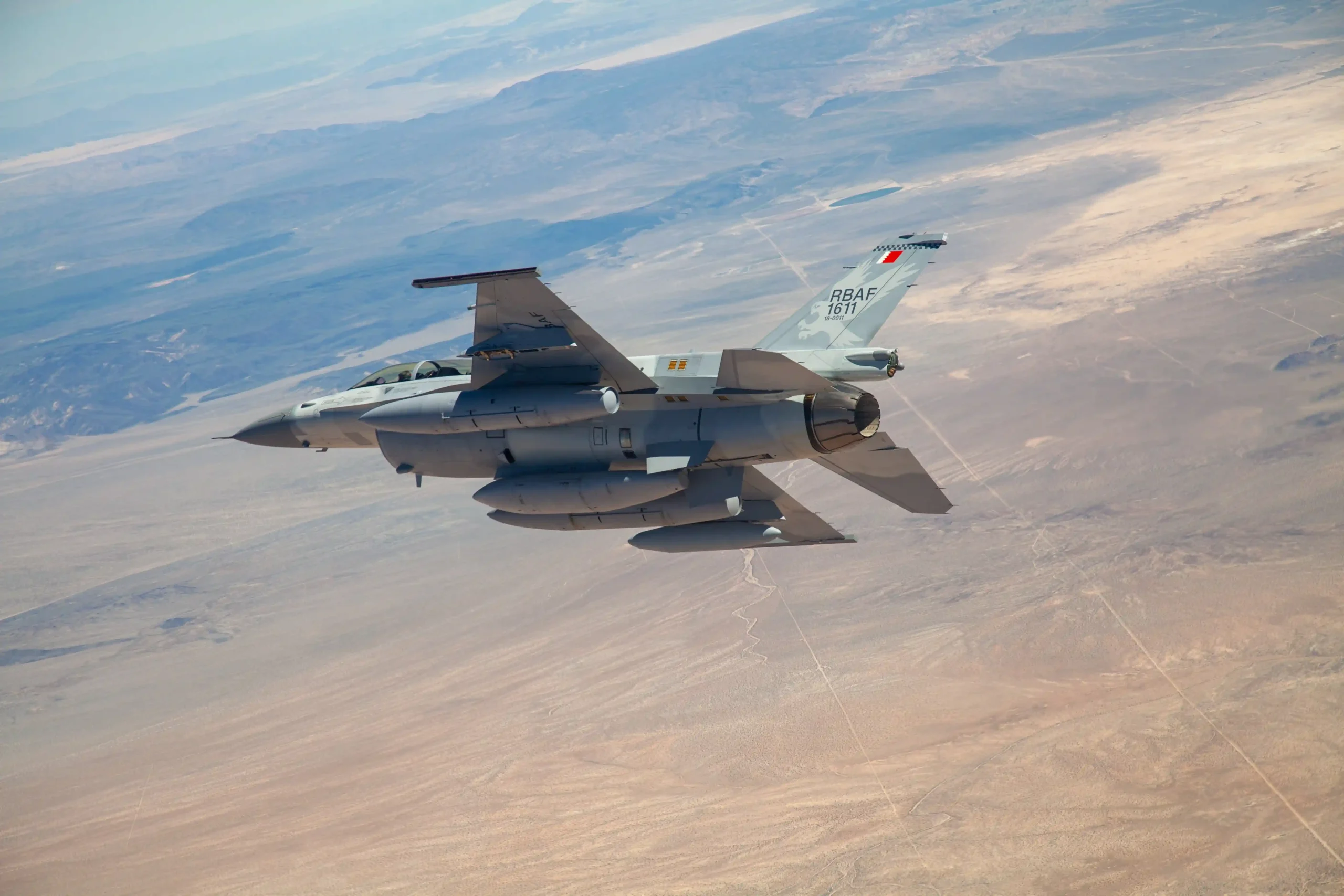
Lockheed Martin flew the first F-16 Block 72 built for the Royal Moroccan Air Force (RMAF) on October 6, 2026, from its Greenville, South Carolina, plant. The two-seat F-16D is the first new-build Block 72 to fly. It lands as Middle East and North African air forces converge on one answer to aging fleets: new-production F-16 Block 70/72 Vipers, bought as a bridge to fifth-generation fighters most of them cannot yet obtain.
Morocco ordered 25 F-16C/D Block 72s in 2019 in a package estimated at $3.787 billion and is upgrading its 23 F-16C/D Block 52s to the same standard, for a fleet of 48. Seven years separated approval and first flight. Bahrain already flies the Block 70 in combat, Jordan holds a contract for 12, Egypt reportedly filed a formal request at the El Alamein International Airshow in September 2026, according to Military Africa, and Türkiye reportedly resumed F-16 talks with Washington in late September after its 40-jet request stalled. The fifth-generation alternative remains selective: on September 17, 2026, the State Department cleared a possible $24.3 billion sale of 48 F-35s to Saudi Arabia.
F-16 Block 70 Configuration: AESA Radar and 12,000-Hour Airframe
The Block 70 and Block 72 share one airframe and mission system and differ only by engine: the General Electric F110-GE-129 on the Block 70, the Pratt & Whitney F100-PW-229 on the Block 72, both in the 29,000-pound thrust class according to Lockheed Martin. The choice is logistical: Morocco’s Block 52s already run the F100-PW-229, so the Block 72 keeps one engine supply chain and one depot pipeline across all 48 aircraft.
The core is Northrop Grumman’s AN/APG-83 Scalable Agile Beam Radar (SABR), an active electronically scanned array (AESA) that Lockheed says shares hardware and software commonality with the F-22 and F-35 radars. It is paired with a new modular mission computer, a high-resolution Center Pedestal Display integrating radar and targeting pod imagery, Link 16, and the Automatic Ground Collision Avoidance System (Auto GCAS). Lockheed lists a maximum takeoff gross weight of 48,000 pounds (21,772 kilograms) and a structural life of 12,000 flight hours, more than 50 percent above earlier production F-16s, or roughly 40 years of service. An air force taking a Block 70 in 2027 is buying an airframe rated to fly into the 2060s.
The configuration now has a combat record. On April 1, 2026, during the conflict with Iran, a Royal Bahraini Air Force (RBAF) F-16D Block 70 shot down two Iranian drones, the variant’s first air-to-air kills. Lockheed did not disclose the weapons used; according to The War Zone, the pilot fired one AIM-120 Advanced Medium-Range Air-to-Air Missile (AMRAAM) and one AIM-9X Sidewinder. Bahrain’s weapons package, approved by the State Department in 2019, includes AIM-120C-7 and AIM-9X missiles. It is the AESA-equipped Viper’s first operational data point against the one-way attack drones that defined the 2026 Gulf threat picture.
How Bahrain, Jordan and Morocco Are Building Block 70/72 Fleets
Bahrain is the launch customer. Manama signed for 16 new F-16C/D Block 70s in 2018, received its first three jets in March 2024, and is upgrading its 20 F-16C/D Block 40s to the same standard. The result is 36 Block 70-standard aircraft, a dense fleet for a state its size, already integrated into the regional air defense architecture tested this spring.
Jordan took a narrower path. The State Department approved a $4.21 billion package in February 2022 for 12 F-16Cs and four F-16Ds with APG-83 radars, modular mission computers and Link 16 terminals. Amman signed a letter of offer and acceptance for eight jets in June 2022, later expanded to 12 Block 70s, a contract Lockheed confirmed in January 2024. The Royal Jordanian Air Force (RJAF) flies an all-F-16 fighter force built on legacy F-16A/B models, so the Block 70s will form a small modern spearhead ahead of airframes decades older.
Morocco combines both approaches at larger scale. Lockheed is also building a maintenance, repair and overhaul (MRO) facility of more than 8,000 square meters at Benslimane, designed initially for C-130 Hercules heavy maintenance with stated plans to expand to the F-16. In-country sustainment for a 48-jet fleet reduces reliance on US depot slots and shortens turnaround.
The common thread is fleet homogenization: each operator is converging on a single radar, mission computer and datalink standard, simplifying training, spares and weapons integration while keeping its force interoperable with US Air Forces Central assets.
Egypt and Türkiye Requests Test Greenville Production Capacity
Egypt flies roughly 220 F-16s, but open-source assessments count 129 of them as Block 15, 32 and 40 airframes built between 1982 and 1995, with avionics upgrades that never addressed structural fatigue. Cairo has never received the AIM-120, a restriction tied to Washington’s commitment to Israel’s qualitative military edge (QME), and has diversified with Dassault Rafales, MiG-29M/M2s and reported interest in China’s J-10C. The size of its request is undisclosed, and no Defense Security Cooperation Agency (DSCA) notification has been published. Whether a package includes the AIM-120 will decide if a Block 70 changes Egyptian air defense capability or merely refreshes airframes.
Türkiye’s file is further along on paper and more stalled in practice. Ankara requested 40 Block 70s and 79 modernization kits in October 2021 after its removal from the F-35 program over the S-400 purchase. Washington cleared the sale in early 2024, but Ankara dropped the kits in November 2024 for the domestic Özgür program led by Turkish Aerospace (TUSAŞ). Talks on the new jets then stalled over price, Lockheed’s request that the buyer fund mission computer and production line upgrades, and a reported Turkish demand for mission computer source code. Türkiye signed for 20 Eurofighter Typhoons on October 27, 2025, with first delivery due in 2030. Al-Monitor reported in late September 2026 that F-16 talks had resumed, without specifying whether they cover the 40 new jets; no production contract exists.
Both requests land on one line. Lockheed targeted four F-16s per month at Greenville and reported a backlog of 117 Block 70/72 jets in February 2025, led by Taiwan’s 66-aircraft order. Forty Turkish jets alone equal ten months of full-rate output, before any Egyptian order.
Analysis: The Block 70/72 has become the default answer to a structural gap. Fifth-generation access remains rationed by US policy, through Israel’s QME, the S-400 dispute and concerns over Chinese access to sensitive technology, while F-16s bought in the 1980s and 1990s reach their structural limits. The Saudi clearance shows the F-35 door can open, but slowly and at a $24.3 billion price point. For everyone else, a 12,000-hour airframe flying into the 2060s will likely serve less as a bridge than as the backbone of the force for a generation. For the US defense industrial base, the binding constraint is Greenville throughput, and the Turkish dispute over who pays for capacity suggests new customers may be asked to help finance the line itself.
The Moroccan F-16D now enters flight testing; Lockheed has not announced a delivery date. The next decision points are a DSCA notification for Egypt, which would reveal aircraft count and weapons; a firm Turkish letter of offer and acceptance for the 40 jets; and congressional review of the Saudi F-35 sale. Delivery schedules for Jordan’s Block 70s and Morocco’s upgraded Block 52s remain undisclosed.