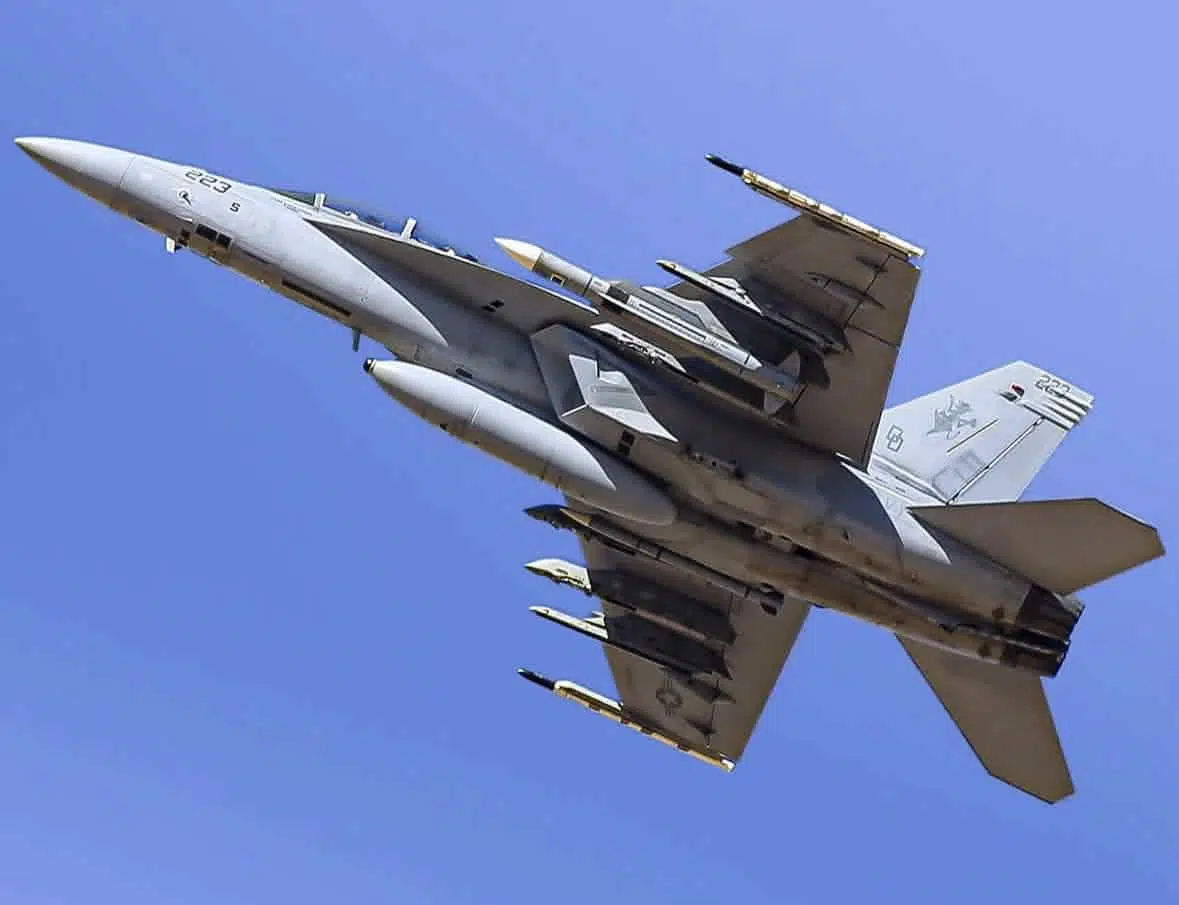
A U.S. Navy F/A-18F Super Hornet assigned to Air Test and Evaluation Squadron 31 (VX-31) was photographed on October 14, 2026, over Ridgecrest, California, near the squadron’s home at Naval Air Weapons Station China Lake, carrying both the AIM-174B and AIM-260A Joint Advanced Tactical Missile (JATM). Naval News, which reported the sighting on October 21, 2026, describes it as the first publicly documented instance of the two air-to-air weapons on the same aircraft. The jet also carried a Lockheed Martin IRST21 infrared search and track sensor integrated into its centerline fuel tank.
Both missiles appear to be inert rounds, marked with blue bands, in a captive-carry configuration, according to The War Zone (TWZ), which also obtained the image from aviation photographer @_photosxlyss2_. The configuration reflects the Navy’s Air Wing of the Future (AWOTF) initiative, which will bring new sensors, uncrewed aircraft, and longer-range weapons to carrier air wings over the next decade. The goal is to extend the reach of the existing strike fighter fleet against near-peer competitors, chiefly China. The Air Force said in 2019 that the JATM, then in development for about two years, was intended to counter China’s PL-15 long-range missile.
AIM-174B and AIM-260A: Two Missiles, Two Engagement Roles
The AIM-174B Gunslinger is the air-launched configuration of the Raytheon RIM-174 Standard Missile-6 (SM-6). According to the Navy’s official fact file, it measures 16.5 ft (5.03 m) in length and 13.5 in (0.34 m) in diameter, weighs 1,830 lb (830 kg), and combines a dual-thrust solid rocket motor, an active radar seeker, and a blast-fragmentation warhead. Adapting the shipboard interceptor for carrier aviation meant deleting the surface-launch booster and adding a strongback and fin locks for safe carriage.
Range remains classified. TWZ assesses it as far in excess of the AIM-120D’s and probably in the hundreds of miles. The missile is optimized against large, high-value targets such as airborne early warning aircraft, tankers, and bombers. A U.S. Pacific Fleet spokesperson has described it as the Navy’s first dedicated long-range air-to-air weapon since the AIM-54 Phoenix left service in 2004, pushing the threat ring around a carrier strike group well beyond the reach of the AIM-120 Advanced Medium Range Air-to-Air Missile (AMRAAM).
The AIM-260A, developed by Lockheed Martin under a joint Air Force and Navy program, is intended to supplement and eventually replace the AMRAAM. Its defining design choice is size: Brig. Gen. Anthony Genatempo, then the Air Force’s weapons program executive officer, said in 2019 that the JATM would keep a form factor similar to the AIM-120 and would not use a ramjet. That allows carriage on existing launch rails and in the internal weapons bays of the F-22 and F-35, as well as on the F/A-18E/F. Its range is officially undisclosed, though earlier reporting pointed to a target of at least 120 miles, TWZ notes. In practice, the JATM offers extended beyond-visual-range performance against fighters without the weight and drag penalty of the AIM-174B.
Fielding Status and the Path to AIM-424 Malice
The AIM-174B is further along. It appeared at RIMPAC 2024 and Northern Edge 2025, and the Office of the Director, Operational Test and Evaluation moved it into Live Fire Test and Evaluation in 2025. The missile has since reached forward-deployed Navy squadrons in Japan. A U.S. Pacific Fleet spokesperson said the incremental rollout is designed to “balance today’s readiness with tomorrow’s capabilities.”
The JATM has followed a more opaque path. VX-31 logged more than 26 hours of AIM-260A flight testing in 2024, including Category C events that carry significant risk to personnel or equipment, according to a since-deleted squadron post first reported by Naval News. The Navy confirmed JATM testing to Naval News in March 2025, and the missile was first photographed in May 2026 on a VX-31 F/A-18F departing Eglin Air Force Base, Florida. It has since also been seen on a Royal Australian Air Force F/A-18F, as reported by TWZ. On September 17, 2026, the Pentagon and Lockheed Martin signed a framework agreement to ramp up production, laying the groundwork for a multiyear procurement contract pending congressional approval and including planned foreign military sales.
Both weapons precede the AIM-424 Malice, unveiled in August 2026 as a long-range missile designed to engage agile targets such as fighters at distances approaching those of the AIM-174B, according to Naval News. Unlike the Standard-derived AIM-174B, Malice is purpose-designed for air launch and reportedly uses a two-stage configuration with a range in excess of 250 nautical miles, TWZ notes. Malice has been in testing since early 2026, with captive carry flights underway. The Navy did not comment further on its test status.
What the AIM-174B and JATM Pairing Means for Carrier Air Wings
Analysis: As Naval News notes in its analysis, the two missiles are complementary rather than redundant: the AIM-174B holds high-value support aircraft at risk at extreme distance, while the AIM-260A covers the conventional beyond-visual-range fight without a heavy payload penalty. The IRST21 adds a passive layer to that picture. TWZ points out that the sensor can detect airborne targets without relying solely on radar emissions, but cannot on its own provide all the data a long-range shot requires. The Navy and Air National Guard placed IRST21 Block II into full-rate production under a $233 million Lockheed Martin contract in October 2025. Together, the load-out points to a layered approach to Indo-Pacific air combat in which a single Super Hornet can threaten both the enablers of an adversary kill chain and its escort fighters. The binding constraint is magazine depth. Each AIM-174B occupies a heavy wing station, and JATM quantities depend on a production ramp that is only now being formalized.
Key milestones ahead include congressional action on JATM multiyear procurement, the pace of AIM-174B distribution beyond the squadrons in Japan, and the first disclosed results from Malice testing. The Navy has not said whether the combined AIM-174B and AIM-260A configuration seen over Ridgecrest reflects a planned operational load-out or a test arrangement. TWZ suggests the flight may have supported weapons integration or handling and compatibility work. Ranges for all three missiles remain classified.