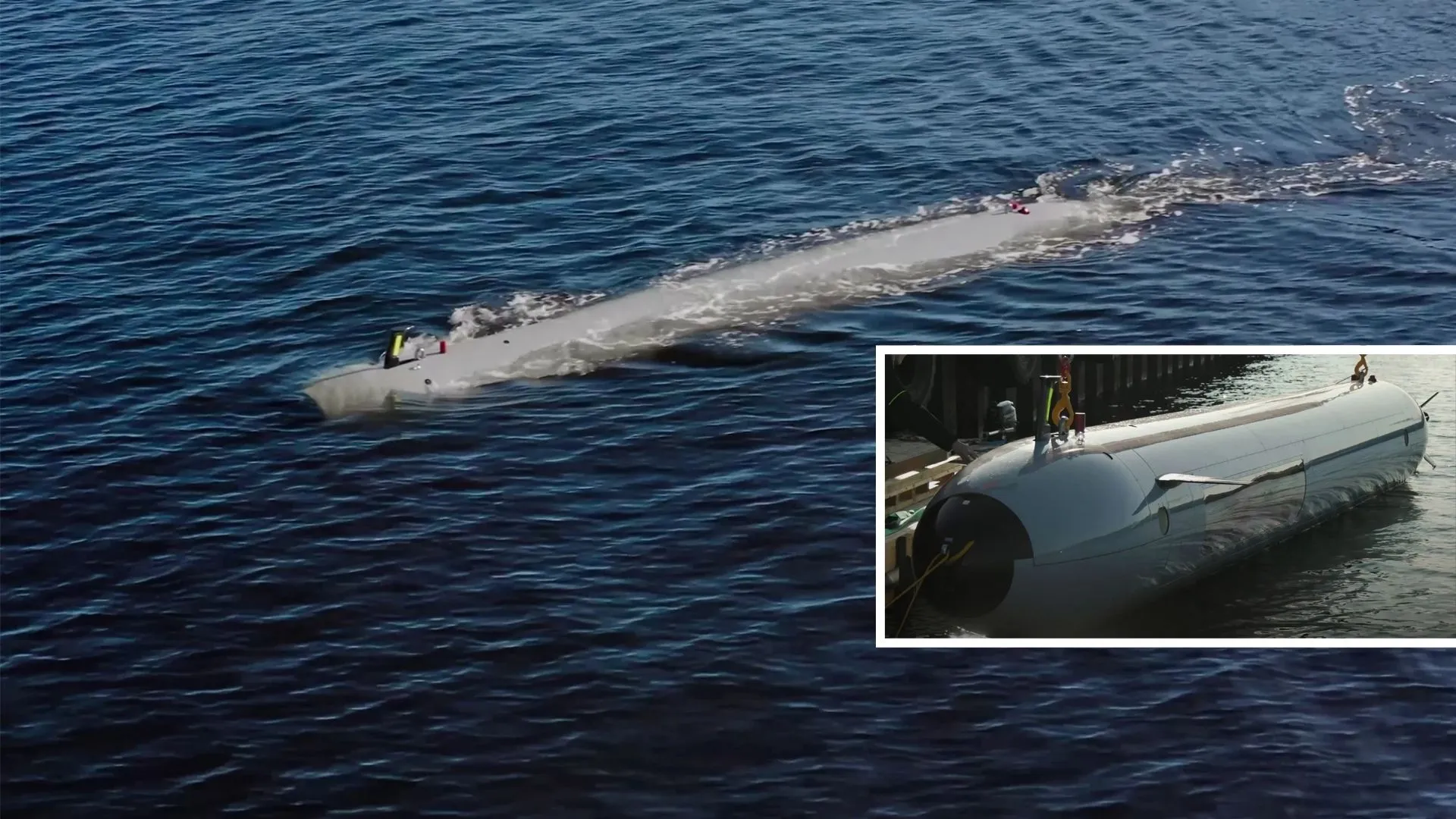
Norway’s Kongsberg is pressing navies to treat autonomous underwater vehicles (AUVs) as core undersea warfare assets rather than survey tools, positioning its HUGIN family for intelligence, surveillance and reconnaissance (ISR), intelligence preparation of the operational environment (IPOE), mine countermeasures (MCM), seabed warfare and the protection of critical undersea infrastructure. An October 2026 company paper pairs four vehicles, the HUGIN Edge, HUGIN, HUGIN Superior and HUGIN Endurance, with a doctrinal shift toward persistent, uncrewed presence on the seabed.
Communication cables, pipelines and offshore energy installations form a dense network beneath allied waters, and rising activity in contested maritime regions has turned seabed awareness into a requirement on par with air and surface surveillance. Kongsberg’s pitch targets a specific cost driver: dependence on large support vessels to launch, track and recover underwater systems. The company says HUGIN is in service with twelve navies, and Richard Patterson, its Vice President of Sales for Unmanned Platforms, has framed the same argument around the U.S. Navy’s move toward a hybrid fleet of crewed and uncrewed platforms.
HUGIN AUV Family: Endurance, Superior, and Edge Specifications Compared
HUGIN Endurance underpins the persistent presence argument. It is the largest member of the family: publicly available specifications indicate a length of roughly 10 meters, a 1.2-meter diameter and a mass of about 8,000 kilograms. Lithium-ion batteries give it up to 15 days at sea, a mission range of up to 2,200 kilometers (1,200 nautical miles) and a 6,000-meter depth rating. Swept fins stabilize flight through water layers of varying density, while contra-rotating dual propellers add propulsion redundancy. Its primary payload pairs the HISAS 1032 Dual Receiver synthetic aperture sonar (SAS) with an EM 2040 MkII multibeam echosounder, a combination credited with mapping close to 1,100 square kilometers in a single dive.
Those figures change the geometry of a mission. A vehicle that launches from shore and transits 1,000 kilometers to a choke point or cable corridor removes the mothership from the threat area and from the cost equation. In 2024, Endurance completed a multi-week fully autonomous mission reaching depths of 3,400 meters.
HUGIN Superior is the deep-water workhorse. It measures 22 feet (6.7 meters) long and 35 inches (0.89 meters) in diameter, according to the manufacturer. A 62.5-kilowatt-hour pressure-tolerant lithium-polymer battery supports roughly 72 hours at 3 knots or 52 hours at 4 knots, with a top useful speed of 5.2 knots. The dual-receiver HISAS 1032 produces imagery and bathymetry across a 1,000-meter swath, while navigation relies on the Sunstone aided inertial navigation system with Doppler velocity log aiding. At the other end of the range, HUGIN Edge is a 4-meter, wet-flooded carbon monocoque vehicle rated to 1,000 meters and 2 to 5 knots, built for low-logistics launch from uncrewed surface vessels and expeditionary teams.
From Minehunting to Seabed Warfare: How Navies Are Fielding HUGIN
Mine countermeasures remain the anchor mission. The Royal Norwegian Navy has operated HUGIN for MCM for more than two decades, an approach that keeps personnel outside the minefield while the vehicle detects, classifies and identifies contacts. Poland is extending that model: Kongsberg Maritime is supplying three HUGIN systems, together with HiPAP High Precision Acoustic Positioning equipment, to shipbuilder Remontowa Shipbuilding for the second series of Kormoran II-class minehunters, under a contract valued at more than €10 million. Those ships are due to enter service between 2026 and 2027.
Seabed warfare is the faster-growing demand signal. France’s procurement agency, the Direction générale de l’armement (DGA), contracted HUGIN Superior on August 12, 2022, for up to about €4 million to support sea campaigns under the French seabed control strategy. In the United States, the Pentagon’s Defense Innovation Unit (DIU) awarded Kongsberg Discovery a 24-month frame contract in 2024 tied to the Navy’s Large Displacement Unmanned Underwater Vehicle (LDUUV) effort, and the first HUGIN Superior cleared acceptance testing about a year later. On July 14, 2026, DIU selected Kongsberg and Oceaneering International to support its Combat Autonomous Maritime Platform (CAMP) program for an extra-large uncrewed undersea vehicle (XLUUV).
Kongsberg’s paper concedes the limiting factor. Advances in artificial intelligence, navigation and onboard processing expand what the vehicles can do, but the company identifies operational trust as a key factor in adoption. For commanders, trust translates into measurable questions: navigation drift over multi-day transits, classification error rates, and whether the vehicle returns its data intact.
Analysis: The paper is a marketing document, but the shift it describes is visible in procurement. Crewed minehunters, submarines and survey ships cannot provide continuous coverage of thousands of kilometers of cable and pipeline routes across the North Atlantic, the Baltic and the Indo-Pacific. A shore-launched, 15-day AUV with SAS-grade imaging sharply lowers the cost of seabed awareness. The binding constraint is not the vehicle. Acoustic links offer limited bandwidth, so persistent presence often means delayed intelligence, not real-time cueing, unless the vehicle surfaces or relays through a gateway. The navies that gain most will be those that fuse AUV data into command and control and accept autonomous decisions at depth, the trust gap Kongsberg itself flags.
Several milestones will test the case. The CAMP design deliverable was expected in the third quarter of 2026, and it remains unclear whether that design has been delivered or what follow-on phase DIU will fund. Kongsberg’s October paper discloses no new orders or pricing, so the next hard indicator will be contract awards from navies converting seabed warfare strategies into funded AUV programs.