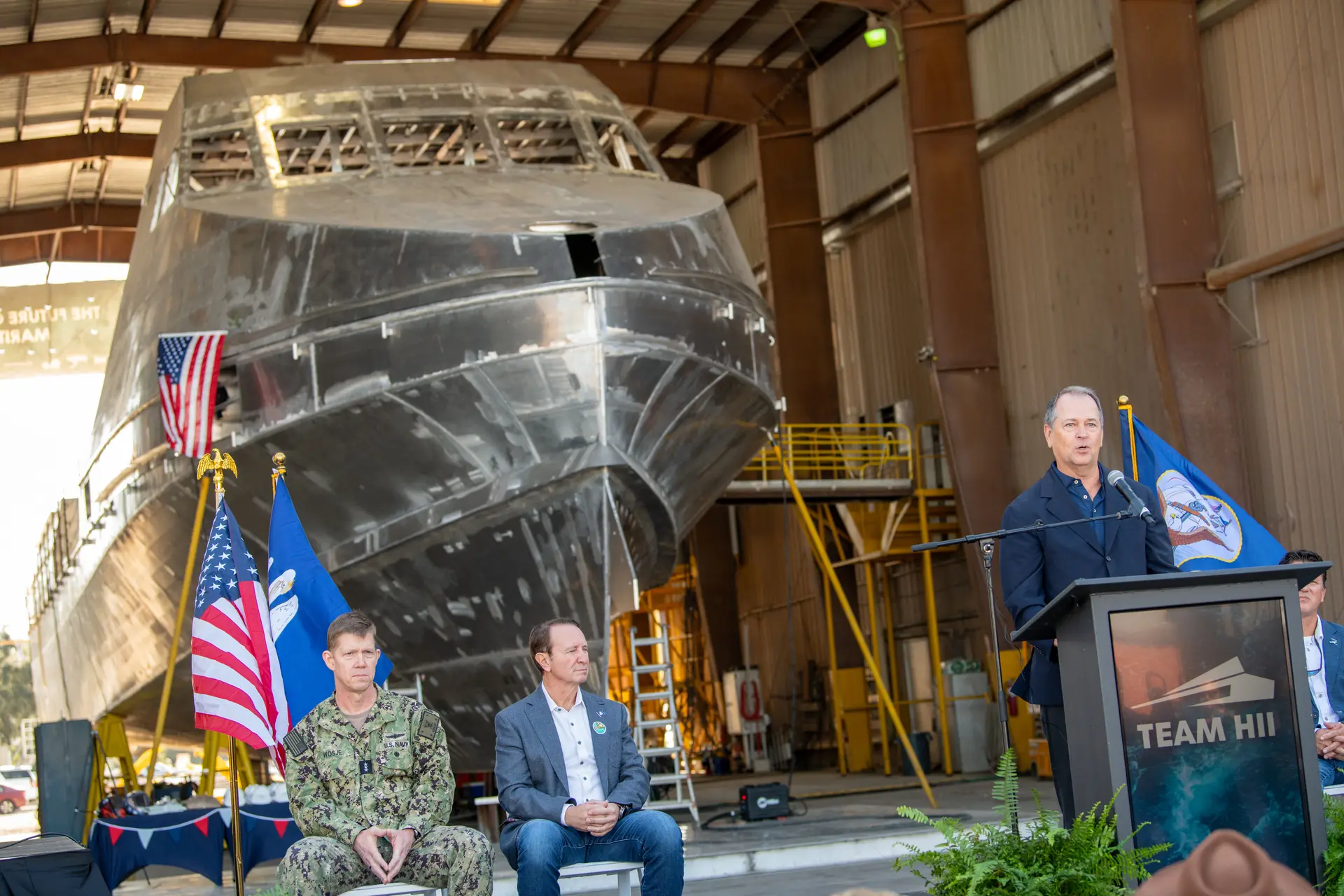
HII installed a commemorative plaque on the hull of its first-in-class ROMULUS 151 unmanned surface vessel (USV) on October 27, 2026, in New Iberia, Louisiana, marking production progress on the 10 vessels the U.S. Navy ordered under its Medium Unmanned Surface Vessel (MUSV) program. Louisiana Gov. Jeff Landry, Vice Adm. Michael Wosje, deputy chief of naval operations for Warfighting Requirements and Capabilities (N9), HII President and CEO Chris Kastner and Breaux Brothers Enterprises President Brannon Breaux attended the ceremony.
The event follows the Navy’s September 29, 2026, award of Production Other Transaction Authority (OTA) agreements for 30 MUSVs, split evenly among HII, Saronic Technologies and Galliano Marine Services. The Navy put the average procurement cost at about $40 million per vessel, roughly $1.2 billion across the buy; HII has not disclosed the value of its own agreement or a hull-by-hull delivery schedule. The winners emerged from seven Phase I at-sea competitors under the MUSV marketplace, which replaced the Modular Attack Surface Craft (MASC) effort in March 2026. Wosje called building and fielding the MUSV “an essential tailored offset within the CNO’s Hedge Strategy.”
ROMULUS 151 USV Design: Hull, Speed, Range, and Modular Payloads
HII unveiled ROMULUS in September 2025 with a 190-foot flagship derived from an offshore crew support boat. Company figures for that variant list speeds above 25 knots, a minimum range of 2,500 nautical miles and a payload deck sized for four 40-foot ISO intermodal containers. The family was developed with Louisiana marine engineering firm Beier Integrated Systems and naval architect Incat Crowther.
The Navy order covers the ROMULUS 151. HII has not published dimensions, speed, range, displacement, propulsion type or payload deck capacity for the 151, and those figures remain unconfirmed. HII and its lead builder describe aluminum construction.
HII markets ROMULUS for intelligence, surveillance and reconnaissance (ISR), mine countermeasures, strike, counter-unmanned systems, and the launch and recovery of unmanned underwater and aerial vehicles. The operating logic is a modular truck: hull, power and autonomy stay fixed, while sensors and effectors arrive as mission packages. That lets the Navy configure each hull for a specific tasking, but it also means the combat value of MUSV depends on payloads the service has not publicly specified.
The undersea pairing is where HII holds an internal advantage. The company builds the REMUS family of unmanned underwater vehicles, including the Lionfish small UUV based on the REMUS 300, which the Navy already buys. A surface vessel able to deploy and recover those vehicles could extend mine countermeasures reach without sending crewed ships into a minefield.
Odyssey Autonomy and the 420-Nautical-Mile Navy Evaluation
Every ROMULUS runs HII’s Odyssey Autonomous Control Solutions (ACS), an open-architecture suite that handles perception, navigation, onboard systems and payload management, and coordination with crewed and uncrewed platforms. HII said in 2025 that Odyssey had logged more than 6,000 operational hours across more than 35 USV platforms operated by the Navy, the Marine Corps, the Coast Guard and international customers.
During Phase I, HII and partners Applied Intuition, Greenroom Robotics and Rodi Marine completed 13 days of Navy-monitored testing in the Gulf of America. The Navy assessed candidates on autonomous navigation, maritime situational awareness, compliance with international collision regulations (COLREGS) and extended-mission performance. In a long-endurance mission simulation, the HII autonomy system covered 420 nautical miles in 28 hours and met all success criteria, according to the company.
That run implies an average speed of 15 knots, well below the advertised sprint figure but representative of an economical transit profile. It also marks the limit of the evidence: 28 hours validates autonomy behavior, not the mechanical reliability multi-week uncrewed patrols demand. The Phase II Call for Solutions, issued in late September 2026, drops Phase I’s speed and at-sea refueling targets and opens the competition to new entrants.
How HII and Louisiana Yards Are Scaling MUSV Production
HII is building ROMULUS through commercial yards rather than its Newport News or Ingalls naval shipyards. Partners include Breaux Brothers Enterprises, Halimar Shipyard in Morgan City and Bayou Metal Supply & Manufacturing. HII began securing partners, suppliers and production capacity in 2025, before any award.
That head start is visible. Before the September award, five ROMULUS 151 hulls were already under construction in Louisiana, four at Breaux Brothers and one at Halimar. Teams completed the structural build of the first ROMULUS 151 hull at Breaux Brothers and flipped it in September 2026, clearing the way for deck and pilothouse construction. HII has not said whether those five hulls count toward the 10-vessel order.
Company executives said in 2025 that, at full rate, HII expected to build up to six vessels concurrently and deliver four or five per year. In March 2026, HII unveiled an expanded ROMULUS assembly facility at Breaux Brothers sized for vessels from roughly 20 to 190 feet. Kastner said that “when the U.S. Navy put us to the test in the Gulf, ROMULUS met all the Navy requirements.”
Analysis: The MUSV award is a bet on industrial breadth over exquisite design. By splitting 30 hulls evenly across three vendors at roughly $40 million each, and by easing requirements for Phase II, the Navy is prioritizing production redundancy and price competition over a single optimized platform. HII’s case rests less on the hull, a militarized commercial design rivals can match, than on Odyssey’s operational record and the REMUS undersea portfolio. The exposure lies in geography: all three winners build in Louisiana, tying the program to one hurricane season, one labor pool and one regional supplier network.
The Navy expects first MUSV deliveries before fiscal 2027 closes on September 30, 2027, as it works toward a stated goal of more than 30 MUSVs in the Indo-Pacific by 2030. Open questions include HII’s contract value, its delivery cadence, which mission packages the Navy fields first, and whether ROMULUS wins follow-on Phase II quantities.