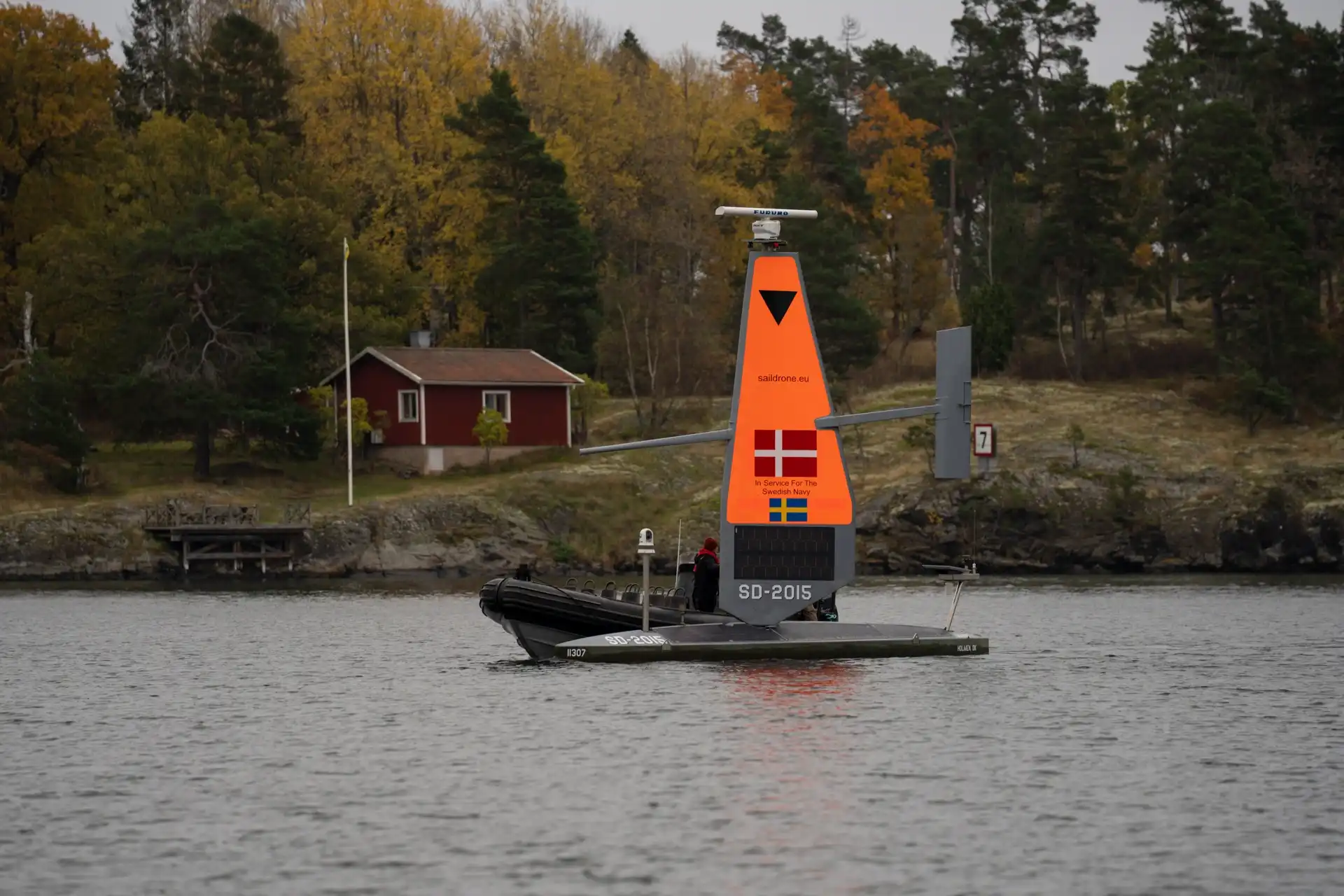
Sweden’s Defence Materiel Administration (FMV) has signed a framework agreement with U.S. uncrewed systems company Saildrone to provide the Swedish Navy with persistent maritime surveillance in the Baltic Sea using four wind-powered Saildrone Voyager uncrewed surface vehicles (USVs). Announced on October 22, 2026, and placed on behalf of the Swedish Armed Forces, the contract buys surveillance data as a service rather than the vessels themselves. The drones have been operating in the Baltic since October 2026.
The agreement was developed within Nordic Defence Cooperation (Nordefco), the framework linking Sweden, Denmark, Finland, Iceland and Norway since 2009, and is structured so that other Nordic nations can place their own orders against it. It also supports NATO Allied Command Transformation’s Task Force X Baltic, an effort to accelerate uncrewed maritime surveillance in the region. The initiative grew out of Operation Baltic Sentry, launched in January 2025 to protect critical undersea infrastructure after a series of cable ruptures in 2024 and 2025.
How the Saildrone Voyager Delivers Persistent Baltic Surveillance
Under the current call-off, four Voyagers are committed to the Swedish service for one year, and the framework allows additional USVs to be added. FMV describes the vessels as 10-meter sailing craft driven primarily by wind, with solar panels powering the onboard electronics and a small engine with a fuel tank for auxiliary propulsion. The craft navigate autonomously within assigned mission parameters, such as transiting between patrol areas, while Saildrone personnel monitor them continuously.
Publicly available manufacturer specifications list a 6-meter wing, a 2-meter draft, a survey speed of around 5 knots, up to 100 days at sea between service stops and 3.5 kilowatts of peak payload power. The Voyager’s maritime security configuration lists an infrared pan-tilt-zoom camera, radar and a vessel-identification transceiver. FMV has confirmed camera and radar for the Swedish mission but has not detailed the full sensor fit.
The operational logic centers on verification. The Swedish Navy tasks Saildrone and receives data around the clock, feeding its picture of Baltic traffic. FMV project manager Johan Wahren said the drones can detect vessels, check whether a ship matches the identity broadcast by its Automatic Identification System (AIS) transponder, and confirm the actual position of ships reporting a false location. That capability targets a recurring Baltic problem: vessels associated with Russia’s shadow fleet have repeatedly been reported to manipulate or disable their transponders.
Why FMV Is Buying Maritime Data Instead of Hardware
Wahren described the contract’s novelty as the ability to call off surveillance as a service, with the Navy paying for data rather than equipment. “This is fundamentally not about four uncrewed vessels, but about access to persistent information gathering at sea,” he said.
The model transfers acquisition, sustainment and crewing burdens to the contractor. It is also designed to scale. FMV has drawn up an Implementing Arrangement to ease cooperation among the Nordic countries, allowing partners to buy into the same service according to national requirements. Saildrone, headquartered in Alameda, California, operates a Danish subsidiary, and its Voyagers are already known to NATO planners: four of them operated in the Gulf of Finland and the western Baltic from June 16 to 27, 2025, during a Task Force X Baltic demonstration.
Analysis: The Swedish contract moves uncrewed surface surveillance in the Baltic from NATO experimentation to a funded national service. Its strength is inexpensive persistence: a wind-driven USV can hold a patrol box for weeks at a fraction of the cost of a crewed patrol vessel, freeing Visby-class corvettes for missions that require weapons and human judgment. Its limits are equally clear. Four platforms cannot cover the Baltic, the Voyager is slow and unarmed, and a service model makes part of a sovereign surveillance picture dependent on a foreign contractor’s operators and networks. Data security and service continuity in a crisis remain the open questions.
The initial service runs for one year. Key indicators will be whether the Swedish Armed Forces expand the call-off beyond four vessels, whether Denmark, Finland or Norway order under the Nordefco arrangement, and how Voyager data is integrated into NATO’s Baltic maritime picture. FMV has not released the contract value, the full sensor configuration or the operating areas assigned to the drones.