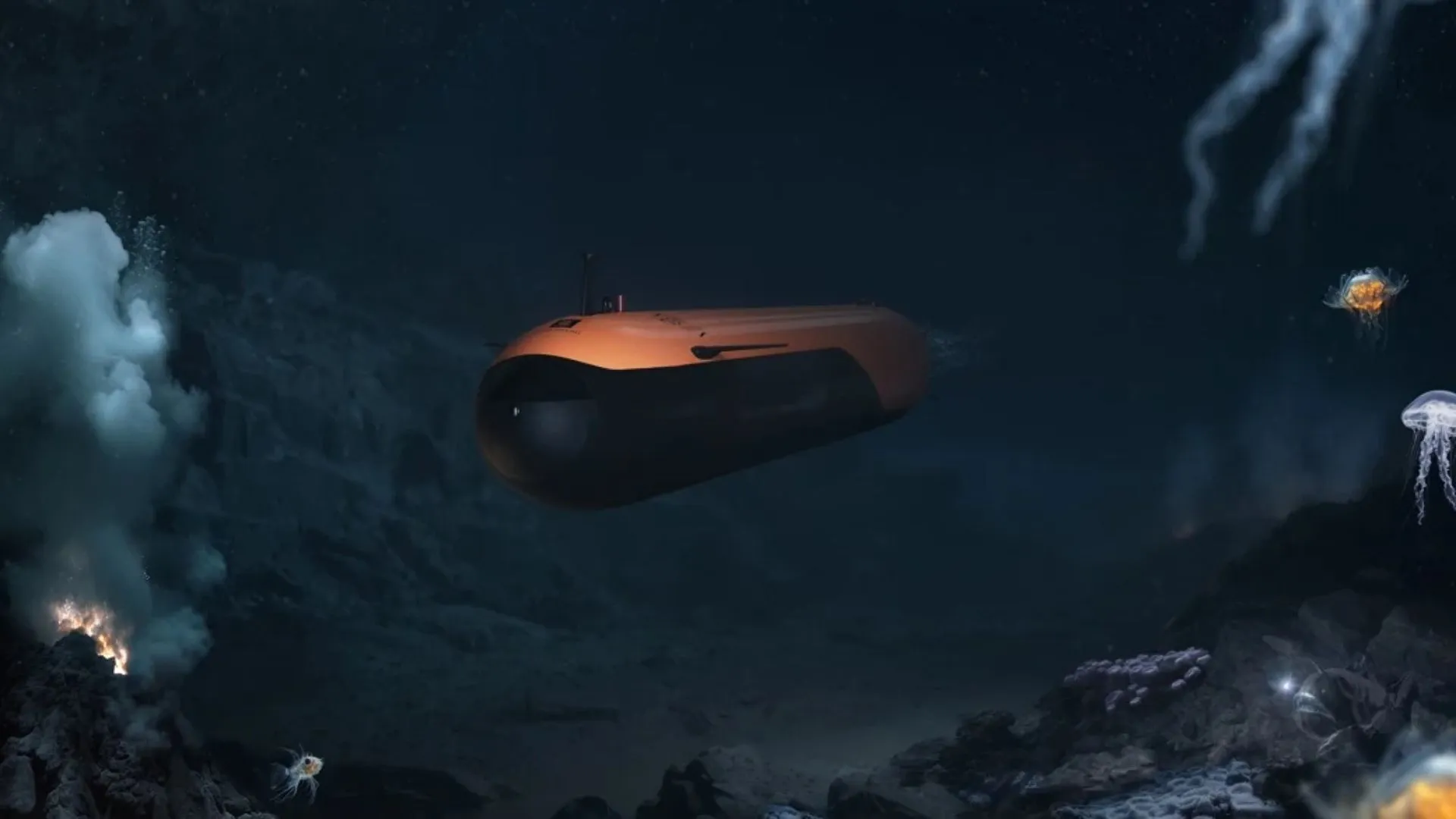
Kongsberg Gruppen ASA has received a $54 million modification to its Prototype Other Transaction Agreement with the Department of War Innovation Unit (DIU), the department’s commercial technology accelerator, the Norwegian company announced on October 29, 2026. The modification is driven primarily by the delivery of a broad range of autonomous underwater vehicles (AUVs), together with associated underwater capability components, under a collaboration Kongsberg says involves both DIU and the US Navy.
The award lands as the Navy continues to rebuild its large unmanned undersea vehicle (UUV) portfolio around commercial designs. The service proposed eliminating its in-house Snakehead Large Displacement Unmanned Undersea Vehicle (LDUUV) program in its fiscal 2023 budget, citing cost growth, schedule delays and misalignment with Virginia-class attack submarine hosting interfaces. Congress approved the termination and directed the Navy toward commercially available alternatives. DIU became the main channel for that pivot, and in February 2024 it awarded Kongsberg a 24-month prototype agreement to support the Navy’s LDUUV effort with HUGIN-family vehicles.
What the Kongsberg DIU Contract Modification Covers
Kongsberg did not disclose the number or type of vehicles covered by the $54 million modification, nor the delivery schedule or the Navy commands that will operate them. The company also did not confirm whether the modified agreement is the February 2024 LDUUV prototype award. It described the scope only as a broad range of AUVs plus related capability components, a category that could span sensor payloads, launch and recovery equipment or support systems. Those details remain unconfirmed.
The contracting vehicle matters. Other Transaction authority lets DIU buy outside standard Federal Acquisition Regulation procedures, and a successful prototype can transition to follow-on production without a new competition. A modification centered on vehicle deliveries rather than studies points to added hardware, not a restarted evaluation.
Kongsberg President and CEO Eirik Lie framed the award as a continuation. “This contract continues our collaboration with DIU and the US Navy and reflects confidence in KONGSBERG’s autonomous underwater technology,” Lie said, adding that it demonstrates the value of the company’s dual-use portfolio in delivering defense capabilities.
The modification also lifts Kongsberg’s AUV order intake for the year. According to Camilla Kiss, executive vice president and president of the Discovery division, which builds the HUGIN line, the company has signed AUV contracts worth a total of NOK 1.7 billion across defense and commercial markets so far in 2026. Kiss cited artificial intelligence, edge processing and autonomy as enablers of longer, more complex undersea missions.
HUGIN Superior and HUGIN Endurance Performance for Navy Missions
Kongsberg did not name the platforms, but the HUGIN family is the company’s large AUV line and the basis of its previous DIU work. The 2024 agreement covered two deep-water models, HUGIN Superior and HUGIN Endurance, integrated with Kongsberg sensors for intelligence preparation of the operational environment (IPOE), mine countermeasures (MCM), seabed warfare and seafloor mapping. Kongsberg delivered the first HUGIN Superior within a year of signature and completed acceptance testing in February 2025.
Publicly available specifications indicate HUGIN Superior is built for full ocean depth operation, offers more than 70 hours of endurance and holds navigation error below 0.04 percent of distance travelled. That accuracy is the operational differentiator in seabed warfare: an AUV mapping a cable route or a suspected minefield must return contacts precise enough to cue a second vehicle or an explosive ordnance disposal team without surfacing for a satellite fix.
HUGIN Endurance is the larger, longer-range vehicle. Open-source data put it at roughly 10 to 11 meters long, 1.2 meters in diameter and about 8,000 kilograms. Pressure-tolerant lithium-ion batteries give it up to 15 days of endurance and a range of 2,200 kilometers, or 1,200 nautical miles, with a 6,000-meter depth rating. Contrarotating dual propellers provide redundancy. Its HISAS 1032 Dual RX synthetic aperture sonar and EM 2040 MkII multibeam echosounder can cover close to 1,100 square kilometers in a single dive, guided by the Sunstone inertial navigation system with sonar micronavigation and terrain-referenced navigation.
For the Navy, that endurance profile is the point. A vehicle that can launch from shore or a vessel of opportunity and transit 1,200 nautical miles reduces dependence on a dedicated host ship in contested waters and supports persistent survey of chokepoints and critical undersea infrastructure. Kongsberg has not said whether vehicles under this modification are intended for submarine, surface ship or shore launch, the integration question that ultimately ended Snakehead.
Analysis: The modification indicates that DIU’s commercial-first approach to large UUVs is moving from evaluation toward quantity buys, in this case of a foreign-designed platform with a long commercial survey record. For Kongsberg, the US undersea market is becoming a growth axis alongside missiles and air defense. The company completed its acquisition of Santa Barbara-based acoustics supplier Sonatech on September 1, 2026, announced plans in 2025 to produce HUGIN vehicles in the United States, and co-leads a team with Oceaneering on DIU’s Combat Autonomous Maritime Platform (CAMP) extra-large UUV effort. A $54 million order is small against a NOK 174.2 billion backlog, but it builds incumbency where the Navy has struggled for a decade to field large vehicles.
Key unknowns remain the vehicle mix, the delivery timeline and whether the Navy will establish a program of record moving these prototypes into procurement funding. Watch the Navy’s fiscal 2028 budget request, progress on the CAMP competition, and whether US-built HUGIN production supports deliveries under this agreement.