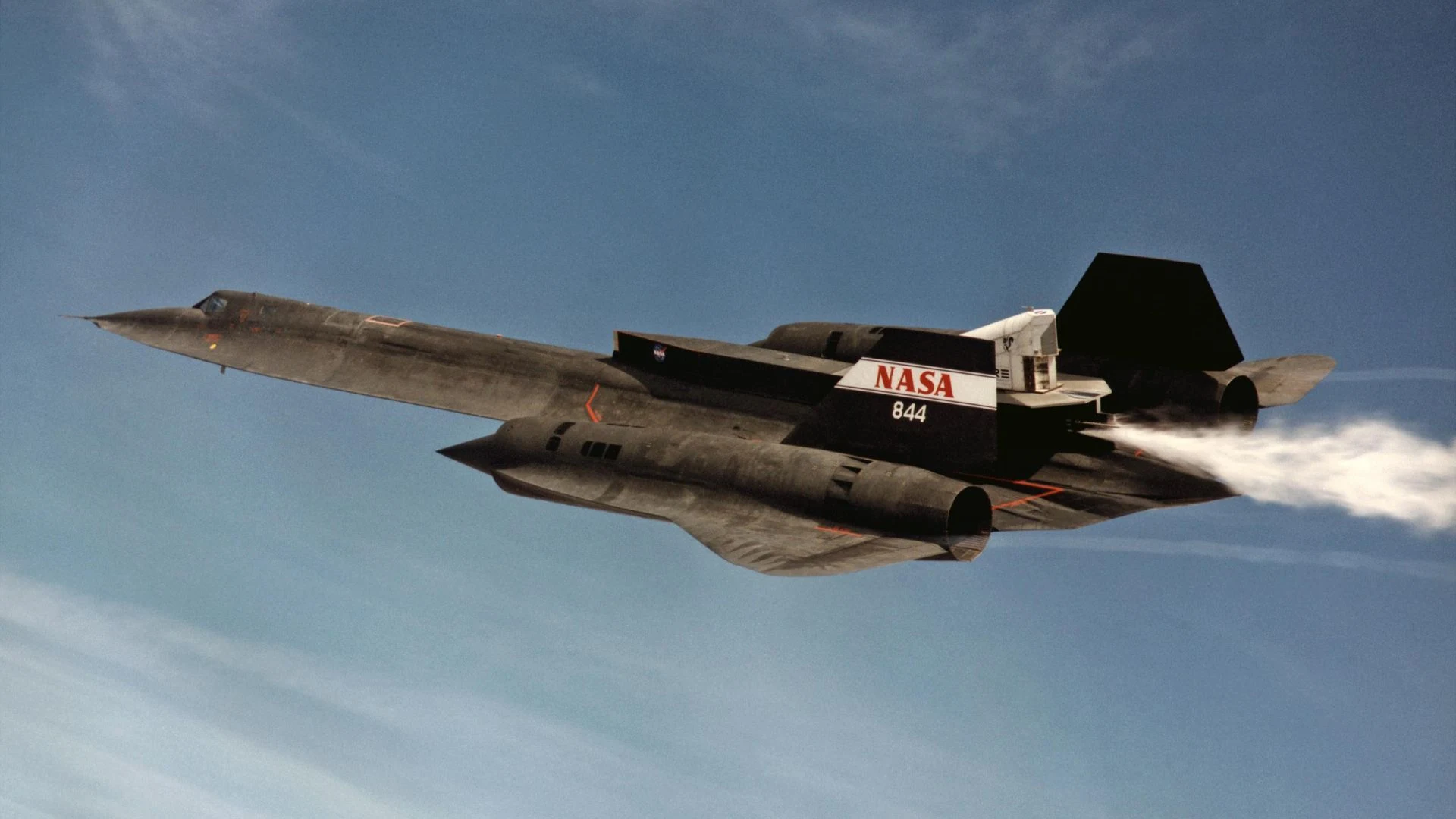
NASA will announce a new X-plane at its Max Power aerospace expo and airshow at Kennedy Space Center, Florida, on November 7-8, 2026, Administrator Jared Isaacman said on NASASpaceflight’s The Flame Trench podcast, released October 30, 2026. Isaacman said the aircraft is unrelated to the SR-71 Blackbird that disappeared from public display at NASA’s Armstrong Flight Research Center earlier this year: “it is not the one you’re thinking about.” Asked whether that Blackbird, NASA tail number 844, had been powered up, he deflected: “we’re just cleaning it, man.”
The remarks land as two threads in NASA aeronautics converge. In September, Isaacman used a presentation at the All-In Summit to show an unidentified aircraft silhouette with a planform closely resembling the Blackbird, under a slide on rebuilding the agency’s X-plane portfolio, while declining to say what it depicted. Days later, Aviation Week reported that 844 was gone from its outdoor display site at Armstrong, which is co-located with Edwards Air Force Base, California; satellite imagery has not shown the aircraft there since at least May 2026. Reports that NASA has approached former SR-71 personnel about a return-to-flight effort have circulated since, but NASA told The War Zone (TWZ) that it had no additional information to share about the aircraft.
NASA X-Plane Push: From Town Hall Pledge to Max Power Reveal
Isaacman has made X-plane revival a defining priority of his tenure. On his second day in office in December 2025, he told agency staff at a town hall that he wanted an expanded X-plane portfolio. In April 2026, NASA launched the Aeronautics Flight Accelerator (AFA), soliciting subsonic, supersonic, and hypersonic concepts from industry, academia, and government for cost-shared maturation leading to flight within three years.
The podcast offered no detail on the new aircraft’s configuration, speed regime, mission, industrial partner, or crewing concept, and NASA has not said whether it emerged from the AFA solicitation. Isaacman framed the reveal as delivering on his pledge that more X-planes are coming.
Max Power will run from the former Shuttle Landing Facility’s 15,000-foot runway, with the U.S. Air Force Thunderbirds scheduled to perform and exhibits spanning space systems, vertical takeoff and landing (VTOL) designs, and drones. Isaacman said NASA may build permanent infrastructure beside the runway to grow a recurring event modeled on the Paris, Farnborough, and Dubai air shows.
Isaacman also recounted a recent Armstrong visit to mark Troy Asher’s appointment as center director, joking about other jets on site, including the X-62A Variable Stability In-flight Simulator Test Aircraft (VISTA), a heavily modified two-seat F-16D that remains an active U.S. Air Force testbed at Edwards.
SR-71 Tail 844: Airframe Pedigree and Return-to-Flight Hurdles
Tail 844 is SR-71A U.S. Air Force serial 61-7980, the last A-model built. It arrived at what was then Dryden Flight Research Center on February 15, 1990, and later carried the Linear Aerospike SR-71 Experiment (LASRE), a rocket propulsion experiment mounted atop the fuselage, which first flew on October 31, 1997. Its final flight on October 9, 1999, reached Mach 3.21 and about 80,100 feet, according to NASA, and remains the last flight by any Blackbird.
Publicly available specifications indicate the SR-71A measures 107 feet 5 inches in length with a 55-foot 7-inch wingspan, and that roughly 85 percent of its structure is titanium alloy to withstand the skin temperatures of sustained Mach 3-plus cruise. Propulsion came from two Pratt & Whitney J58 afterburning turbojets with compressor bleed bypass, which behaved increasingly like ramjets at high Mach, each rated at about 32,500 pounds of thrust in afterburner. The aircraft burned specialized JP-7 fuel and relied on triethylborane chemical ignition.
Those features are precisely what make a return to flight difficult. The engine, fuel, ignition, and ground support ecosystem was dismantled after the type’s retirement, and the airframe sat outdoors in the desert for more than two decades. NASA has not described any assessment of 844’s structural condition, and options ranging from a crewed restoration to an optionally piloted or uncrewed conversion would each represent a different scale of engineering effort.
X-59 QueSST Flight Testing Sets NASA’s Supersonic Baseline
NASA’s most visible X-plane today is the X-59 Quiet SuperSonic Technology (QueSST) demonstrator, built by Lockheed Martin Skunk Works, which will also appear at Max Power. Since its first flight in October 2025, the X-59 has completed 41 test flights, reaching a top speed of Mach 1.53 and an altitude of 56,000 feet. Publicly available specifications indicate a single General Electric F414-GE-100 engine and an overall length of roughly 99.7 feet, much of it a slender forebody that breaks up shock waves. The program aims to reduce the sonic boom to a quiet thump, generating community response data that regulators could use to revisit the ban on commercial supersonic flight over land.
The X-59 is not designed for anything near the Blackbird’s speed envelope, but it shows NASA can take a clean-sheet X-plane to routine flight test, a capability any high-speed successor would require.
Analysis: The speed band between Mach 2 and Mach 4 has regained relevance across the U.S. military after years in which investment concentrated on hypersonics. Tim Conners, a former NASA SR-71 program engineer now technical director for advanced weapons systems at Tiberius Aerospace, told TWZ that vehicles in that regime can largely stay within titanium structures rather than exotic high-temperature materials, lowering cost while still holding many military targets and air defenses at risk. In his assessment, computational fluid dynamics now models airframe aerodynamics in this regime accurately; what remains hard to replicate on the ground is a new engine integrated into a high-speed airframe and running for long durations, which is why he believes NASA is pursuing a high-speed engine testbed. A flying platform able to carry J58-class propulsion would fill that gap, and its data would carry value well beyond NASA for military high-speed reconnaissance, strike, and propulsion programs. Whether through 844, a new airframe, or both, Isaacman’s messaging points to a deliberate return to sustained air-breathing Mach 3 research flight, a capability NASA has lacked since 1999.
Max Power opens Saturday, November 7. Open questions include the new aircraft’s designation, speed regime, prime contractor, funding source, and whether it follows the AFA’s three-year path to flight. Equally open is whether NASA uses the event to clarify 844’s status.