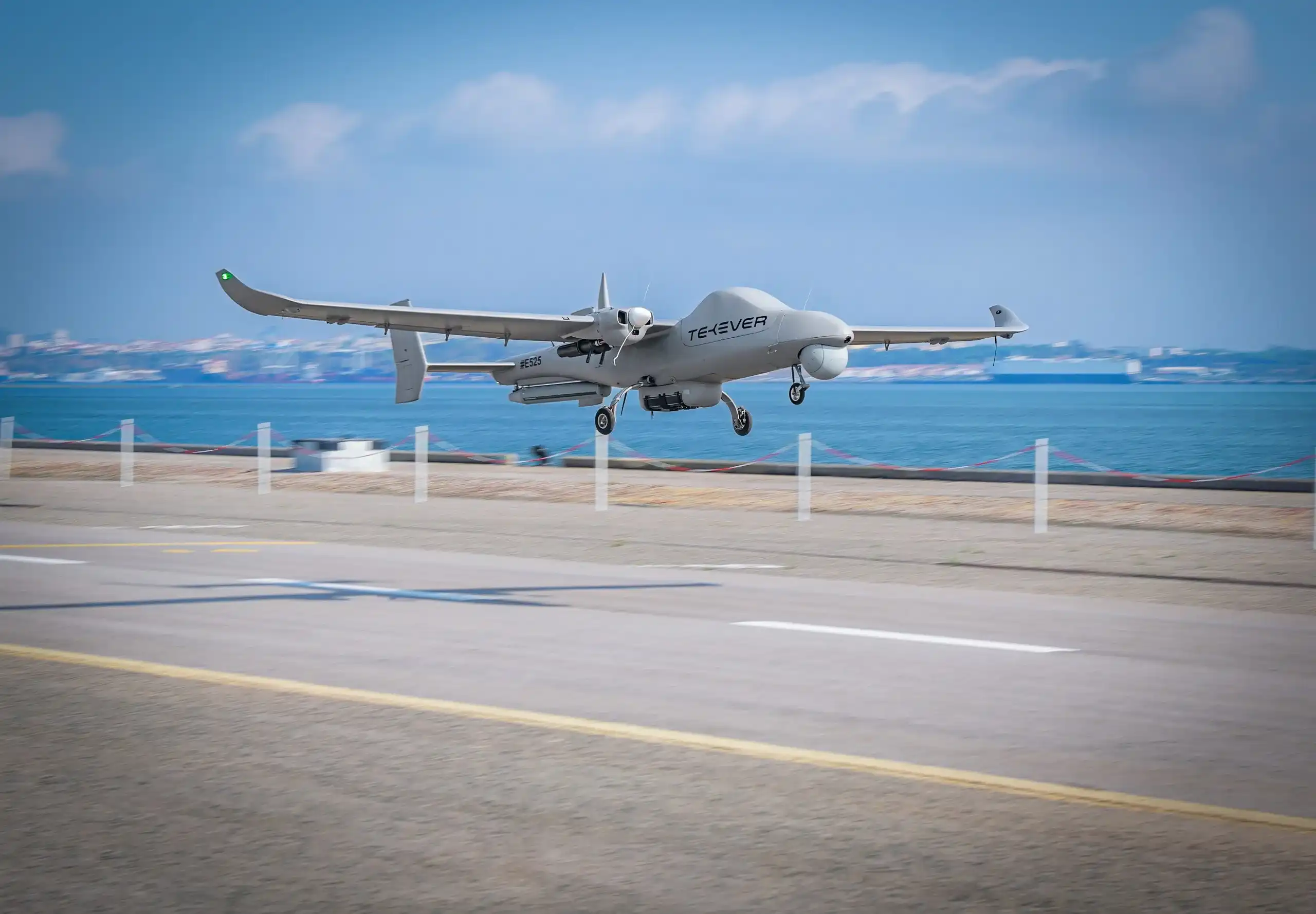
Portuguese drone maker TEKEVER and General Dynamics Mission Systems-Canada (GDMS-Canada) detected underwater targets during NATO’s REPMUS 2026 exercise off Portugal using sonobuoys dropped from a TEKEVER AR5 uncrewed aerial system, the companies announced on November 2, 2026. The demonstration chained sonobuoy deployment, acoustic processing and target detection into TEKEVER’s ATLAS mission management platform, then shared the resulting data with the wider operational picture in real time.
REPMUS, short for Robotic Experimentation and Prototyping with Maritime Unmanned Systems, ran from August 31 to September 25, 2026, around the Tróia Peninsula. The Portuguese Navy-led edition, run with the NATO Centre for Maritime Research and Experimentation, drew more than 3,700 participants from 36 navies and 60 research and development companies. The anti-submarine warfare (ASW) serial addresses a persistent allied problem: extending sonobuoy coverage without committing scarce crewed maritime patrol aircraft such as the P-8A Poseidon to every search.
How the TEKEVER AR5 Sonobuoy Chain Worked Off Portugal
According to the companies, the demonstration covered the detection end of the ASW chain: sonobuoys released at sea from the AR5, detection of underwater targets, and integration of those detections into both ATLAS and the GDMS-Canada Distributed Acoustic Processing System. Tony Morris, Vice-President, Air and Naval Systems at GDMS-Canada, said the team succeeded in “deploying sonobuoys from a TEKEVER AR5 and processing the resulting acoustic data to detect and track underwater contacts.”
The AR5 is a twin-engine, medium-altitude, medium-endurance fixed-wing aircraft built around a 7.3 by 4.0 meter airframe. Publicly available specifications indicate a maximum takeoff weight of 180 kg, a 50 kg payload capacity, a cruise speed of 100 km/h and endurance of up to 20 hours depending on payload. The aircraft operates beyond line of sight through satellite communications. For ASW, endurance is the figure that counts: sonobuoys transmit over line-of-sight radio links to an aircraft overhead, so a platform able to loiter above its own buoy field for most of a day can relay acoustic data continuously instead of seeding a pattern and leaving.
Payload is the constraint. Publicly available specifications cap a standard A-size sonobuoy at 39 pounds (about 18 kg), which would limit the AR5 to a small number of full-size buoys per sortie unless smaller G-size buoys were used. Neither company disclosed the buoy type or quantity, the dispenser configuration, the nature of the targets, detection ranges, or whether acoustic processing ran onboard or at a ground node.
From REPMUS 2024 to 2026: Building a Distributed ASW Chain
REPMUS 2026 marks the third consecutive sonobuoy outing for the AR5. TEKEVER first dropped sonobuoys from the aircraft at REPMUS 2024, then returned in 2025 alongside General Dynamics Mission Systems-United Kingdom to pair those drops with a distributed acoustic processing suite. This year the acoustic side moved to the Ottawa-based Canadian unit, maker of the UYS-505 and UYS-506 sonobuoy processors.
GDMS-Canada launched its distributed acoustics processing suite in 2023 around the UYS-506 Sonobuoy Processor, which the company says reduces the bandwidth needed to move data from aircraft to ground station without degrading performance. The companies have not said which processor configuration flew at REPMUS. That matters because an aircraft this size carries no acoustic operators; compressed data pushed over satellite links to analysts ashore is what makes ASW viable on the platform.
The nearest precedent is American. In November 2020, General Atomics Aeronautical Systems used an MQ-9A Block 5 to drop 10 A-size sonobuoys and track an MK-39 training target for about three hours, generating the track with GDMS-Canada’s UYS-505 processor over a satellite link. The MQ-9B SeaGuardian can carry four dispenser pods holding up to 40 A-size buoys. The AR5 sits far below that class in weight and payload, trading buoy count for a smaller logistics footprint.
Existing AR5 contracts, including the British Army’s Watchkeeper replacement worth up to £400 million and a Portuguese Air Force order for exclusive economic zone surveillance, backed by a Defense Ministry budget ceiling of about €7.8 million, cover intelligence, surveillance and reconnaissance roles with no announced ASW configuration.
Analysis: The demonstration does not show a small drone replacing a maritime patrol aircraft; the AR5 carries no torpedoes and only a handful of buoys. It does show a cheaper way to seed and hold a sonobuoy field for long periods, with processing distributed to whoever needs the picture. That would let navies reserve P-8As and frigate-based helicopters for localization and attack, the phases that demand weapons and crews. For NATO, it also widens the uncrewed ASW supplier base beyond large American airframes.
No customer, timeline or price for an AR5 ASW mission kit has been announced, and the companies have released no detection or tracking performance data from the serial. The first indicator will be whether an existing AR5 operator, such as Portugal or the United Kingdom, funds sonobuoy integration as a formal requirement rather than an exercise experiment.