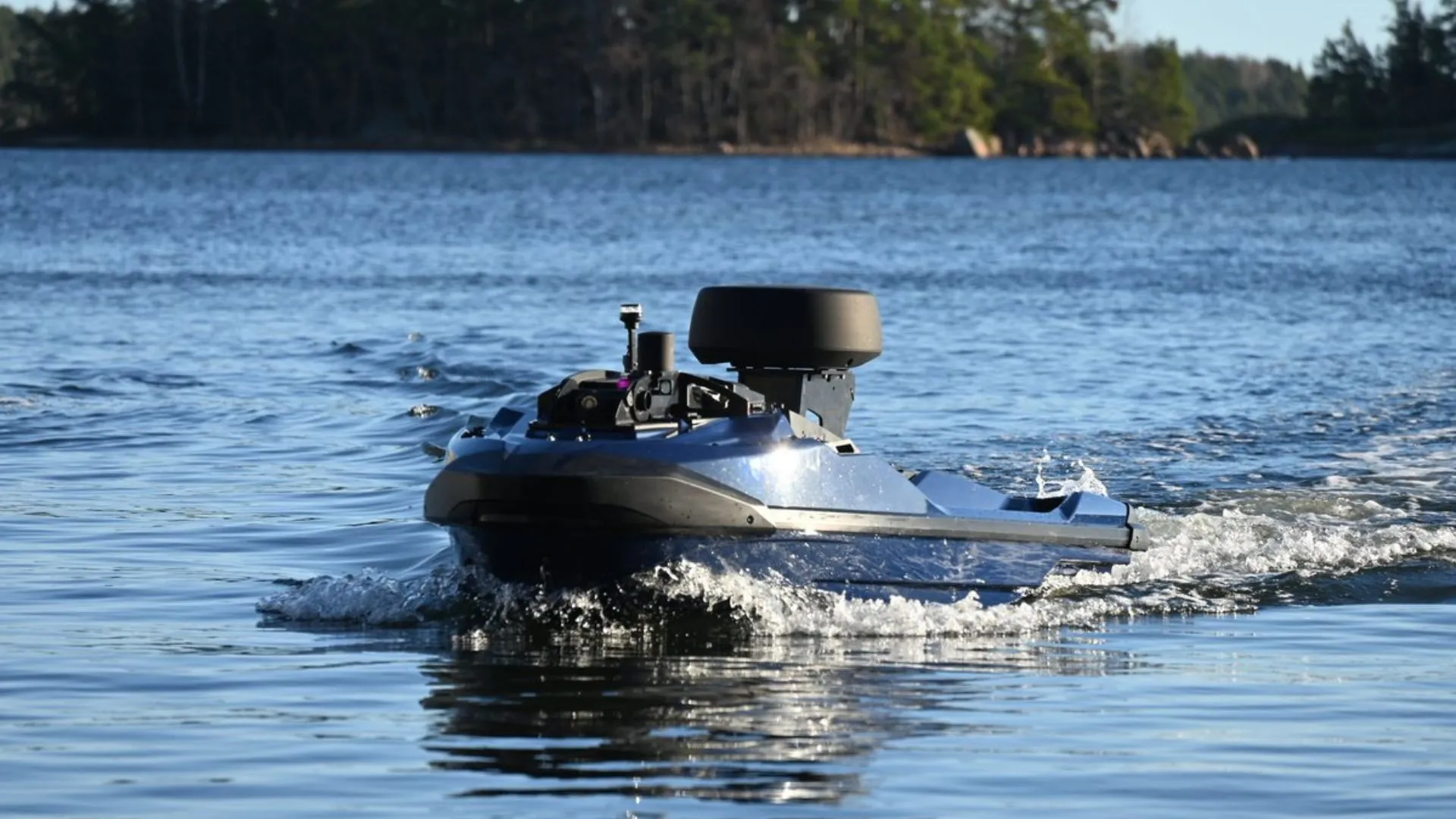
The Finnish Defence Forces demonstrated a Patria-developed multi-domain swarm of unmanned surface and aerial systems at an event hosted by the Finnish Navy in Upinniemi on November 5, 2026, where the service also announced that the Coastal Brigade will stand up a dedicated Unmanned Systems Company at the start of 2027. The swarm completed its assigned mission while being remotely controlled from two separate locations in Finland, according to Patria.
The announcement places unmanned systems directly into the force structure of the Coastal Brigade, the Upinniemi-based formation responsible for the Finnish Navy’s amphibious warfare, naval reconnaissance and special operations. It also reflects a wider push by Finland, a NATO member since April 4, 2023, to field autonomous capabilities across the Baltic littoral. Rear Admiral Tuomas Tiilikainen, Commander of the Finnish Navy, said the service intends to “integrate unmanned systems into our naval defence,” either as standalone unmanned units or embedded in operational formations such as combat vessels and intelligence units.
How the Patria Multi-Domain Swarm Linked Sea and Air Assets
The demonstration centered on Patria’s mission management system, which integrates different platforms into a single multi-domain network. Rather than operating each drone as an isolated asset, the architecture allows surface and aerial vehicles to execute a shared mission under common control, a prerequisite for employing unmanned systems at scale in congested archipelago waters.
At sea, the swarm included an unmanned surface vessel (USV) running Patria’s autonomy kit. Patria says the kit can be rapidly installed on virtually any sufficiently modern vessel, converting a crewed hull into an uncrewed platform. The company has not released a designation, hull type, sensor fit or performance figures for the vessel used at Upinniemi. Patria referred to surface vessels in the plural but did not specify how many took part.
In the air, the swarm combined a lightweight fixed-wing unmanned aerial vehicle (UAV), which Patria did not identify, with a Patria ONE quadcopter. According to Patria, the systems can perform surveillance, target acquisition and reconnaissance, or operate in a so-called One-Way mode with a warhead fitted, effectively functioning as loitering munitions. Patria did not state whether the One-Way configuration was employed during the event.
For force generation, an installable autonomy package offers a route to uncrewed surface capacity across Finland’s existing small craft without a dedicated new-build USV program, although no procurement decision tied to the kit has been announced.
Patria ONE and the Jehu-Class Launch Platform: Key Specifications
The Patria ONE entered Patria’s portfolio after the company announced the acquisition of Finnish manufacturer Nordic Drones in June 2024. Publicly available specifications indicate a quadcopter with two-blade, 18-inch rotors mounted above the motors, measuring 620 x 620 x 310 mm without propellers and 1,245 mm in diameter with them. Its modular design supports swappable radios, fibre-optic control, interchangeable payloads including explosives, and tether readiness, with a three-step safety system for handling explosive payloads. Patria has exhibited the drone with a shaped-charge payload generating an explosively formed penetrator against armoured targets, and lists a manufacturing capacity of 1,000 to 20,000 units per year.
The quadcopter launched from the aft deck of a Jehu-class vessel, the Watercat M18 armoured modular craft built by Marine Alutech. The Finnish Navy ordered 12 units in 2012, with deliveries beginning in 2015. Open-source data list a length of 19.9 m, a beam of 4.3 m, a draught of 1.1 m and a full-load displacement of 32 tonnes. Two 660 kW Scania diesels drive two Rolls-Royce 40A3 waterjets, and the craft can carry up to 26 passengers. Its armament centers on a Saab Trackfire remote weapon station.
Launching a strike-capable quadcopter from a high-speed landing craft extends the reconnaissance and engagement reach of small coastal units well beyond the range of their onboard sensors and weapons.
Analysis: The weight of the Upinniemi event lies in the organizational decision attached to it. By creating an Unmanned Systems Company inside the Coastal Brigade, the Finnish Navy is moving unmanned capability from experimentation into force structure, consistent with lessons from the Black Sea, where low-cost surface and aerial drones have constrained conventional naval operations. For NATO’s northern flank, a Finnish coastal force able to field inexpensive, mass-producible drones from existing craft adds sensing and strike depth in the Gulf of Finland at limited cost. Mikko Leino, Executive Vice President of Patria’s Defence and Weapon Systems business area, said the company will keep investing in the segment.
Key details remain undisclosed, including the size, equipment and manning of the new company, any associated contract value, procurement quantities and the identity of the fixed-wing UAV. The next milestone is the formal establishment of the Unmanned Systems Company in early 2027, which should clarify which Patria systems move from demonstration into service.