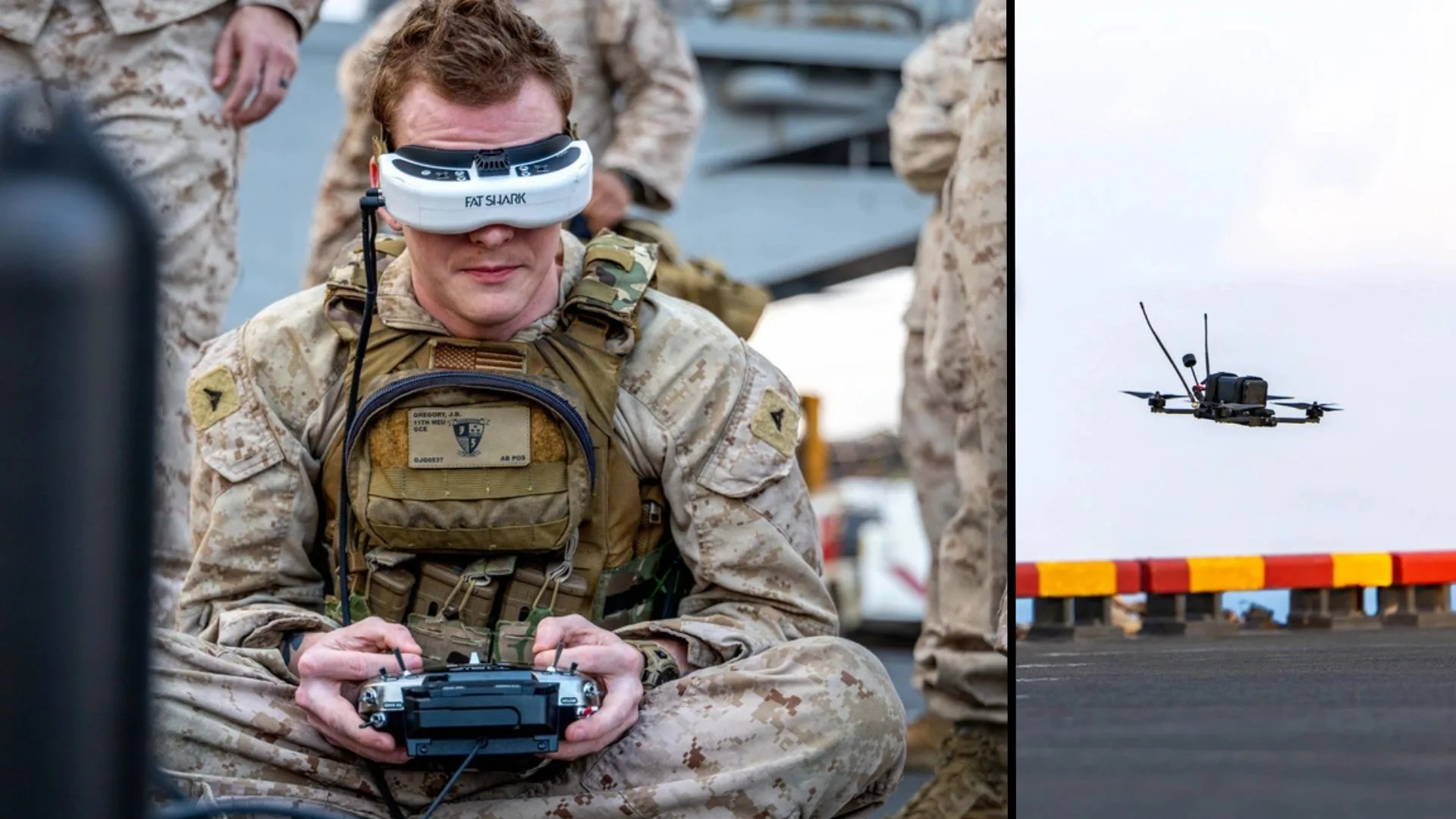
U.S. Marines with the 11th Marine Expeditionary Unit (MEU) flew Neros Archer first-person-view (FPV) strike drones from the Wasp-class amphibious assault ship USS Boxer (LHD 4) and the San Antonio-class amphibious transport dock USS Portland (LPD 27) while underway in the Arabian Sea, according to the Marine Corps. The training, conducted in the U.S. 5th Fleet area of operations and disclosed on November 3, 2026, also validated the Boxer Amphibious Ready Group’s (ARG) ability to detect and track small unmanned aircraft systems (sUAS) at sea with kinetic and electronic counter-drone (C-sUAS) systems.
The Boxer ARG, which also includes the dock landing ship USS Comstock (LSD 45), deployed from San Diego in March 2026 and is now operating in the Middle East. The Marine Corps said the training drew on lessons from contemporary conflicts, in which drones have been used both to attack naval assets and to launch from them. The service stood up its Marine Corps Attack Drone Team in January 2025 and began fielding the Archer to operating forces in late 2025.
How the 11th MEU Flew Neros Archer FPV Drones at Sea
Attack drone teams from Battalion Landing Team (BLT) 3/5 flew the Archer through several flight profiles simulating precision strikes from the sea, launching, tracking, and recovering the aircraft aboard ships under way. Sgt. Austin Mercier, a battalion attack drone team leader with BLT 3/5, said the teams had relied mainly on simulators earlier in the deployment, which do not capture external factors such as wind, propeller oscillation, or density altitude well. The live flights, he said, served as “a proof of concept that our attack drone teams could be employed from the deck of amphibious ships.”
Built by California-based Neros Technologies, the Archer is funded by the Defense Innovation Unit and has been fielded by the Marine Corps Warfighting Laboratory since September 2025. Marine Corps figures give it a top speed above 90 mph, a range of about 20 km, and a payload of roughly 5 lb (2.3 kg). The drone holds Blue UAS clearance, excluding Chinese-made components, and carries modular warheads, including the Archer Strike configuration with a Kraken Kinetics munition.
Those figures matter most at the platoon level. A 20 km reach with pilot-in-the-loop terminal guidance and a live video feed, which doubles as reconnaissance, places targets well beyond the range of a rifle platoon’s organic weapons. 1st Lt. John Pfeiffer, a rifle platoon commander with BLT 3/5, said the system gives the lowest echelon “a precision-strike capability that simply did not exist within the formation before deployment.” He noted that FPV drones on today’s battlefields strike high-value targets such as ground radar stations, energy and communications infrastructure, and hardened structures, and said the training was tailored toward defeating critical enemy infrastructure. Afloat, it offers a strike option that does not consume an aviation combat element sortie.
SMASH, Regulus Ring, and Titan SV: Layered Counter-Drone Defense Afloat
On the defensive side, the ARG employed three C-sUAS systems spanning kinetic and non-kinetic defeat. The kinetic layer was the SMASH fire-control optic from Israel’s SmartShooter, mounted on Marines’ service rifles. The Marine Corps began fielding the SMASH 2000L in fiscal 2026 under its counter-sUAS effort, with priority to deployed and deploying units, and 11th MEU Marines were photographed using it aboard Portland in April 2026. The optic computes a firing solution that lets a rifleman engage small drones with standard small-arms fire while keeping the rifle’s ground-combat role. Pfeiffer said the optic is likely to become common in future conflicts, making familiarity with it as important as with standard optics.
The non-kinetic layer combined the Israeli-developed Regulus Ring and the Titan SV. Ring relies on Global Navigation Satellite System (GNSS) manipulation, alongside radio-frequency (RF) datalink manipulation, to push back, hold, or force down hostile drones; Regulus claimed a 5 km defeat range against swarms when it launched the system in January 2023. In October 2025, Leonardo DRS announced that Ring, with Regulus as its technology partner, had taken first place in a demonstration run by the Pentagon’s Joint Counter-small Unmanned Aircraft Systems Office. Titan SV, built by AeroVironment subsidiary BlueHalo, provides RF detection and electronic defeat of command, control, and navigation links. The Marine Corps awarded BlueHalo a $22.8 million contract modification in March 2026 for additional Titan SV MPv3 systems under its Organic Counter-sUAS program, though the Marine Corps has not specified which Titan variant the MEU used. Pfeiffer described both as part of a multi-layered defense offering early detection and insight into the attacking system.
Analysis: The more consequential test was the defensive one. Ring and Titan SV both act on RF and satellite navigation links, precisely the vulnerability that fiber-optic-guided FPV drones, now common over Ukraine, eliminate. Against that class of threat, the ARG’s electronic layer loses most of its defeat value, and the burden shifts to rifle-mounted fire control and shipboard self-defense weapons. The Boxer event shows the amphibious force can generate platoon-level drone strikes from its own decks; it does not yet show that an ARG can defend itself against a disciplined, jam-resistant drone attack. That gap is where investment decisions are likely to concentrate.
The Marine Corps has not released dates, sortie counts, strike distances, or whether live warheads were used. Mercier said lessons from the MEU and Camp Pendleton will feed tactics, techniques, and procedures into Marine Corps doctrine. The indicators to watch are whether attack drone teams become standing elements of MEU load plans, how fast Archer procurement scales, and whether the Navy formalizes a C-sUAS requirement for amphibious ships.