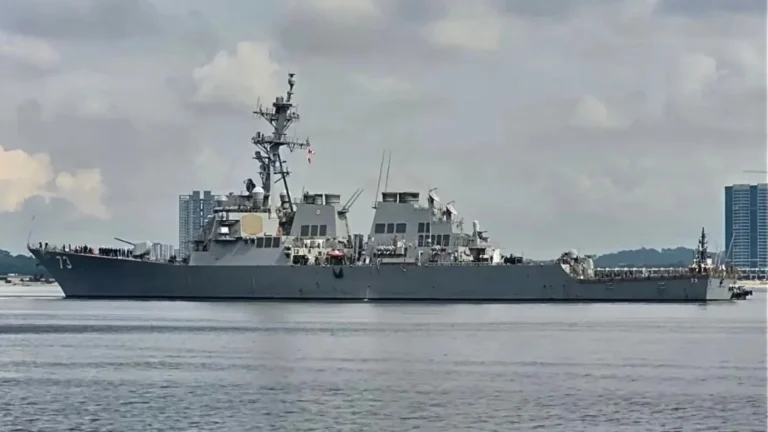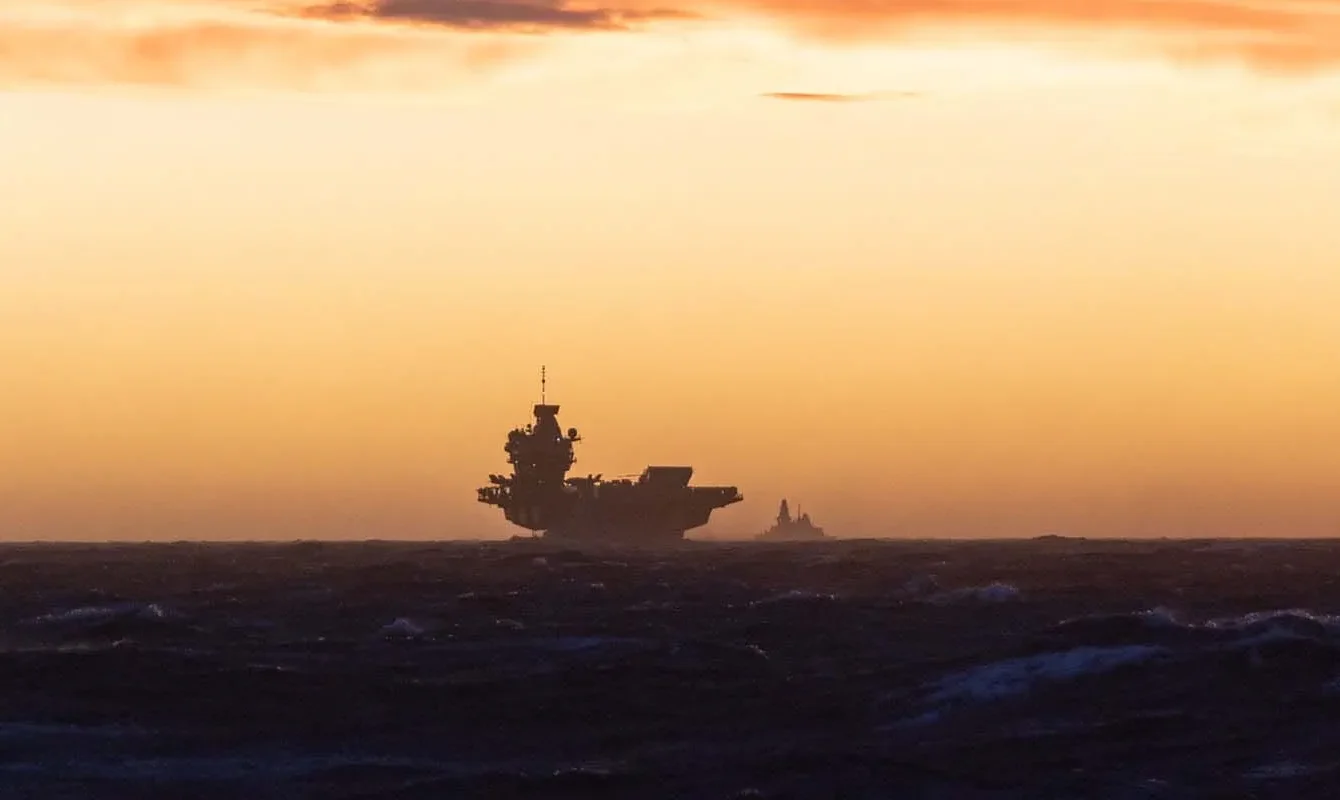
HMS Prince of Wales, the Royal Navy’s fleet flagship, arrives in Oslo this weekend after a fortnight of high-tempo training in and around Norway, closing the dynamic phase of the United Kingdom’s 2026 Operation Firecrest deployment, the Royal Navy announced on November 6. The 65,000-tonne Queen Elizabeth-class carrier will berth below Akershus Fortress and host the Atlantic Future Forum on November 11 and 12 and the International Sea Power Conference, two UK-led gatherings of European leaders on Northern European security.
Firecrest is the UK Carrier Strike Group’s 2026 mission to operate a fifth-generation carrier in Arctic and sub-Arctic waters and reinforce the defence of the North Atlantic, including the Greenland-Iceland-UK (GIUK) gap. After a spring phase, the autumn phase began when Prince of Wales left Portsmouth on October 18 under Commodore Richard Hewitt, with Type 45 destroyer HMS Dauntless as principal escort. With sister ship HMS Queen Elizabeth still working up after an extensive maintenance period, Prince of Wales is the Royal Navy’s only fully operational front-line carrier and remains at very high readiness for government tasking.
HMS Prince of Wales F-35Bs Join Global Thunder B-52 Escort
On October 24, F-35B Lightning II jets of 617 Squadron, “The Dambusters,” launched from the carrier and joined Royal Norwegian Air Force F-35As flying from mainland Norway to escort a US Air Force B-52 Stratofortress over the Norwegian Sea during Exercise Global Thunder, the annual nuclear command and control exercise run by US Strategic Command. A Royal Air Force Voyager tanker supported the formation. According to the UK Carrier Strike Group, it was the first time carrier-based British F-35Bs escorted a B-52 alongside Norwegian F-35As.
Pairing the two variants carries practical weight. The F-35B is the short takeoff and vertical landing (STOVL) variant, using a Pratt & Whitney F135-PW-600 engine and a Rolls-Royce LiftFan to recover aboard a carrier without catapults or arresting gear. Publicly available specifications indicate it carries about 6,100 kg of internal fuel against roughly 8,300 kg for the land-based F-35A, giving it a shorter unrefuelled combat radius. Both share the AN/APG-81 radar and the Multifunction Advanced Data Link, which lets mixed formations build a common picture without compromising low observability. For Norway, which fields the F-35A as its only fighter, a sea-based F-35B squadron offshore adds fifth-generation airframes that do not depend on runways exposed to Russian long-range strike.
Hammernesodden Rearming Tests Carrier Independence From Support Ships
After the Global Thunder sortie, Prince of Wales sailed through the fjords to the military jetty at Hammernesodden in Namdalseid, near Namsos and about 70 miles north of Trondheim, and loaded ammunition there on October 26. The site is a key Norwegian munitions storage area that also supports the US Marine Corps Prepositioning Program-Norway. According to the Royal Navy, it was the first time a Queen Elizabeth-class carrier has taken on ammunition in a port outside the UK.
The evolution addresses a structural weakness in carrier logistics: munitions and solid stores at sea depend on RFA Fort Victoria, in service since the mid-1990s. The Royal Navy says the ammunitioning paves the way for operations when no solid support ship, whether Fort Victoria or one of the future Resurgent-class vessels, is available. Proving that a carrier can rearm from an allied depot widens the options for sustaining a strike campaign on the Northern Flank.
The Norwegian Home Guard provided force protection, with patrol boats in the fjord and armed emplacements on the jetty. At sea, frigate KNM Fridtjof Nansen sailed as escort and Skjold-class corvettes exercised with the carrier force. Publicly available specifications indicate both classes carry the Naval Strike Missile, giving the group dense anti-ship firepower in confined fjord waters.
17 Nations, 20 Warships: Inside Neptune Strike 26-4 Off Norway
From Hammernesodden, the carrier shifted to NATO tasking and worked up its air group, the 617 Squadron F-35Bs plus Merlin helicopters from the Commando Helicopter Force and 820 Naval Air Squadron, on Neptune Strike 26-4. The fourth iteration ran from late October to November 5 and drew 17 nations, 20 warships and 40 aircraft across three naval task groups: two in the Mediterranean led by Italy and Türkiye, and a third off Norway under Prince of Wales. NATO frames it as a multi-domain enhanced Vigilance Activity centred on maritime strike in the High North.
The northern task group combined HMS Dauntless and KNM Fridtjof Nansen with Type 23 frigate HMS St Albans, a French frigate and Norwegian logistics vessel HNoMS Maud. During the exercise, the F-35Bs loaded and dropped live Paveway IV precision-guided bombs. The 500 lb class Paveway IV, with combined GPS/inertial and laser guidance, is the principal UK F-35B air-to-ground weapon. The jets also conducted a live land strike alongside the Norwegian Army.
The concentration of allied combat power drew Russian attention. Prince of Wales scrambled F-35Bs to intercept a Tu-95 Bear long-range bomber, a reminder that air defence of the Northern Flank is a live mission rather than a training serial.
Analysis: The two firsts of the autumn phase, carrier jets folded into a US strategic bomber escort and a carrier rearmed from an allied depot, point in the same direction. London is shaping its carrier into a Northern Flank asset that plugs directly into US and Norwegian force structures rather than operating as a self-contained national task group. That integration multiplies deterrent value but exposes the limits of British mass. With one front-line carrier and a single aging solid support ship, the Royal Navy leans on host-nation infrastructure and allied escorts to generate sustained combat power. Hammernesodden is a valuable option, not a substitute for logistics afloat.
Next week, the eighth Atlantic Future Forum, the first held in mainland Europe, convenes aboard the carrier, with First Sea Lord General Sir Gwyn Jenkins leading Royal Navy involvement. The carrier’s schedule after Oslo has not been published. The next markers are HMS Queen Elizabeth’s return to front-line readiness, which would restore a two-carrier rotation, and delivery timelines for the Resurgent-class ships that would make host-nation rearming a contingency rather than a necessity.