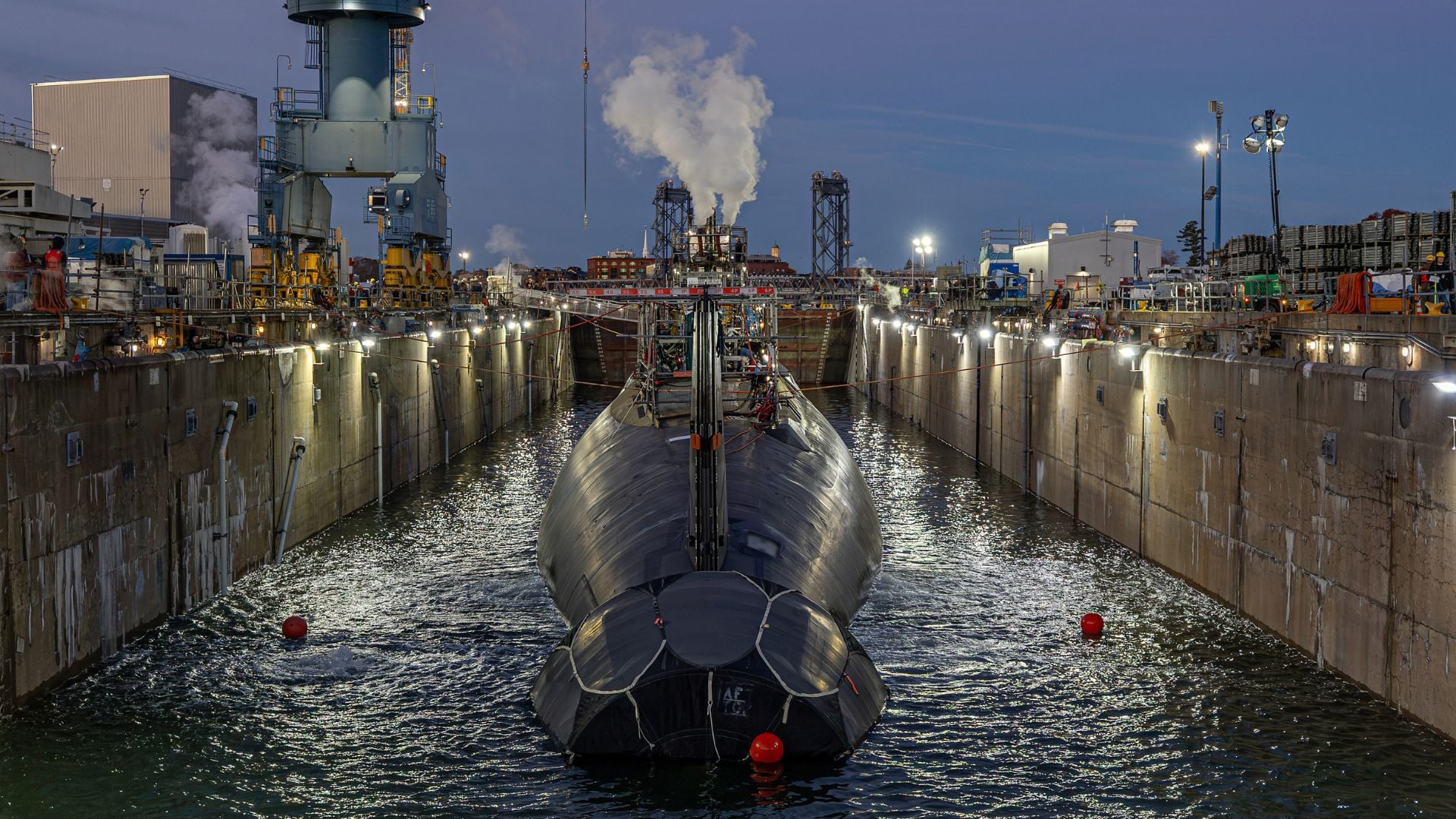
The U.S. Navy has awarded BAE Systems a $138 million contract to continue manufacturing propulsors for the Virginia-class nuclear-powered attack submarine (SSN) program, the company announced on November 12, 2026. The award covers propulsor assemblies, engineering services, replacement parts and associated support services, with an ordering period running through September 2032.
The contract arrives as the Navy works to lift submarine output toward its “1+2” cadence: one Columbia-class ballistic missile submarine (SSBN) and two Virginia-class boats per year. That rate underpins both U.S. force-structure goals and the AUKUS commitment to Australia. Although Virginia-class boats have been procured at roughly two per year since fiscal year 2011, actual production has held at about 1.1 to 1.2 boats per year since 2022, according to the Congressional Research Service. In May 2026, Navy leadership told lawmakers the two-per-year delivery rate is now expected around 2032, four years later than the 2028 target set in 2024.
Virginia-Class Propulsor Contract Scope and Ordering Period to 2032
BAE Systems states it is meeting the Navy’s goal of two Virginia-class propulsor sets per year and has delivered major propulsor assemblies for every boat in the class to date. The work is spread across three sites: Louisville, Kentucky, home to the company’s Submarine Center of Excellence; Jacksonville, Florida, where its shipyard has taken on submarine structural fabrication; and Minneapolis, Minnesota, which provides engineering support. The company attributes its capacity to self-funded investment in advanced manufacturing at those facilities.
“BAE Systems is delivering the complex components essential to U.S. undersea dominance,” said Jason Casciotti, vice president of BAE Systems Weapon Systems. “Our scaled facilities and skilled workforce are focused on strengthening the submarine force.”
The announcement does not disclose the contract type, the contracting activity, the number of propulsor shipsets covered or the hull numbers involved. It also leaves unclear how the $138 million divides between new-build assemblies and sustainment hardware. For reference, BAE received a $92 million award in October 2024 covering four Propulsor Forward Assemblies plus design engineering support and sustainment hardware, at which point it reported 33 forward assemblies delivered. The new award is 50 percent larger in value, though without shipset counts a per-unit comparison is not possible.
Pump-Jet Propulsion and Virginia-Class Acoustic Performance
The propulsor is among the largest and most acoustically sensitive structures on a U.S. attack submarine. Publicly available specifications indicate the Virginia class uses a shrouded pump-jet propulsor rather than an open propeller, driven through a single shaft by the General Electric S9G pressurized water reactor, which is designed to operate for the life of the boat without refueling. A pump-jet encloses rotor and stator blades within a duct, pushing cavitation onset to higher speeds and suppressing the blade-rate tonals that passive sonar uses to detect and classify submarines. For a platform whose value rests on remaining undetected near adversary coastlines, the propulsor is a primary determinant of survivability.
According to open-source data, Block I through IV boats displace about 7,800 tons submerged on a 377-foot hull. Block V boats fitted with the Virginia Payload Module (VPM) stretch to roughly 460 feet and about 10,200 tons, adding 28 Tomahawk-capable launch cells to the 12 carried in the bow. BAE’s Louisville plant also manufactures the VPM launch tubes and a heavy propulsor structure for the Columbia class, concentrating critical work for both programs at a single site. Propulsor production demands heavy fabrication and precision machining to tight tolerances, and delays at this stage feed directly into hull completion at General Dynamics Electric Boat and HII’s Newport News Shipbuilding.
Analysis: The contract’s weight lies less in its value than in its duration. A six-year ordering window through September 2032 gives BAE demand visibility that aligns with the Navy’s revised timeline for reaching two boats per year, supporting workforce retention and capital planning at a key supplier. The company’s claim that it already meets a two-set-per-year propulsor rate also points to where the constraint now sits. If a major component supplier is pacing at two sets annually while the shipyards deliver closer to 1.2 boats, the binding limit lies increasingly in hull construction, outfitting and labor at the prime yards and lower-tier vendors, not in large propulsor structures. That should shape how Congress directs future submarine industrial base funding.
Upcoming delivery orders under the contract should reveal shipset quantities and hull assignments. AUKUS plans call for transferring three to five Virginia-class submarines to Australia beginning in 2032, which would require Virginia-class production to reach 2.33 boats per year. Whether BAE’s propulsor output must rise above two sets annually to meet that demand, and how the Navy will fund it, remain open questions not addressed in the announcement.