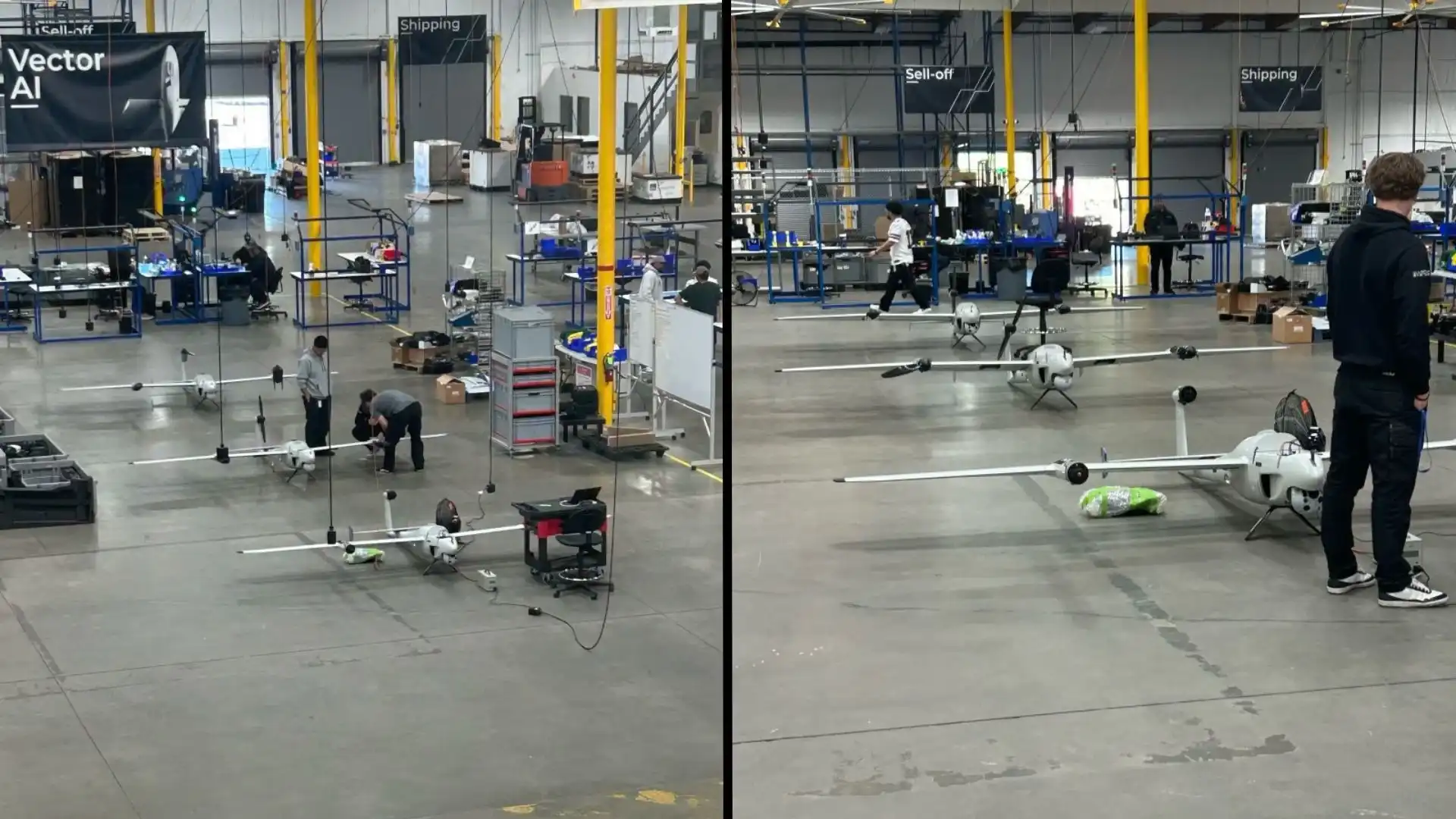
Quantum-Systems Inc., the U.S. subsidiary of German drone maker Quantum Systems, has shown its Reliant long-range vertical take-off and landing (VTOL) unmanned aircraft system (UAS) on the production floor of its plant in Moorpark, California. Chief Executive Dave Sharpin posted the images on LinkedIn this week, describing the aircraft as “on the production floor in Moorpark, CA.”
The images arrive two weeks after Sharpin, on October 28, 2026, published photos of an armed Reliant carrying 82 mm mortar rounds and 40 mm grenades on wing hardpoints. Together, the two disclosures mark a shift for an airframe the company introduced at SOF Week in Tampa in May 2024 as a pure intelligence, surveillance and reconnaissance (ISR) asset. They also come as the U.S. Army moves to rapidly field commercial unmanned systems with its maneuver units.
Quantum Systems Reliant Specifications and Armed Configuration
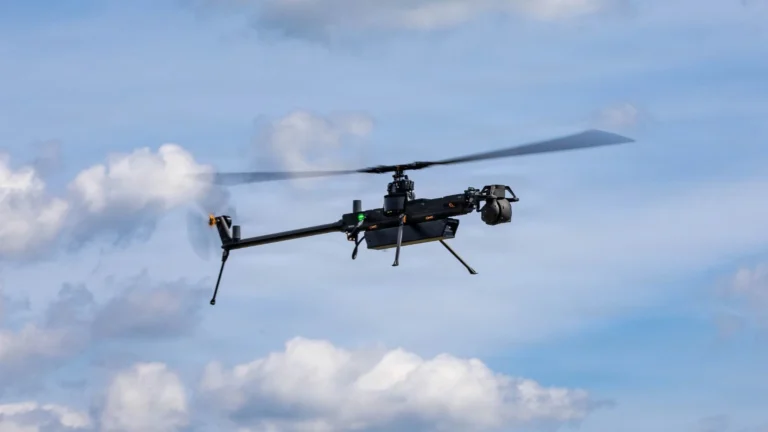
Reliant is a Group 2 fixed-wing VTOL design: it lifts off on rotors, then transitions to wing-borne cruise, which removes the need for catapults, runways or recovery nets. At launch, the company quoted a 3.9-meter (12.8-foot) wingspan, a 2.38-meter (7.8-foot) length and more than 10 hours of endurance; a later company technical sheet lists a 4.3-meter span. Publicly available specifications from 2024 indicate a 160-kilometer datalink range, with an optional satellite link.
The upgrade announced on July 27, 2026 introduced a hybrid-electric power unit, raised payload capacity to up to 9 kg and brought maximum takeoff weight to 45 kg (99 pounds). The company says the aircraft can now carry electro-optical sensors, laser target designators, synthetic aperture radar, electronic intelligence and electronic warfare packages, satellite communications and relay equipment. Reliant is also integrated into the MOSAIC UxS software ecosystem, which networks it with air, ground and maritime systems in multi-domain operations. Quantum Systems markets Reliant as built around a European supply chain, without Chinese components or ITAR restrictions.
The wing hardpoints first appeared on a variant developed for U.S. customers, and the company has said the extra mounts are, for now, offered only in the U.S. market. Each wing carries one attachment point that can host additional modules or release munitions and smaller drones, including the Archer first-person-view (FPV) attack drone built by California-based Neros. Open-source reporting credits Archer with a payload of up to 2 kg over more than 20 km, and the Marine Corps recently flew it with live warheads in Japan. Quantum Systems has not disclosed whether the mortar and grenade configuration has been live-fire tested, what release mechanism it uses or how many rounds it carries per sortie.
Moorpark Production, SOCOM Funding and the Army Vector AI Award
The Moorpark plant covers 135,000 square feet and opened on June 6, 2025, consolidating the company’s earlier sites in the city. It houses secure manufacturing lines, engineering labs and in-house flight operations, and was set up to build all three aircraft in the family: the short-range Twister, the mid-range Vector AI and Reliant. U.S. Special Operations Command (USSOCOM) had earlier committed $20 million in fiscal 2023 Accelerate the Procurement and Fielding of Innovative Technologies (APFIT) funds to expand U.S. production of Vector.
Vector remains the company’s commercial anchor. Sharpin has said the platform logged more than 20,000 operational flight hours in Ukraine in 2025 alone, and that one aircraft returned from a mission after it “was struck 11 times by small arms fire.” In April 2026, the Army awarded Quantum-Systems Inc. $15.3 million under its Company-Level Small UAS Directed Requirement 2 initiative to field Vector AI with Brigade Combat Teams, the company’s largest sale to a U.S. military service to date. No U.S. service contract for Reliant has been announced.
Analysis: Showing Reliant on a U.S. line, days after showing it armed, positions Quantum Systems for a role it is, for now, offering only to U.S. customers: a single long-endurance airframe that finds targets, designates them and strikes them, or launches FPV drones that do. A Moorpark-built aircraft with hardpoints sits in a different procurement category from an imported ISR drone. It gives the company a credible bid for Army and Marine Corps long-range reconnaissance and strike efforts.
Production rate, unit cost and any Blue UAS listing for Reliant remain undisclosed. The next markers are a first U.S. order for the aircraft, a live-fire demonstration of the armed variant, and whether the Army’s Medium Range Reconnaissance program, which the Vector AI award is meant to inform, opens a path for the larger airframe. “The future is unmanned,” Sharpin wrote.