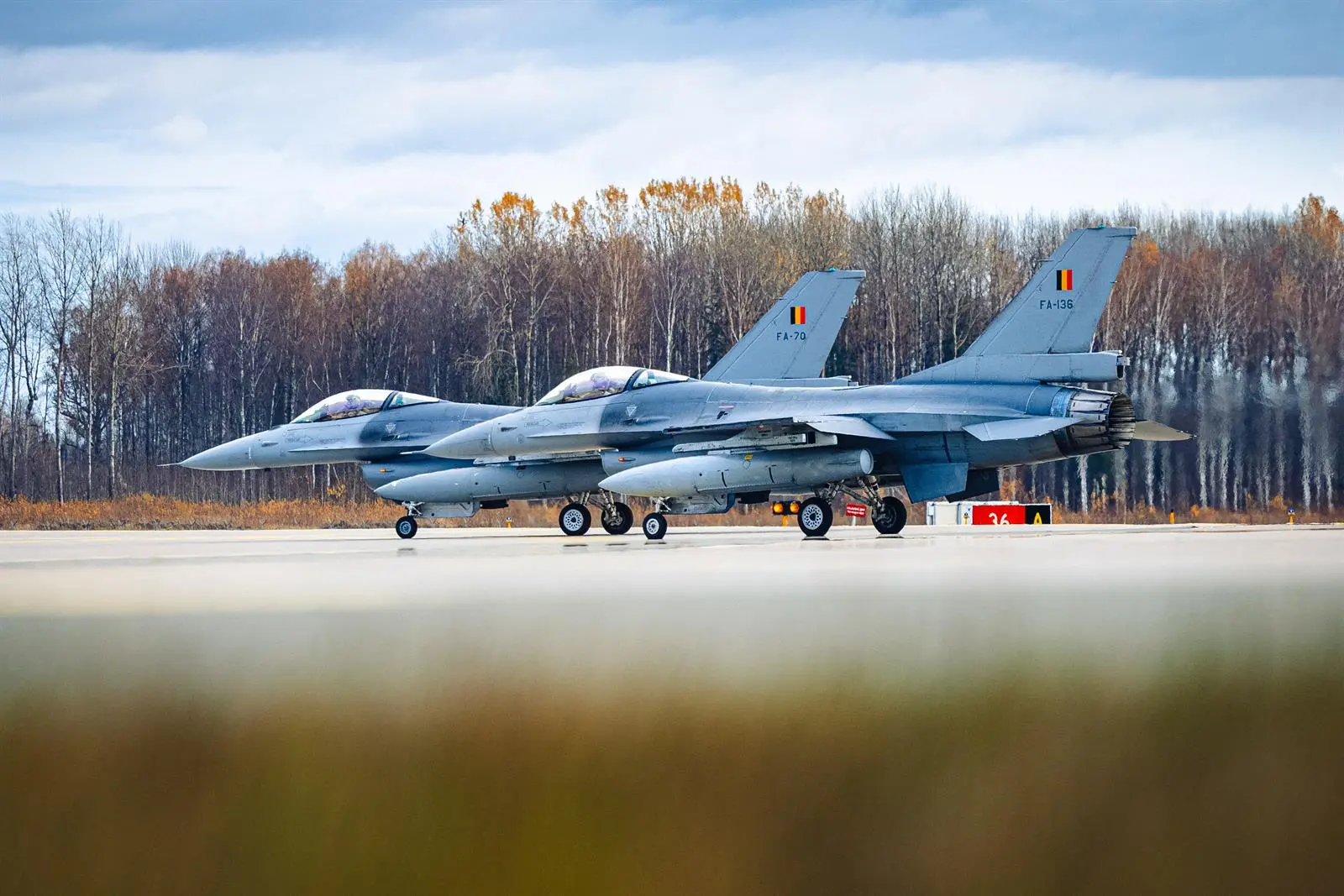
The Belgian Air Force has assumed NATO’s enhanced air defense responsibilities in Lithuania, operating F-16 Fighting Falcons from Šiauliai Air Base after arriving at the start of November, Allied Air Command (AIRCOM) announced on November 8, 2026. The Belgian detachment joins the Italian Air Force, which remains lead nation for Baltic air defense, and reinforces the Alliance’s presence in the region under its new Air Defence framework.
The deployment is one of the first force additions since allies agreed at the NATO Summit in Ankara in July 2026 to convert the Baltic Air Policing mission, flown continuously since March 30, 2004, into an air defense mission. The change took effect on August 1, 2026. Lithuania, Latvia and Estonia field no fighter aircraft of their own, and it was Belgian F-16s that opened the original mission at Šiauliai hours after the three states joined the Alliance.
How the Baltic Air Defense Framework Expands NATO’s Mission
Air policing was built around peacetime quick reaction alert: identifying, shadowing and escorting aircraft that approached or violated Allied airspace. According to AIRCOM, the new framework brings a broader Integrated Air and Missile Defense (IAMD) posture that combines fighter aircraft, surveillance, command and control (C2), and surface-based air and missile defense (SBAMD). Its layered, 360-degree approach is designed to counter crewed and uncrewed aircraft as well as cruise and ballistic missiles.
Lithuanian President Gitanas Nausėda said in July that the conversion gives Allied pilots a wider mandate, including the destruction of objects that pose a threat. Estonia’s Ministry of Defence has described the shift as a move from airspace surveillance and violation response to defensive operations drawing on NATO’s full IAMD system.
AIRCOM, headquartered at Ramstein, Germany, oversees the mission through its Combined Air Operations Centres (CAOC), which coordinate national contributions to protect NATO territory, populations and forces in peacetime, crisis and conflict.
Belgian, Italian and Turkish Fighters on NATO’s Eastern Flank
The Lithuanian Ministry of National Defence put the Belgian contingent at about 100 personnel and six F-16s, welcomed at Šiauliai in a ceremony attended by Lithuanian Air Force Commander Antanas Matutis. AIRCOM has not published aircraft numbers or the length of the rotation.
The Belgian jets operate alongside four Italian Air Force Eurofighter Typhoons, which took over at Šiauliai on July 31, 2026, with roughly 200 personnel. In Estonia, the Turkish Air Force flies five F-16s from Ämari Air Base with 76 personnel from its 181st Squadron, its first deployment to that base.
Belgium flies the F-16AM/BM, upgraded under the Mid-Life Update program. Publicly available specifications indicate an AN/APG-66(V)2 radar and an air-to-air loadout built around the AIM-120 AMRAAM and AIM-9 Sidewinder. The fleet is in its final years of Belgian service: F-35A deliveries to Florennes began in October 2025 against an initial order for 34 aircraft, with 11 more planned to bring the fleet to 45, the F-16 is scheduled to remain in service until 2028, and Brussels plans to transfer its F-16s to Ukraine by the end of 2029.
Analysis: The Baltic air defense framework is, for now, being executed with fourth-generation fighters: two of the three national detachments in the region fly the F-16. Belgium’s commitment of a six-jet detachment while it absorbs the F-35A and prepares F-16 transfers to Ukraine shows how small European air forces are stretching aging fleets to meet rising Alliance demands. The fighters, however, are only one layer. The framework’s added value depends on whether surface-based air and missile defense units deploy to the Baltics on a sustained rotational basis and on how C2 links between those systems and the fighter detachments perform under real conditions.
Key details remain unpublished, including the duration of the Belgian rotation and the rules of engagement under the new mandate. The Turkish rotation at Ämari is scheduled to end on November 30, 2026, setting up the next handover in Estonia. NATO has not announced which allies will provide the SBAMD component in the region, a decision that will determine whether the new framework delivers more than a renamed fighter presence.