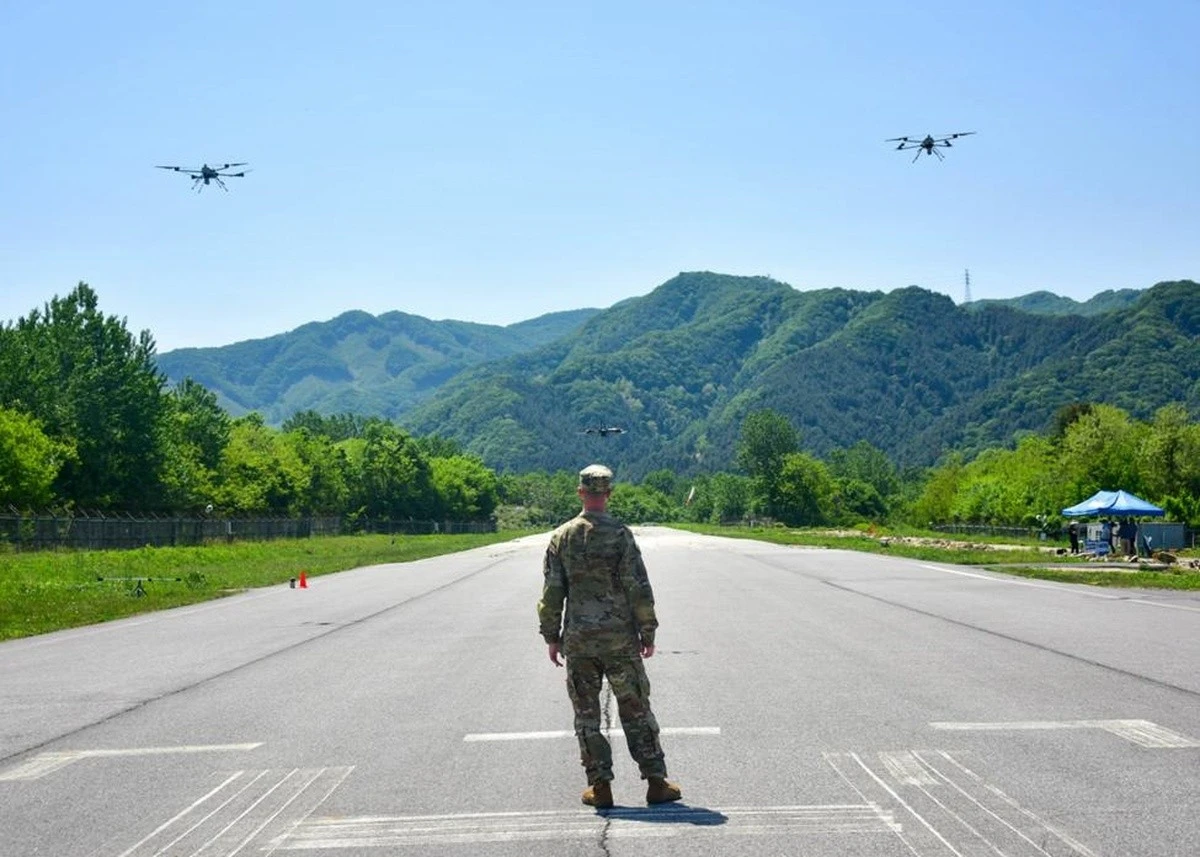
The U.S. Army’s 532nd Military Intelligence Battalion has validated a low-cost passive acoustic network for detecting small drones in South Korea, reaching more than 90% window-level confidence against low-altitude threats during September trials at Baegiri Airfield, according to the U.S. Army. The battalion, part of the 501st Military Intelligence Brigade (Theater), now seeks to move the system, known as Project MANOWAR, into scaled production and a formal Army program of record.
The effort responds to the spread of Group 1 and Group 2 unmanned aircraft systems (UAS), platforms weighing up to 55 pounds, and of first-person-view (FPV) attack drones. “The mass proliferation of Group 1 and 2 unmanned aircraft systems and first-person-view systems has eliminated the concept of sanctuary,” said Lt. Col. William Campbell, the battalion commander, adding that complex urban terrain and dense foliage on the Korean Peninsula restrict line of sight. The project also tracks a wider Army demand signal: in January 2026, the C5ISR Center of the Army Combat Capabilities Development Command (DEVCOM) sought industry input on acoustic detection of Group 1 and 2 drones for dismounted troops.
How Project MANOWAR Detects, Classifies, and Locates Small Drones
MANOWAR, short for Mobile Acoustic Network for Operational Warning and Aerial Reconnaissance, is designed as an attritable sensor to detect, classify and locate low-signature small UAS, including lethal FPV drones. Each node pairs a 3D-printed chassis with a custom machine-learning algorithm developed in-house by military intelligence Soldiers alongside scientists from the Mechanical Sensing Branch of the DEVCOM Army Research Laboratory.
The nodes operate as a distributed, self-healing mesh network. Each sensor doubles as a relay station and runs on standard military batteries, extending the network’s coverage. The Army describes a protection envelope scalable from patrol bases to critical theater infrastructure.
Detection itself is passive: the sensors listen for drones rather than emitting radar energy. The Army has not released detection range, per-node cost, battery endurance or the number of sensors used during the trials.
Baegiri Airfield Trials: From May Baseline to September Validation
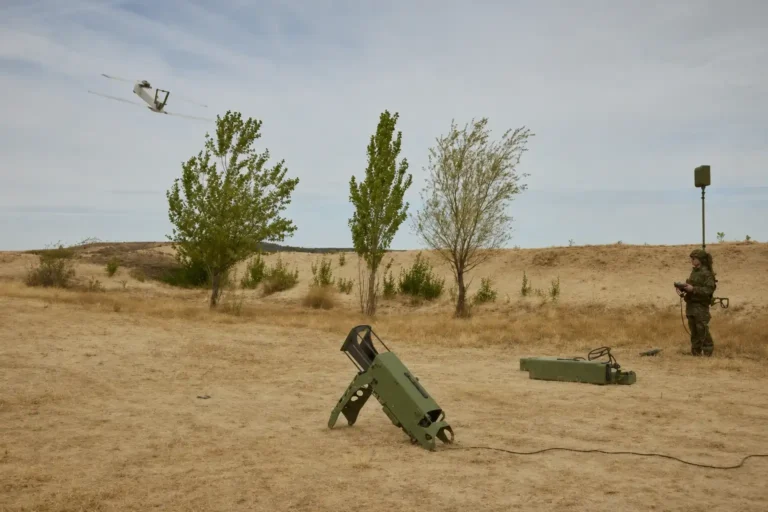
The battalion ran Project MANOWAR over roughly eight months as a series of two-week field experiments at Camp Humphreys and Baegiri Airfield, home of the Republic of Korea Army Drone Academy. Partners included the Army Research Laboratory, the 2nd Infantry Division, industry partners and Republic of Korea Army units.
“Our May experiment established the initial sensing baseline. By September, we had developed a smaller onboard model using recordings collected through our sensors and labels created by our 35T Soldiers,” said Chief Warrant Officer 3 Sidney Beck, the battalion’s senior all-source data scientist. The 35T specialty covers military intelligence systems maintainers and integrators.
According to Beck, operators observed steadier detections in September, and the team demonstrated delivery of sensor reports over the mesh network to a separate local display. The Army did not define its window-level confidence metric or publish false-alarm rates, which makes the 90% figure difficult to compare with commercial acoustic systems.
Analysis: The more consequential result is the development loop rather than the sensor itself. A battalion collected acoustic data in theater, labeled it with organic personnel and developed a smaller onboard model within four months. Ukraine’s Sky Fortress network, which a January 2026 NATO lessons-learned report put at roughly 14,000 sensors, shows how far low-cost acoustic detection can scale. Acoustic nodes only detect and cue, however. Their value depends on integration with the layered air defense architecture MANOWAR was designed to fit, and on the weapons they cue.
The next decision point is whether the Army assigns MANOWAR a program office and funding line. Campbell said a program of record is “critical to achieving the scale necessary for modern conflict” and that the sensor could be exported to other geographic combatant commands. No timeline, production partner or cost target has been disclosed. Eighth Army also framed the bilateral trials as a test of procedural and technical interoperability with Republic of Korea forces, a parallel line of effort for combined early warning.