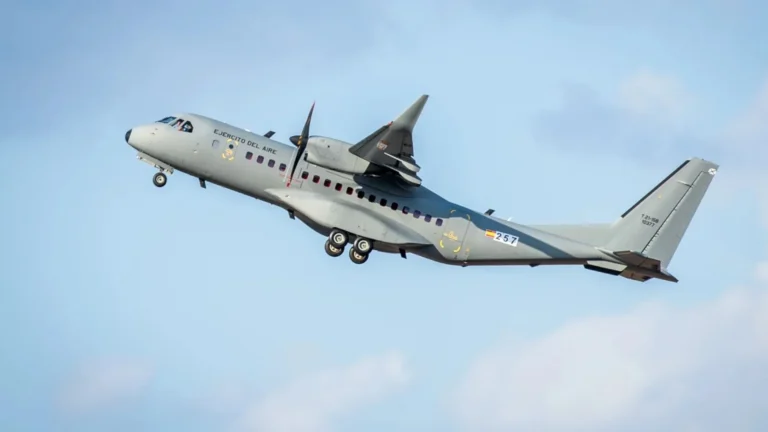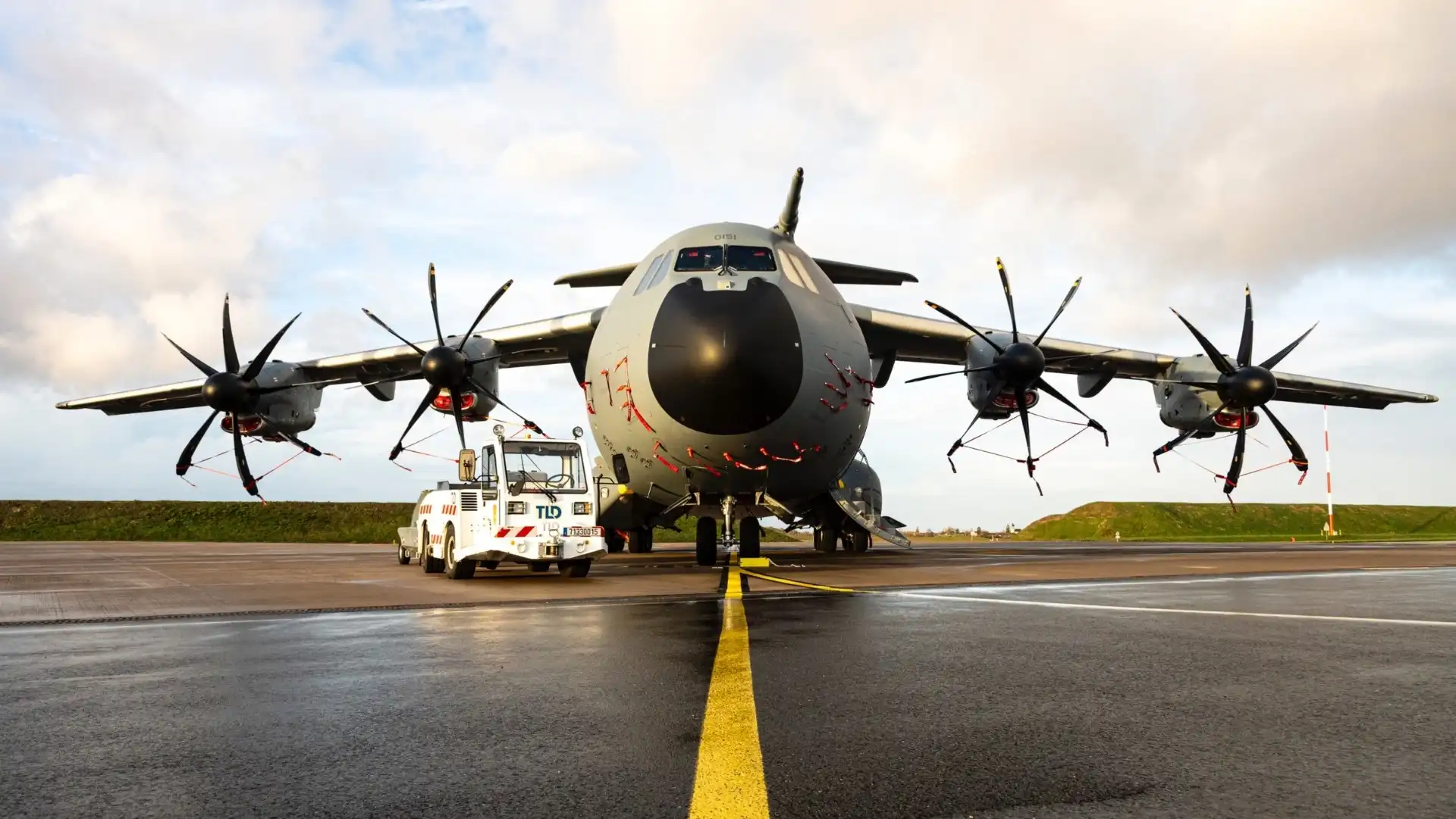
The French Air and Space Force (Armée de l’Air et de l’Espace, AAE) took delivery of its 27th Airbus A400M Atlas on November 18, 2026, at Air Base 123 Orléans-Bricy. The aircraft joins Transport Squadron 4/61 “Béarn” and adds to a tactical and strategic airlift fleet the AAE plans to grow to 34 aircraft by 2027, according to the French Ministry of the Armed Forces.
The delivery comes as Paris rebuilds heavy airlift ambitions it had scaled back. The 2019-2025 Military Programming Law (Loi de programmation militaire, LPM) set a target of 50 A400Ms, which the 2024-2030 LPM cut to 35. The 2026 update to that law raised the objective to 41 aircraft by 2035, as lawmakers cited the strain placed on the fleet by overseas crises, including the 2024 unrest in New Caledonia. France, one of the program’s launch nations, received the first production A400M in August 2013 and declared full operational capability for its fleet in June 2025.
French A400M Fleet Expands at Orléans-Bricy Toward 2027 Goal
Orléans-Bricy is the main operating base of the French A400M force, and the new airframe joins the transport aircraft already in service with ET 4/61 “Béarn.” Reaching 34 aircraft by 2027 implies seven further deliveries in roughly 13 months. That is a markedly faster cadence than the two aircraft programmed for 2026 in the annual finance bill, and the ministry has not published a year-by-year delivery schedule. How Airbus and the Directorate General of Armaments (Direction générale de l’armement, DGA) will close that gap remains an open question.
The A400M has become the backbone of French power projection. The AAE regularly demonstrates its reach through PEGASE long-range deployments, in which the Atlas allows several Rafale fighters and around 100 personnel to deploy thousands of kilometers from mainland France in under 72 hours. PEGASE 2026 opened in September with a leg through the Far North to Alaska. In the Pacific, an A400M deployed to New Caledonia in January 2026 and to French Polynesia from August 1 to 8, 2026, as the AAE works toward a permanent A400M presence in the region by 2030.
Payload, Range, and Low-Level Flight: The Atlas Tactical Envelope
The A400M carries up to 37 metric tons of cargo or more than 100 passengers, per the ministry; publicly available specifications put troop capacity at 116 fully equipped paratroopers. Power comes from four Europrop International TP400-D6 three-shaft turboprops rated at 11,000 shaft horsepower each, which engine maker MTU describes as the most powerful Western turboprop. Open-source data indicates a cruise speed of Mach 0.68 to 0.72, a service ceiling of 40,000 feet, and a range of about 3,300 kilometers at maximum payload, extending to roughly 6,300 kilometers with 20 tons. That places the Atlas between the C-130J, which carries roughly half its payload, and the C-17, rated at about 75 tons.
The ministry stresses the aircraft’s ability to land on short or austere strips close to deployed forces and to airdrop personnel and materiel under oxygen from very high altitude, with paratroopers able to jump from up to 7,500 meters, or about 24,600 feet. French A400Ms also fly automatic terrain-following at very low altitude, including in degraded visibility, per the ministry. Airbus certified the automatic low-level flight function for flight with crew visibility in May 2020, with a second phase covering flight without visibility to follow. The capability improves terrain masking, making the aircraft less detectable in hostile areas.
Modularity extends the airframe beyond airlift. Fitted with medical modules, the A400M performs aeromedical evacuation and disaster relief. The AAE has also adapted it for aerial firefighting with a removable kit able to drop up to 20 tons of retardant in a single pass, work launched in 2024 with Airbus Defence and Space and the French civil protection directorate. The prototype kit made its first real-world drop on a wildfire near Lacanau, in Gironde, on July 25, 2026, although Airbus says it remains in development and certification.
Analysis: The 27th delivery matters less for the airframe than for the trajectory it confirms. By raising its target from 35 to 41 aircraft, Paris has acknowledged that airlift, not combat mass alone, sets the tempo of French power projection, from rapid Rafale deployments to overseas crisis response. Fleet size is only part of the equation, however. A 2026 parliamentary fact-finding mission found that self-protection suites equip only a minority of French A400Ms, a constraint that weighs more heavily than headline numbers if the Atlas is to operate in the contested environments the ministry describes. For NATO, a larger French fleet adds to the Alliance’s tactical airlift capacity.
The next milestones are the remaining deliveries toward 34 aircraft in 2027 and 41 by 2035, the planned permanent Pacific detachment by 2030, and certification of the firefighting kit. Airbus is also working to raise the type’s certified maximum payload to 40 tons. The ministry has not disclosed the configuration standard of the 27th aircraft or whether it arrives with a self-protection suite.