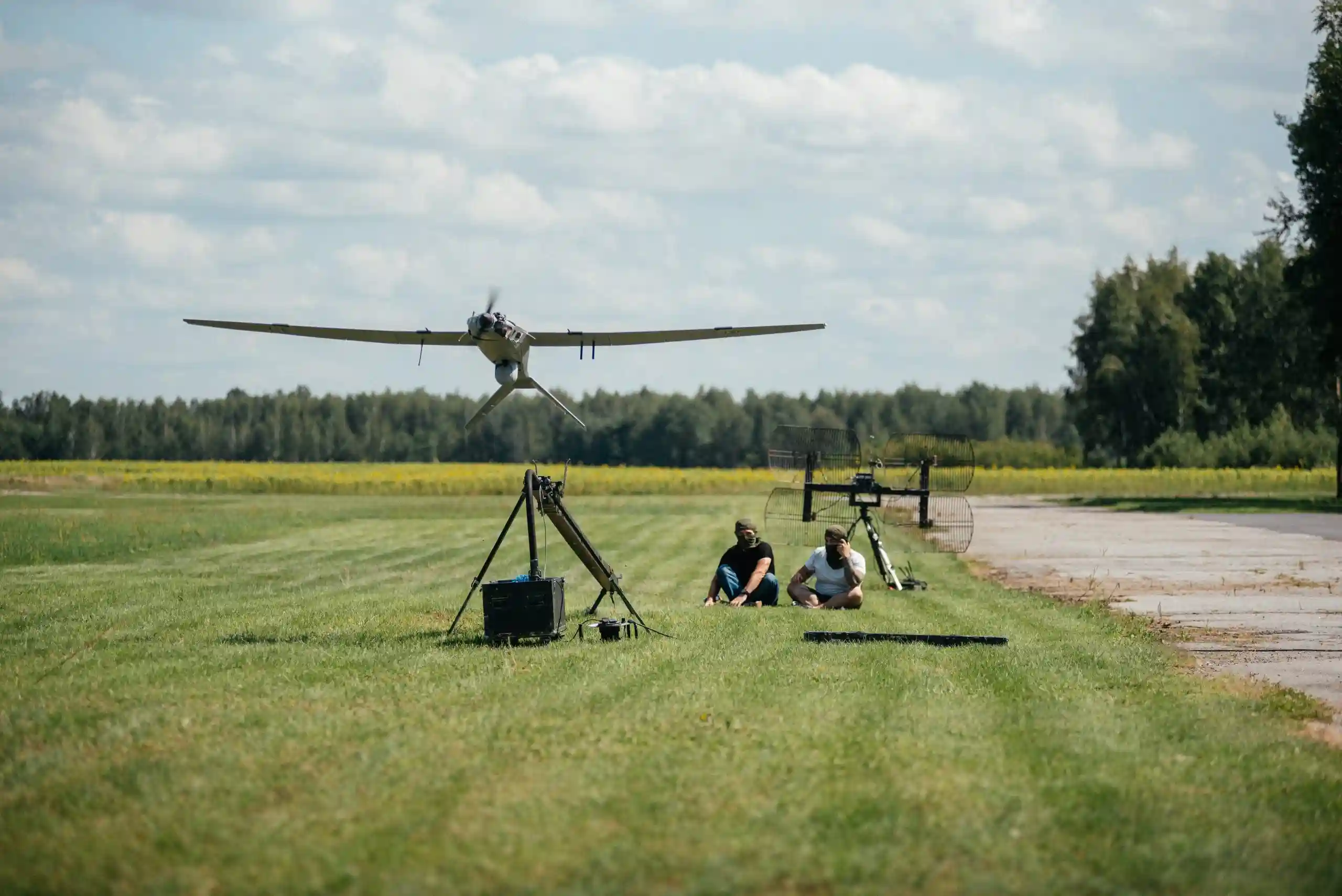
Portuguese drone maker TEKEVER inaugurated its Cahors factory in southwestern France on November 13, 2026, and presented the first AR3 EVO tactical drone for the French armed forces under the SDLRAT program. The first 15 systems for SDLRAT (Système de Drones Légers de Renseignement d’Appui Tactique) are due before the end of 2026. Minister of the Armed Forces and Veterans Catherine Vautrin and Minister Delegate for Industry Sébastien Martin attended the ceremony.
The opening caps an expansion that has moved quickly. TEKEVER announced a €100 million, five-year investment program in France at the Choose France summit in May 2025, selected Cahors two months later, and doubled the plan to €200 million for 2025-2030 at the June 1, 2026 edition of the summit in Versailles, with 200 highly skilled jobs attached. The company says it has filled almost half of those positions in roughly 18 months. For the Direction Générale de l’Armement (DGA), France’s defense procurement agency, the result is a light tactical intelligence drone entering service from a production line on French soil.
Inside the TEKEVER Cahors Factory: AR3 and AR5 Production Lines
The plant sits in Fontanes, about 20 km south of Cahors in the Lot department, next to the Cahors-Lalbenque aerodrome. That location lets TEKEVER move aircraft from final assembly to flight testing without leaving the site. Both AR3 and AR5 airframes are already in production. First shown publicly in February 2026, the plant complements TEKEVER’s French headquarters in Toulouse, opened in 2024.
Cahors will also host a Space Lab, scheduled for 2027. TEKEVER’s space work in France already includes the active synthetic aperture radar (SAR) antenna for DESIR, the sovereign SAR satellite demonstrator led by the French space agency CNES on behalf of the DGA. Regional press has reported 4,500 m² of production space for the site; TEKEVER has not disclosed its annual production capacity.
The Occitanie Region expects the site to employ around 100 people by the end of 2027 and to reach 200 jobs over three to five years. “The investment announced at the latest Choose France summit is becoming a reality, with more than 200 jobs set to be created,” Martin said.
AR3 EVO Specifications and the Seven-Year SDLRAT Contract
The SDLRAT agreement is a seven-year contract with the DGA covering AR3 EVO systems, training and support. The first 15 systems are due before the end of 2026. Neither the contract value nor the total number of systems has been made public. The French configuration integrates national payloads: MERIO supplies the imagery intelligence (IMINT) sensor, and AVANTIX, an Eviden company, provides the signals intelligence (SIGINT) package. Missions span land and maritime reconnaissance.
Unveiled in September 2025, the AR3 EVO is a substantial rework of the original AR3. Manufacturer data list a 4.2 m wingspan, a 1.96 m length and a 25 kg maximum takeoff weight, rising to about 30 kg with the vertical takeoff and landing (VTOL) kit. Payload capacity climbs to 6 kg from 4 kg, endurance reaches up to 22 hours in fixed-wing configuration (14 hours with VTOL) against 16 hours previously, and communications range extends to 230 km from 100 km. The aircraft launches by catapult or VTOL, recovers by parachute or VTOL, and accepts satellite, LTE or line-of-sight datalinks.
A 230 km link and nearly a full day aloft give a catapult-launched, 25 kg aircraft a reach and persistence once reserved for larger, runway-dependent systems. TEKEVER also fitted the EVO with a precision landing system that does not depend on GNSS, a design choice shaped by the jamming environment over Ukraine.
Analysis: SDLRAT shows how Paris now defines sovereignty in practice. The prime contractor is Portuguese, but the aircraft are built in France and the mission payloads are French. That model gave the DGA a mature, combat-informed airframe without funding a new development program. For TEKEVER, a French contract alongside the British Army’s CORVUS program, worth up to £400 million for the AR5, makes it an ISR drone supplier to two of Europe’s leading military powers.
The immediate test is delivery: 15 systems by December 31, 2026. The receiving units have not been named. The next markers are the Space Lab’s 2027 start-up and the site’s progress toward 100 employees by the end of that year.