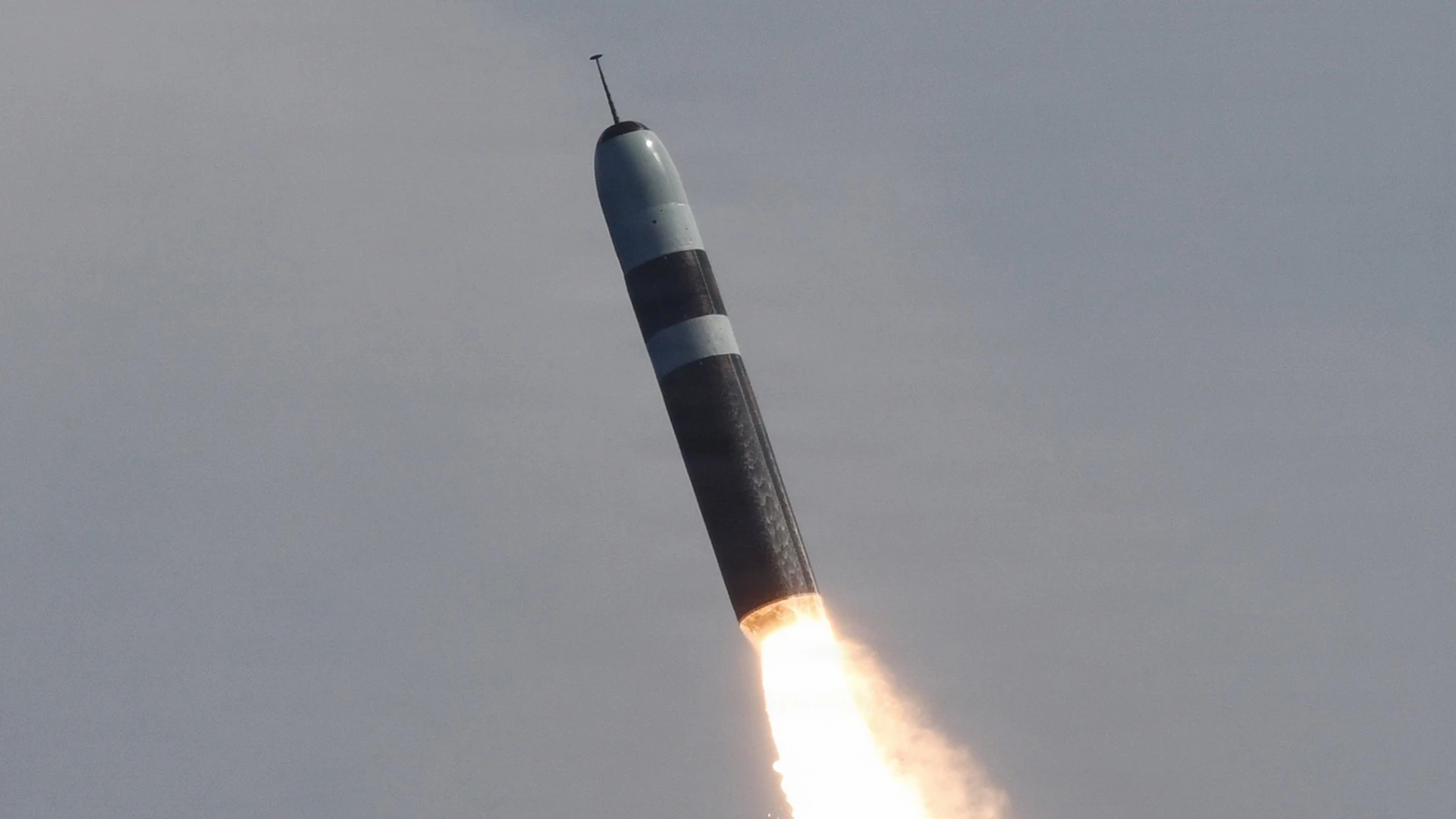
The U.S. Navy awarded Lockheed Martin an un-priced letter contract modification worth up to $1,533,124,563 on November 20, 2026, for Trident II (D5) submarine-launched ballistic missile (SLBM) production and deployed systems support. Issued by Strategic Systems Programs (SSP) in Washington, D.C., the not-to-exceed action modifies contract N0003026C0100 and runs through September 30, 2031. Lockheed Martin’s Fleet Ballistic Missile business in Titusville, Florida, received the award on a sole-source basis under 10 U.S. Code 3204(a)(1), according to the Department of War contract announcement. The three-stage, solid-propellant missile arms the Navy’s Ohio-class submarines and will form the initial loadout of the Columbia class.
The modification lands as the Navy sustains the Trident II force through a long transition from the 14 Ohio-class ballistic missile submarines (SSBNs) to the 12-boat Columbia class, while funding a second life extension of the missile. SSP opened the base contract in July 2026 with a $15.9 million action for long-lead materials and production planning, carrying the same 2031 completion date. Its predecessor, N0003025C0100, supported the fiscal 2026 production schedule and was valued at up to roughly $1.42 billion, which suggests the new vehicle plays the same role for the next annual buy. The announcement does not specify missile quantities, the split between production and support, or the final contract type.
Trident II D5 Production Work Spread Across 17 Named Sites
The work-share breakdown maps the industrial base behind the missile. Magna, Utah, takes the largest portion at 16%. Northrop Grumman casts and assembles the solid rocket motors for all three stages of the D5 at its Bacchus campus there. Cape Canaveral, Florida, and Denver, Colorado, each account for 14%. Cape Canaveral hosts the Naval Ordnance Test Unit, which supports Trident II flight testing, while Denver anchors Lockheed Martin Space engineering. Titusville represents 11%.
Deployed systems support shows up in the 8% assigned to Kings Bay, Georgia, and the 6% assigned to Bangor, Washington, home to the two Strategic Weapons Facilities that assemble, load, and maintain missiles for the Atlantic and Pacific SSBN squadrons. Culpeper, Virginia, receives 7%, Sunnyvale, California, 4%, Valley Forge, Pennsylvania, 3%, and Huntsville, Alabama, 2%. Seven further named locations, including Elkton, Maryland, Biddeford, Maine, and Joplin, Missouri, sit at 1% each, while sites below 1% total 8%.
That distribution matters for schedule risk. A solid-propellant strategic missile depends on a narrow supplier set for motors, propellant ingredients, guidance electronics, and reentry system interfaces, and many sub-tier vendors have no commercial market to fall back on. The 16% share in Utah underscores how closely Trident output tracks the health of the large solid rocket motor sector, which also supports the Air Force’s Sentinel intercontinental ballistic missile (ICBM) and hypersonic programs.
Trident II D5LE Specifications and the Bridge to D5LE2
Publicly available specifications describe the Trident II D5 as a three-stage, solid-propellant SLBM about 44 feet (13.4 meters) long and 83 inches (2.1 meters) in diameter, with a launch weight near 130,000 pounds. The Navy lists its range at 4,000 nautical miles. Its astro-inertial guidance pairs an inertial measurement unit with a stellar sighting in flight, letting the missile correct for errors in the submarine’s own position at launch. The missile carries Mk4A reentry bodies with the W76-1 or low-yield W76-2 warhead, or Mk5 reentry bodies with the W88, in multiple independently targetable reentry vehicle (MIRV) configurations.
The deployed variant is the D5 Life Extension (D5LE), introduced to the fleet in 2017 after SSP replaced aging guidance and flight control electronics. SSP states that D5LE will remain effective into the 2040s, covering the Ohio class through retirement and arming the first Columbia-class boats, each of which will carry 16 missiles.
The D5LE2 follow-on responds to aging and obsolescence that SSP says can no longer be practically mitigated without a broader modernization effort. Lockheed Martin received a $383 million design contract in January 2025 and an $850 million modification announced in April 2026, with further advanced design awards since. The Navy targets D5LE2 fleet introduction in fiscal 2039 and service through 2084, paired with the new W93/Mk7 warhead. Production contracts such as this one keep the current missile line and its suppliers active until that handover.
Analysis: An award close to the value of the prior production vehicle signals that the Navy is not treating D5LE as a sunset program while D5LE2 matures. Both efforts now draw on the same engineering workforce in Denver and Titusville and the same motor base in Utah, while Lockheed Martin builds a new Titusville production facility expected to open in 2027. The un-priced letter format also points to schedule pressure: SSP is committing funds before final terms are negotiated to protect production continuity. With Sentinel and the Columbia lead boat both running behind their original schedules, the existing Trident II inventory carries a larger share of the deterrence burden than planners intended.
The next milestone is definitization, when SSP and Lockheed Martin will settle final price and contract type. Defense acquisition rules set that deadline at the earlier of 180 days after the contractor submits a qualifying proposal or the point at which more than half of the not-to-exceed amount is obligated. Unlike the fiscal 2026 production award, the announcement makes no reference to a Foreign Military Sale to the United Kingdom, whose Vanguard-class and future Dreadnought-class submarines draw on the same Trident II missile pool. Further D5LE2 design awards and delivery of the first Columbia-class boat remain the indicators to watch.