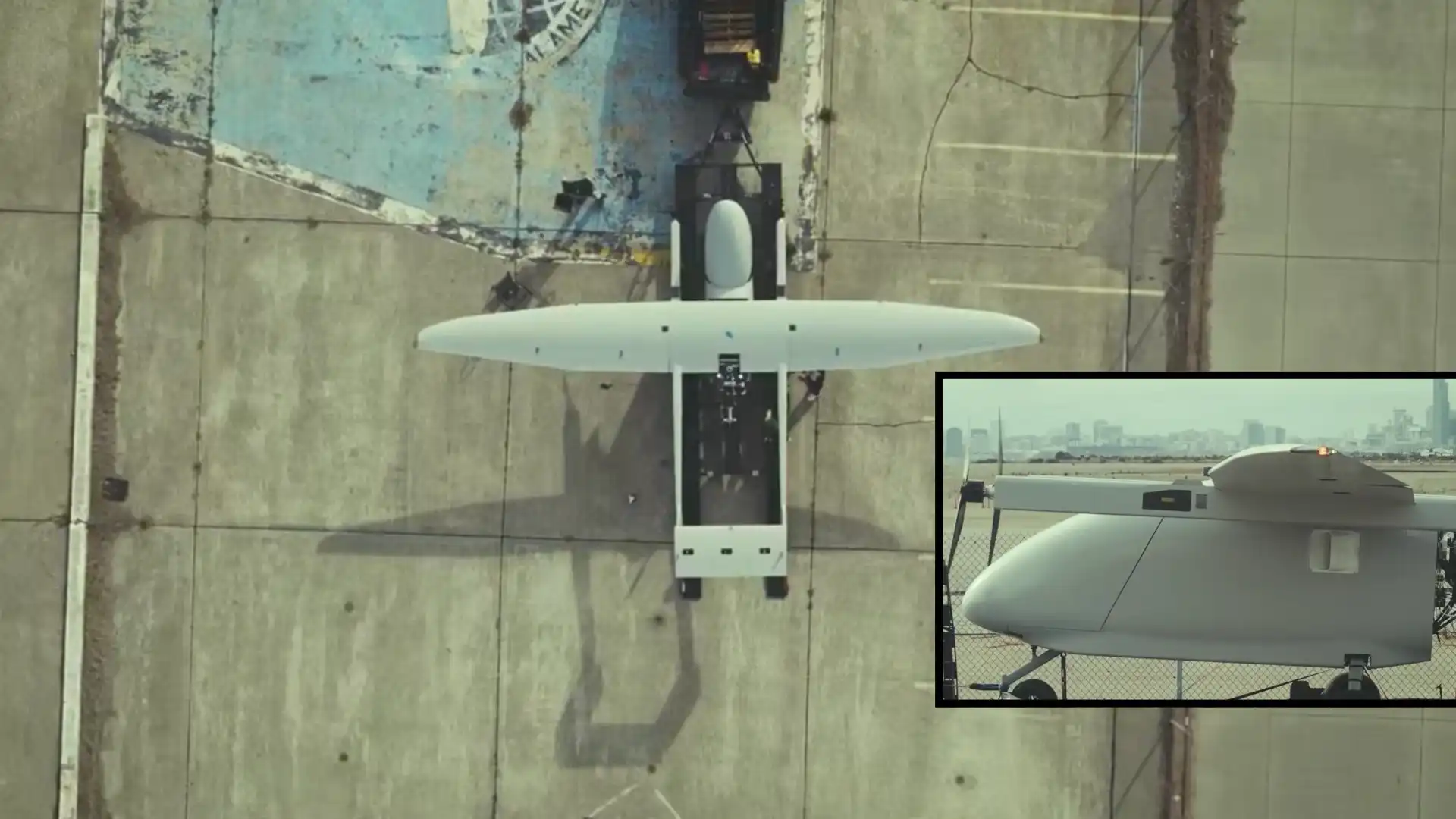
A second Pyka DropShip autonomous cargo aircraft has rolled off the line in Alameda, California, and completed ground testing, Pyka said this week. The company added that the hybrid-electric drone is “charging toward serial production.” Flight testing comes next, followed by a series of demonstrations intended to validate new capabilities in real-world conditions.
The second airframe arrives seven months after the first DropShip made its maiden flight on April 27, 2026, roughly six months after Pyka unveiled the program in October 2025. Until now, every program milestone, from precision airdrop trials to U.S. Army exercise participation, has rested on a single aircraft. A second airframe enables parallel test campaigns and offers the first concrete sign that Pyka can repeat the design on its production line.
Pyka DropShip Specifications: Payload, Range, and Hybrid Propulsion
DropShip is an uncrewed aircraft with a maximum takeoff weight of 635 kg (1,400 lb). Pyka rates it for up to 249 kg (550 lb) of cargo and a ferry range exceeding 5,633 km (3,500 miles), placing it between small delivery drones and crewed tactical airlift. Its hybrid powerplant pairs an internal combustion engine for range and endurance with an all-electric mode that company figures put at roughly 45 minutes, giving operators a quieter, lower-signature option for the final leg into a threatened area.
The aircraft uses a modular, open payload architecture designed to accept cargo, sensors, or mission kits with minimal reconfiguration. Pyka says DropShip fits in a standard 20-foot shipping container and can be made flight-ready by a single operator in under an hour, a footprint suited to expeditionary units without dedicated aviation support. Its autonomy software and electric propulsion derive from Pelican 2, Pyka’s autonomous crop-spraying aircraft, which the company describes as the largest uncrewed aircraft approved by the Federal Aviation Administration (FAA) for commercial use.
From Precision Airdrop Trials to Project Convergence Capstone 6
Pyka has moved DropShip quickly into field-representative events. On June 11, 2026, the company reported that the aircraft autonomously dropped multiple 91 kg (200 lb) loads by parachute from 91 m (300 ft), each landing within 15 m (50 ft) of its target, tighter than the 150-foot accuracy Pyka advertised at launch. During a U.S. Army Reserve Combat Support Training Exercise in Mississippi, DropShip then flew a 32 km (20-mile) uncrewed resupply mission from Gulfport to Diamondhead before executing a precision 91 kg airdrop.
The aircraft later flew continuously throughout the Army’s Project Convergence Capstone 6, carrying field rations, medical equipment, and other supplies to remote and forward locations, according to Pyka. On the Air Force side, Pyka holds an AFWERX Direct-to-Phase II Small Business Innovation Research (SBIR) award connected to DropShip. Pyka CEO Michael Norcia has argued that until now there “hasn’t been a safe, economical, or practical way to autonomously deliver critical supplies” to distant troops.
Analysis: DropShip targets the contested logistics problem that U.S. planners now treat as a baseline assumption, where fixed supply routes and crewed rotary-wing resupply face persistent drone, artillery, and air defense threats. The decisive variable is no longer whether a 550-lb autonomous lifter can fly, which Pyka has demonstrated, but whether the company can deliver airframes at a rate and unit cost low enough to make them attritable. A second aircraft is a modest step on that path. Pyka has not disclosed a production rate, unit price, or firm military order, and DropShip is not a program of record.
The immediate milestone is the second aircraft’s first flight, followed by a demonstration slate for which Pyka has named no dates, venues, or customers. The key unknowns remain the planned production cadence at Alameda, the cost per airframe, and whether Army and Air Force evaluations translate into a procurement contract.