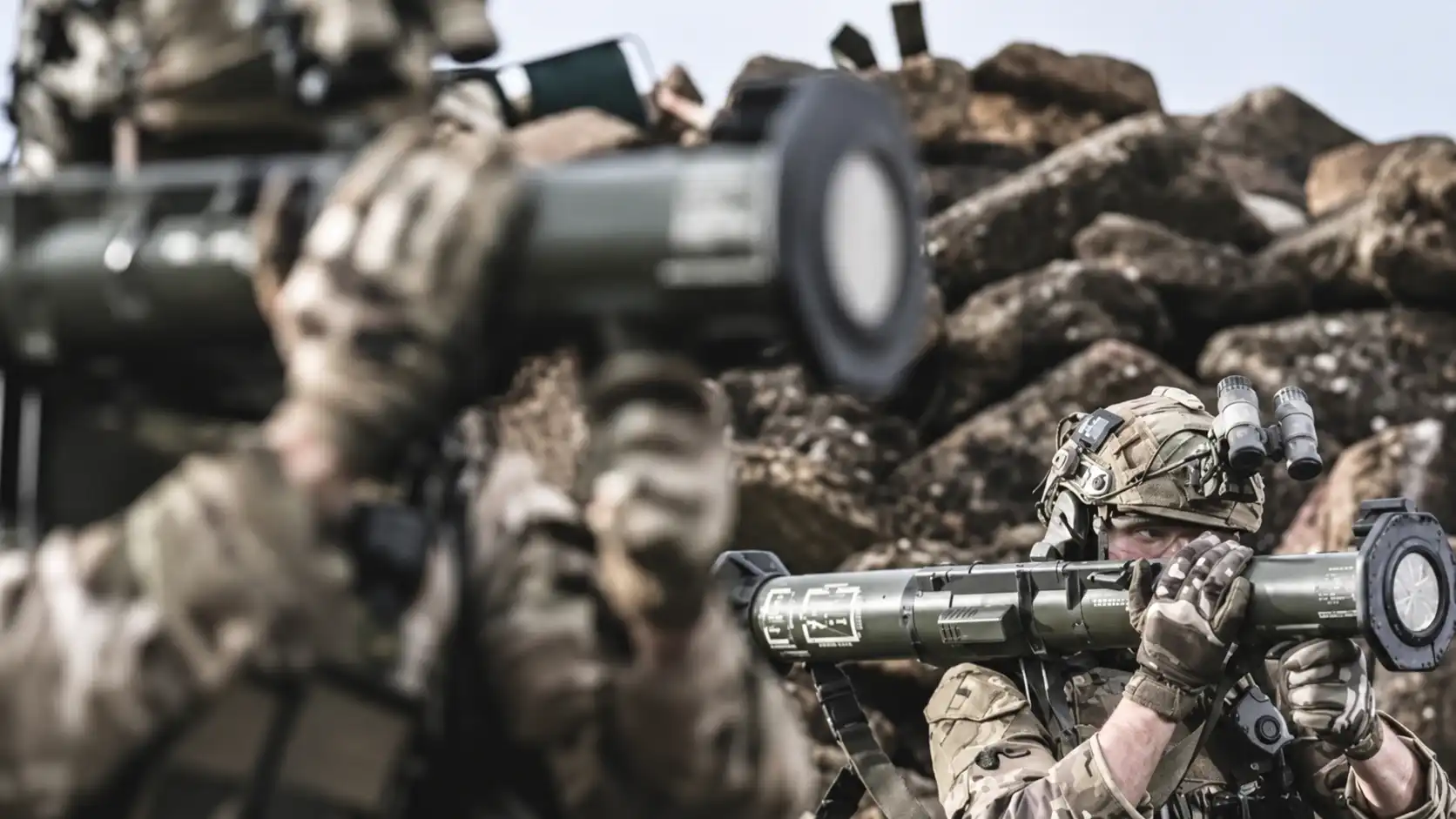
The U.S. Army has placed a $60.3 million order with Saab, Inc. for the XM919 Individual Assault Munition (IAM), Saab announced on November 16, 2026. The disposable shoulder-fired weapon is Saab’s AT4CS TW (Confined Space Tandem Warhead), and deliveries under the order are scheduled for 2029 and 2030.
The order falls under the five-year indefinite delivery, indefinite quantity (IDIQ) contract the Army awarded Saab in August 2024, which carries a ceiling of $494.35 million according to the Pentagon contract announcement. The IAM program, managed by Project Manager Close Combat Systems (PM CCS) within the Joint Program Executive Office Armaments and Ammunition, is the Army’s effort to consolidate its squad-level shoulder-launched munitions into a single multi-target weapon. The Pentagon reported three bids received; Nammo and General Dynamics Ordnance and Tactical Systems were reportedly the other two bidders. Neither the Army nor Saab has disclosed the number of rounds covered by the new order or a unit price.
XM919 Individual Assault Munition Requirements and AT4CS TW Design
The Army’s IAM requirement called for a single-use, recoilless weapon weighing no more than 20 pounds and measuring no more than 40 inches, with fire from enclosure (FFE) capability. The official program fact sheet listed the target set as light armor, earth and timber bunkers, double reinforced concrete, and triple brick walls, with engagement ranges cited out to 500 meters.
Saab’s answer is built on the AT4CS line, which uses the 84mm caliber common to the AT4 family. Publicly available descriptions of the confined space variants indicate a countermass launch principle that ejects an inert mass rearward to absorb backblast, allowing soldiers to fire from inside rooms and other enclosed positions without harming themselves or nearby troops. According to a Saab fact sheet, the AT4CS TW weighs approximately 9 kg, or about 19.8 pounds, just inside the 20-pound ceiling, and has an effective range of 200 meters.
Saab describes the TW as similar to its AT4CS AST (Anti-Structure Tandem) but lighter and developed specifically for U.S. Army requirements. Publicly available specifications for the AST list a length of 980 mm, a weight of 9.3 kg, a 200-meter effective range, and a tandem warhead capable of defeating a 20 cm double reinforced concrete wall, with a selectable delay mode. In a tandem configuration, a precursor charge opens the wall or armor and a follow-through charge delivers effects behind it. Saab states the TW is effective against brick and concrete buildings and light armored vehicles while limiting collateral damage. Penetration figures and the exact length of the TW have not been published. The 200-meter effective range listed by Saab also sits well inside the 500-meter figure cited in the requirement, and neither party has publicly detailed XM919 performance across that envelope.
Replacing Four Legacy Launchers in the Army Squad Inventory
The XM919 is intended to replace four weapons now carried at squad level: the 66mm M72 Light Anti-Armor Weapon (LAW), first fielded in the early 1960s; the M136 AT4 and the M136A1 confined space variant; and the 83mm M141 Bunker Defeat Munition, a single-shot derivative of the Marine Corps’ Shoulder-Launched Multipurpose Assault Weapon (SMAW). Saab says the XM919 combines multiple capabilities in one disposable tube, reducing the need to carry and support separate weapon systems.
“Soldiers operate in unpredictable conditions, so their equipment needs to give them options,” said Erik Smith, president and CEO of Saab, Inc. “This order puts more XM919 IAMs in their hands, giving them the flexibility to respond as the mission changes.”
The selection preserves continuity with a weapon family that has been in U.S. service since 1985. Saab has delivered more than 700,000 AT4 systems to the United States and has produced more than one million for 15 countries. That commonality carries over the AT4 manual of arms into the new munition, and the IAM system also includes training devices such as the XM922 subcaliber trainer. Saab, Inc. is headquartered in Syracuse, New York.
Analysis: At roughly 12 percent of the IDIQ ceiling, the $60.3 million order is a measured production buy rather than a surge. Its more telling feature is the delivery window. Rounds ordered in November 2026 are not scheduled for delivery until 2029 and 2030, a lead time of three to four years. Saab plans to produce the XM919 at its new plant in Grayling, Michigan, which it expects to fully open in early 2027. Until XM919s arrive in numbers, legacy M72, M136, and M141 stocks will keep covering the squad assault and anti-structure role the new munition was designed for in urban and complex terrain. Consolidating four munitions into one should simplify training and logistics once fielded, but the pace of production, not the requirement, now sets the timeline for that benefit.
Key unknowns remain the quantities purchased, the per-unit cost, and whether earlier production orders preceded this one under the 2024 contract. When the IDIQ was awarded, the Pentagon listed an estimated completion date of August 2029, before the end of this order’s 2029-2030 delivery window, and neither the Army nor Saab has said whether that date has been extended. Follow-on buys, a published fielding schedule, and any adoption by the Marine Corps or foreign military sales customers are the next indicators to watch.