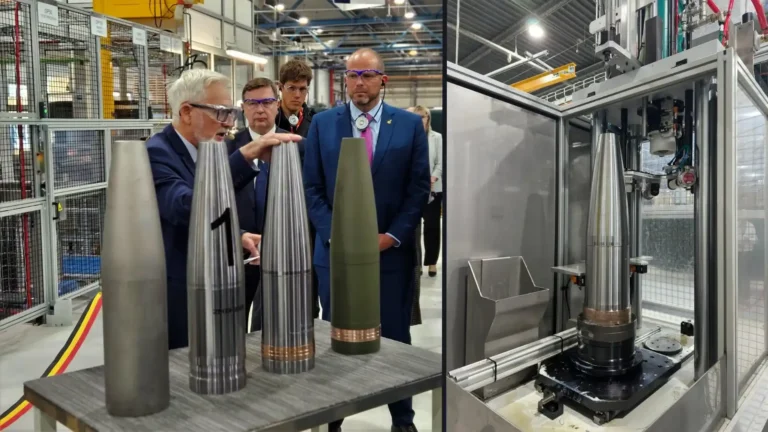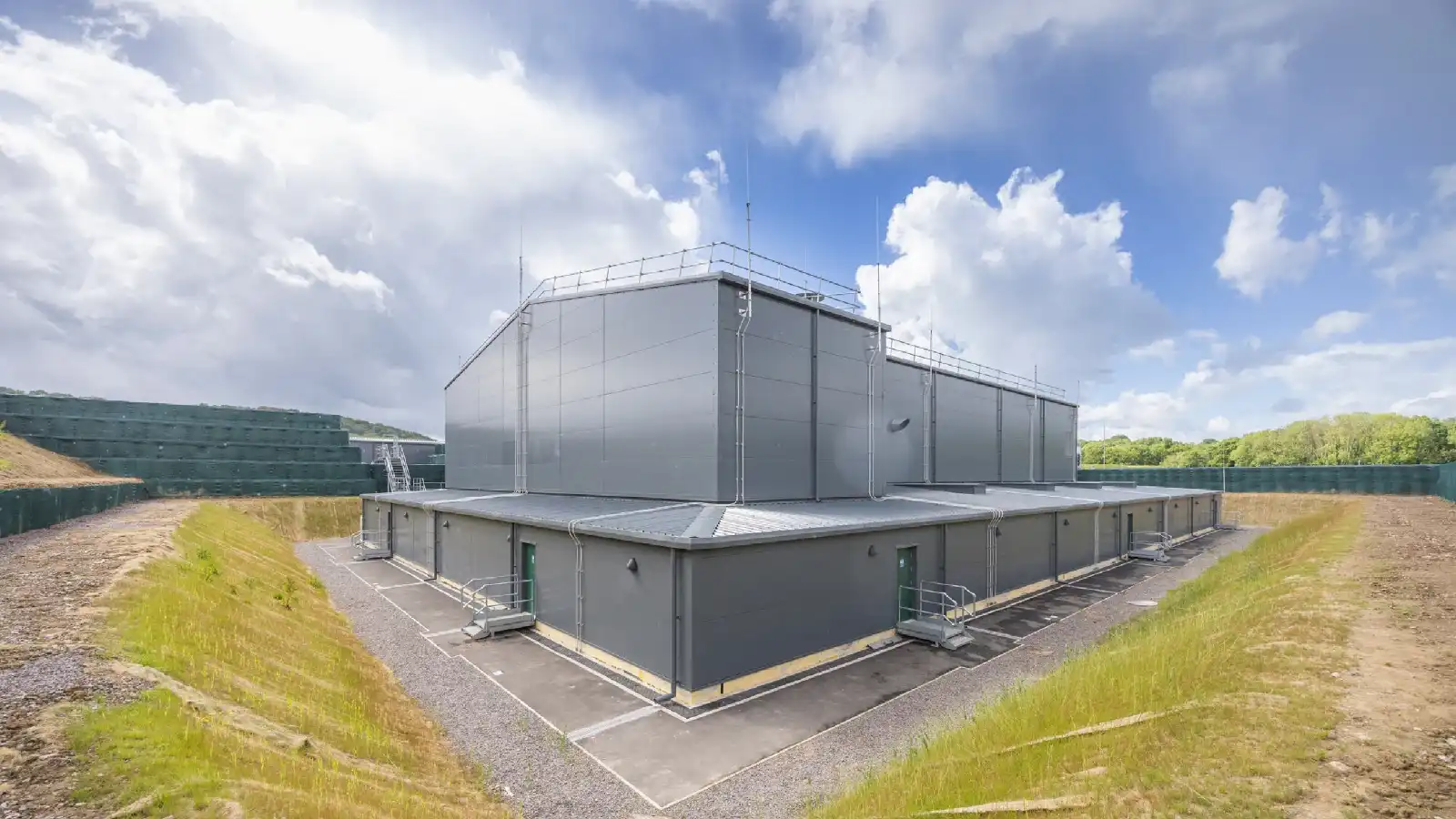
BAE Systems officially opened a fully automated melt-cast explosive filling facility at its Glascoed site in South Wales on November 20, 2026, the UK’s first fully automated large-calibre ammunition factory. The plant is part of a £180 million investment that the company says will enable a sixteen-fold increase in its production capacity for 155mm artillery shells.
The opening completes a ramp-up that began after Russia’s full-scale invasion of Ukraine exposed the thinness of the UK’s artillery ammunition base. In July 2023, the Ministry of Defence (MoD) expanded its orders under the 15-year, £2.4 billion Next Generation Munitions Solution (NGMS) partnering agreement in a package BAE valued at £280 million, later raised to £410 million. That package funded an additional 155mm machining line at Washington, Tyne and Wear, and a new explosive filling facility at Glascoed, then framed as an eight-fold capacity increase. BAE doubled the target to sixteen-fold in April 2025, when it said Glascoed would become operational that summer. The facility has therefore arrived more than a year behind that schedule.
How the Glascoed Munitions Facility Automates 155mm Shell Filling
Melt-cast filling is the standard method for loading high explosive into artillery projectiles. The explosive composition is heated until molten, cast into the empty shell body, then cooled under controlled conditions before the round moves to final assembly. Cooling is the critical step: voids or cracks in the solidified fill can trigger premature detonation under the setback forces of firing, which is why melt-cast lines are tightly regulated and have traditionally depended on large, specialised workforces.
At Glascoed, BAE says the process is run by advanced robotic systems and autonomous guided vehicles (AGVs). The company states that the approach requires limited human resources, allowing greatly expanded production hours and output. Automation targets the two constraints that have capped Western shell production since 2022: the size of the qualified energetics workforce and the number of personnel who can safely occupy an explosive-handling building at any one time. Fewer operators in the filling hall means lower hazard exposure and extended shifts without a proportional rise in headcount.
“By combining our extensive experience with advanced automation, we’re creating a facility that delivers significantly greater capacity, improves resilience of supply and supports the UK’s defence needs long into the future,” said Andrea Thompson, Group Managing Director of BAE Systems Digital Intelligence & Land.
BAE has not disclosed the explosive fill, the line’s cycle time, or the absolute annual output the plant is designed to reach. Publicly available information on melt-cast practice indicates that 155mm high-explosive rounds are typically filled with TNT-based compositions, including RDX/TNT mixtures, or with insensitive melt-cast formulations. The baseline behind the sixteen-fold figure is also absent from the announcement, leaving the real volume gain unverifiable from open sources.
Shell Bodies, RDX Supply, and the UK Energetics Gap
Filling capacity is only one link in the 155mm chain. Shell bodies are forged and machined at BAE’s Washington plant, the main UK source of large-calibre bodies, and Glascoed’s throughput will be bounded by what Washington can deliver. BAE has not said how body production will scale to match the new filling line.
The deeper constraint is energetics. BAE has relied on the United States and France for RDX, the primary high explosive in 155mm fills. In April 2025, the company said it had invested £8.5 million over five years in continuous flow processing to synthesise explosives and in a propellant formulation free of nitrocellulose and nitroglycerine, with initial industrial capacity expected by the end of 2026. Continuous flow keeps less explosive in process at any one time, shrinking safety distances and plant footprint.
The government is targeting the same gap through policy. The June 2025 Strategic Defence Review (SDR) committed £1.5 billion to an “always on” munitions pipeline and at least six new munitions and energetics factories, lifting planned UK munitions spending to £6 billion over the current Parliament. The MoD has since invited industry proposals for domestic production of energetic materials including RDX, HMX, TNT, nitrocellulose, nitroglycerine, and nitroguanidine.
Analysis: British Army consumption alone does not explain a sixteen-fold increase. The Army operates 14 Archer self-propelled howitzers as an interim replacement for the AS90s transferred to Ukraine, and its 72 Boxer-mounted RCH 155 systems, contracted through OCCAR in April 2026 under a deal worth nearly £1 billion, are not due for first deliveries until 2028. Glascoed’s value lies in stockpile regeneration to SDR warfighting readiness levels, continued supply to Ukraine, and exports to NATO allies competing for the same rounds. Automation gives the UK a surge-capable line that can scale without first rebuilding a large energetics workforce. Until domestic RDX production and additional body capacity come online, however, the plant converts imported explosive into finished shells rather than closing the sovereign supply loop.
The next milestones are the completion of live trials and the start of production at scale, for which BAE has given no date. Two further indicators will show whether the sixteen-fold figure becomes deliverable rounds: confirmation that BAE’s continuous flow explosive capacity has met its end-2026 target, and new MoD orders under NGMS sized to the expanded line.