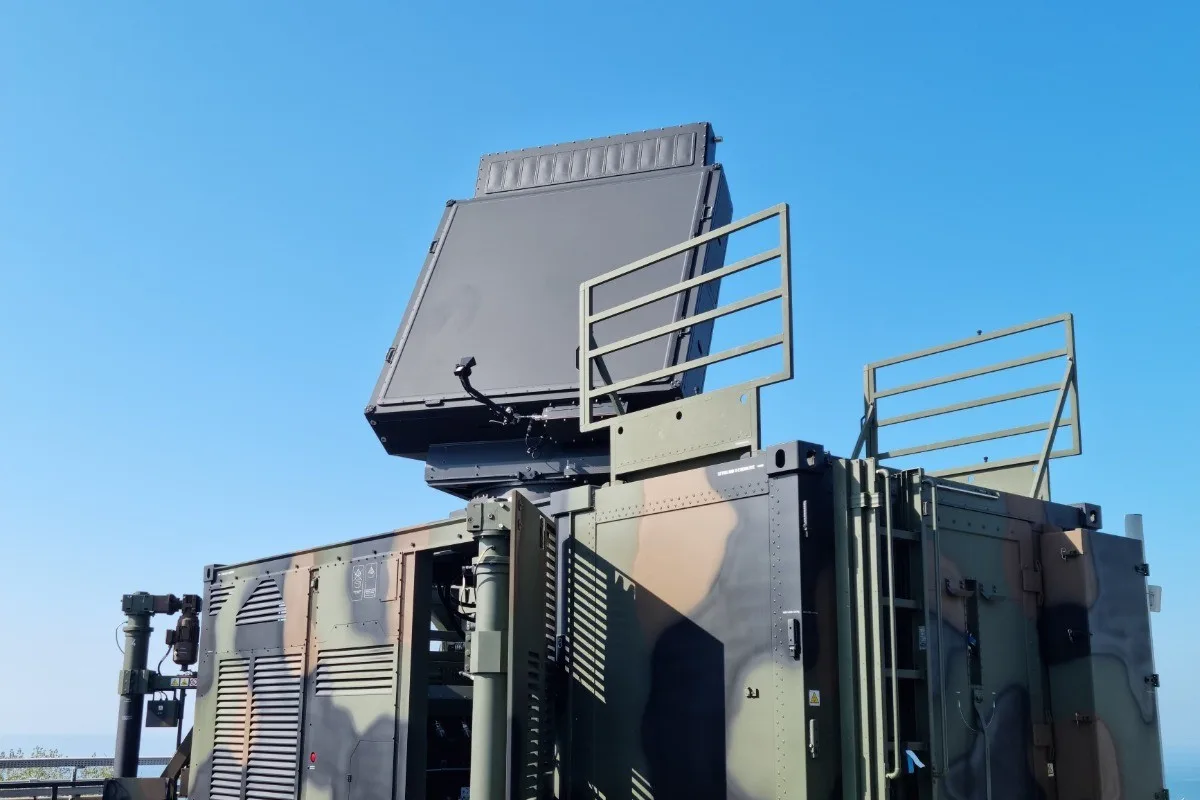
Leonardo’s eighth Kronos Grand Mobile High Power (KGMHP) radar built for Italy’s SAMP/T NG air and missile defense system has completed its Factory Acceptance Tests (FAT), the Organisation for Joint Armament Co-operation (OCCAR) announced on November 23, 2026. The tests took place at Leonardo’s Arco Felice site near Bacoli, outside Naples, in the presence of representatives from OCCAR’s FSAF-PAAMS Programme Division and Eurosam, the Franco-Italian prime contractor formed by MBDA and Thales.
The milestone comes as Italy shifts from qualification to fielding. The Italian Army received its first SAMP/T NG equipment on January 22, 2026, at the Santa Barbara barracks in Sabaudia, home of its Air Defense Artillery Command, and Rome has at least nine systems under contract: four for the Army and five for the Italian Air Force. According to OCCAR, the latest campaign demonstrated both the maturity of the radar and the consolidation of its production line, which underpins deliveries to both services. OCCAR dated the tests only to autumn 2026.
Inside the Kronos Radar: GaN AESA Built for Missile Defense
The KGMHP is the latest iteration of Leonardo’s Kronos Grand Mobile family: a C-band multifunction radar built around a fully active electronically scanned array (AESA) antenna. Its transmit/receive modules use high-efficiency gallium nitride (GaN) components, giving the sensor an instrumented defense range of at least 250 km. Publicly available specifications indicate a surveillance range beyond 300 km, while the Italian Ministry of Defence cites threat detection beyond 350 km.
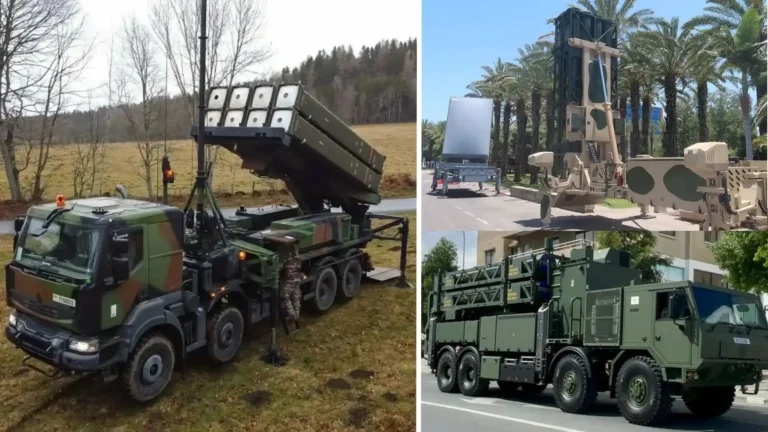
The antenna steers its beam electronically in both azimuth and elevation, allowing one sensor to handle detection, tracking, threat classification and missile guidance against multiple targets simultaneously. In a SAMP/T NG battery, the KGMHP is the fire-control sensor feeding the engagement module and up to six launchers carrying eight Aster missiles each, for 48 ready-to-fire rounds. The radar integrates identification friend or foe (IFF) modes 1, 2, 3/A, C, S, 4 and 5, including the NATO-standard Mode 5.
Mobility drives the design. The radar is housed in a standard 20-ft ISO container transportable by road, rail, air and sea, with an optional redundant power generator and a three-operator C3 shelter in the same format. Earlier FAT campaigns on the line assessed range coverage, IFF modes, electronic counter-countermeasure (ECCM) resilience, and the dual air-breathing and tactical ballistic missile mode. OCCAR’s latest release did not itemize the eighth unit’s test matrix.
From First to Eighth Unit: Italian SAMP/T NG Production Pace
OCCAR awarded the radar production contract to Eurosam in December 2021, nine months after France and Italy launched SAMP/T NG development in March 2021. The first unit completed its FAT in July 2023 with no waivers recorded, a second followed a test readiness review held on January 23, 2024, and a third cleared testing on October 29 and 30, 2024. An eighth accepted unit by autumn 2026 suggests the line has moved from initial qualification into steady serial output.
The radar is the main difference between the two national variants. Italy’s configuration uses the KGMHP, while France’s uses the Thales Ground Fire 300; both share the battery architecture and the new Aster 30 Block 1 New Technology (B1NT) interceptor. The B1NT offers a range of more than 150 km and enhanced capability against ballistic threats. On December 3, 2025, during an Italian SAMP/T NG qualification firing, the Kronos radar guided an Aster to an intercept at a range Leonardo said the SAMP/T system had never before reached in land trials.
Leonardo also presents the KGMHP as a building block of its Michelangelo Security Dome architecture. The Italian Army plans to field six SAMP/T NG batteries alongside nine GRIFO short-range systems, forming the upper tier of its layered ground-based air defense.
Analysis: The eighth acceptance matters less as a single event than as evidence of production rate. Italy has anchored its upper tier on a national radar. That gives Rome sovereign control over a critical node, but it also means Europe now sustains two separate SAMP/T NG radar lines. The first export customer, Denmark, selected SAMP/T NG in September 2025 and signed a contract on April 21, 2026, for the French configuration built around the Thales Ground Fire 300. Leonardo’s ability to hold a steady acceptance cadence will shape whether the Italian configuration becomes a credible export option or remains a national solution.
Next steps include integrating the newly accepted radar into a complete SAMP/T NG section and handing it to either the Italian Army or the Italian Air Force; OCCAR did not specify which. Open questions remain on the total number of KGMHP units on order, the delivery timeline for the Air Force’s five systems, and whether further Italian orders will follow to reach the Army’s six-battery objective. France received its first SAMP/T NG section at the Mont-de-Marsan Air Warfare Centre on February 20, 2026, for operational evaluation.