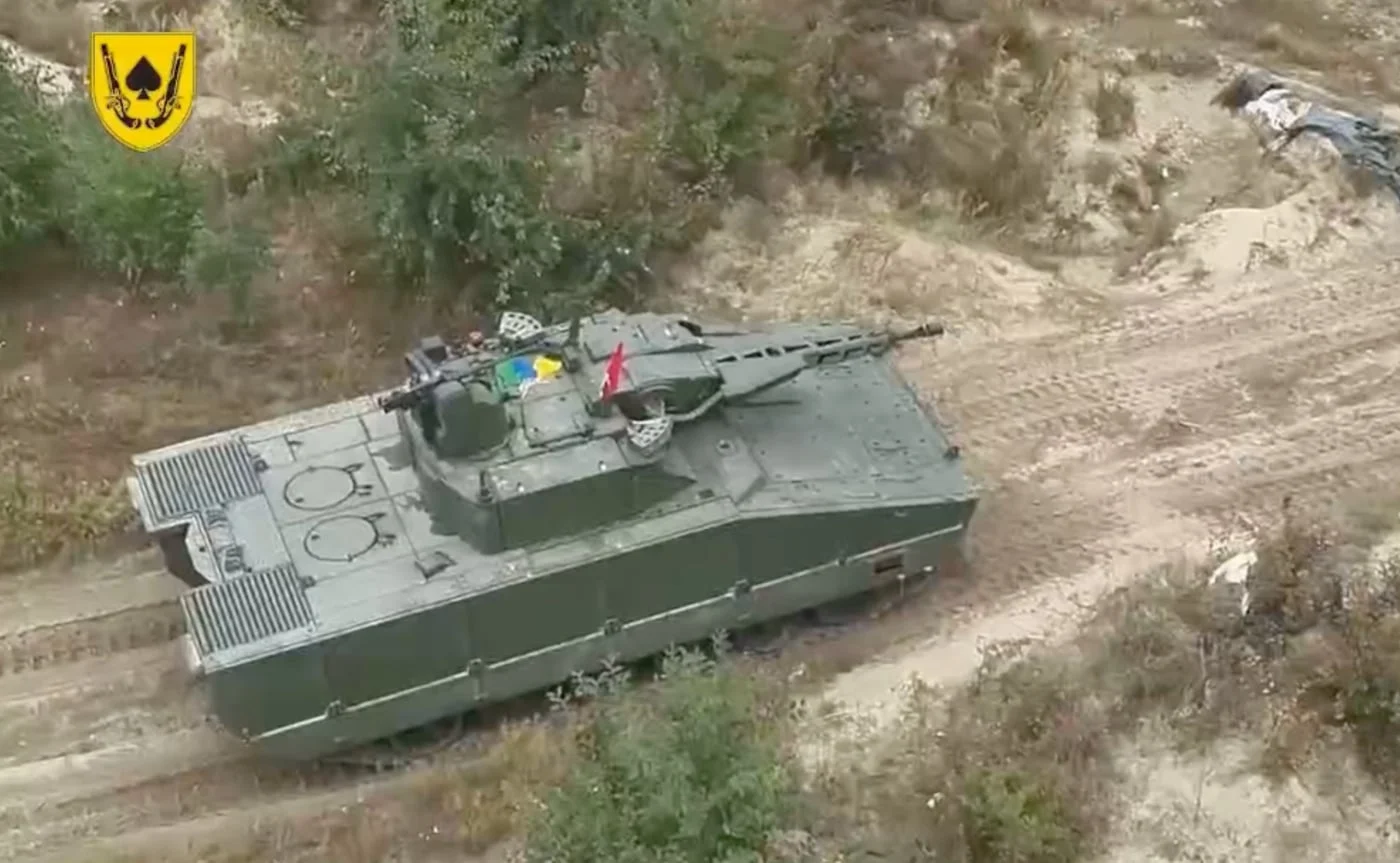
Ukraine’s 21st Separate Mechanized Brigade has begun operating Rheinmetall Lynx KF41 infantry fighting vehicles (IFVs) handed over by the German government, the brigade announced on social media. The Lynx KF41 is a tracked vehicle of about 44 tonnes, armed through a two-person Lance turret and able to carry up to eight dismounts. Crews from one of the brigade’s mechanized units trained in Germany before taking delivery. The post, co-published with the Ukrainian Ground Forces’ 18th Army Corps, did not disclose how many vehicles the brigade received or when they arrived.
The announcement confirms that the Lynx has moved from evaluation into brigade service in Ukraine. Rheinmetall signed its first Ukrainian Lynx contract in December 2025 and disclosed it on January 12, 2026: five KF41 vehicles financed by Berlin, valued in the mid double-digit million euro range, with deliveries scheduled for early 2026. Ukraine had received a single Lynx for trials at the end of 2024, and Rheinmetall said the type was selected after extensive testing. Hungary, the launch customer, ordered 218 Lynx in 2020.
Inside the Lynx KF41 Ukrainian Variant and Its Lance Turret
The Ukrainian vehicles carry the two-person Lance turret in a configuration Rheinmetall says was built specifically for Ukraine’s armed forces. The company has not published the exact fit. Publicly available specifications indicate the Lance is typically armed with the Rheinmetall MK30-2/ABM 30 mm automatic cannon and a coaxial 7.62 mm machine gun, with optional integration of the Spike LR2 anti-tank guided missile.
The ABM suffix stands for airburst munition: the fire control system programs each round at the muzzle to detonate at a calculated point, which makes it effective against infantry behind cover and small uncrewed aircraft. The brigade highlighted precisely that capability, stating that “a modern fire control system and a gun with programmable projectiles make it possible to effectively engage various ground and air targets on the battlefield.” On a front saturated with first-person-view and reconnaissance drones, that gives mechanized crews an organic counter-drone layer, though not a substitute for dedicated short-range air defense.
In IFV configuration, the KF41 weighs about 44 tonnes, with growth margin to 50 tonnes. A Liebherr six-cylinder diesel rated at 850 kW (1,140 hp), coupled to a Renk HSWL 256 transmission, drives the vehicle, which carries a crew of three and up to eight dismounts. Ukrainian crews cited its protection, mobility, spacious turret and troop compartment, and effective armament as its main strengths.
From Five German-Funded Vehicles to Production in Ukraine
Rheinmetall has described the first batch as an entry point. The company said the next step would be further batches, including production in Ukraine, building on a 2024 agreement to manufacture the Lynx in the country and on its first Ukrainian facility, opened with state-owned Ukroboronprom in June 2024 to repair and produce armored vehicles. In June 2024, Rheinmetall also said a framework agreement then under negotiation would cover several hundred Lynx, together with training, maintenance, and repair services.
The 21st Brigade is a logical recipient. Formed in 2023, it already operates Western armor, including Swedish-built CV90 IFVs, a rival of the Lynx in the Czech Republic’s IFV competition, and was originally trained in Sweden.
Analysis: A handful of Lynx will not shift the mechanized balance on any sector of the front. Their value lies in operational data: how the KF41’s protection holds against drone-delivered munitions and anti-tank weapons, how the 30 mm airburst rounds perform against small drones, and how a 44-tonne vehicle is sustained far from its supply base. That feedback will shape any configuration Ukraine produces locally. It also adds another IFV type, with its own spares and ammunition chain, to a fleet that already mixes Soviet-era and Western platforms within single brigades.
The next milestones are confirmation of the number of vehicles delivered, the first evidence of combat employment, and any follow-on order. The status of the several-hundred-vehicle framework Rheinmetall described in 2024, and when Lynx production inside Ukraine begins, remain the key unknowns.