U.S. drone maker Powerus presented Blue Sky Horizon in a post on November 23, 2026, a conversion package that turns boats militaries already operate into crewless vessels fitted with bow-mounted launch rails for long-range drones. The company framed the offer around cost and speed: “We convert hulls people already own, which is faster and cheaper than building new ones.”
The announcement came the same day Ukraine’s 40th Separate Marine Brigade released footage of uncrewed boats ferrying heavy drones toward Russian lines, an operation Powerus cited directly in its post. The concept, using a surface vessel as a forward carrier so short-range drones start closer to the target, is moving from battlefield improvisation to commercial products. U.S. firms have announced comparable drone-launching uncrewed surface vessels (USVs) since August: Splash Industries added a one-way drone launch module to its Typhoon USV, and Seasats said on November 10 it had launched Neros Archer FPV drones from its Quickfish USV at sea.
How Powerus Blue Sky Horizon Converts Existing Hulls
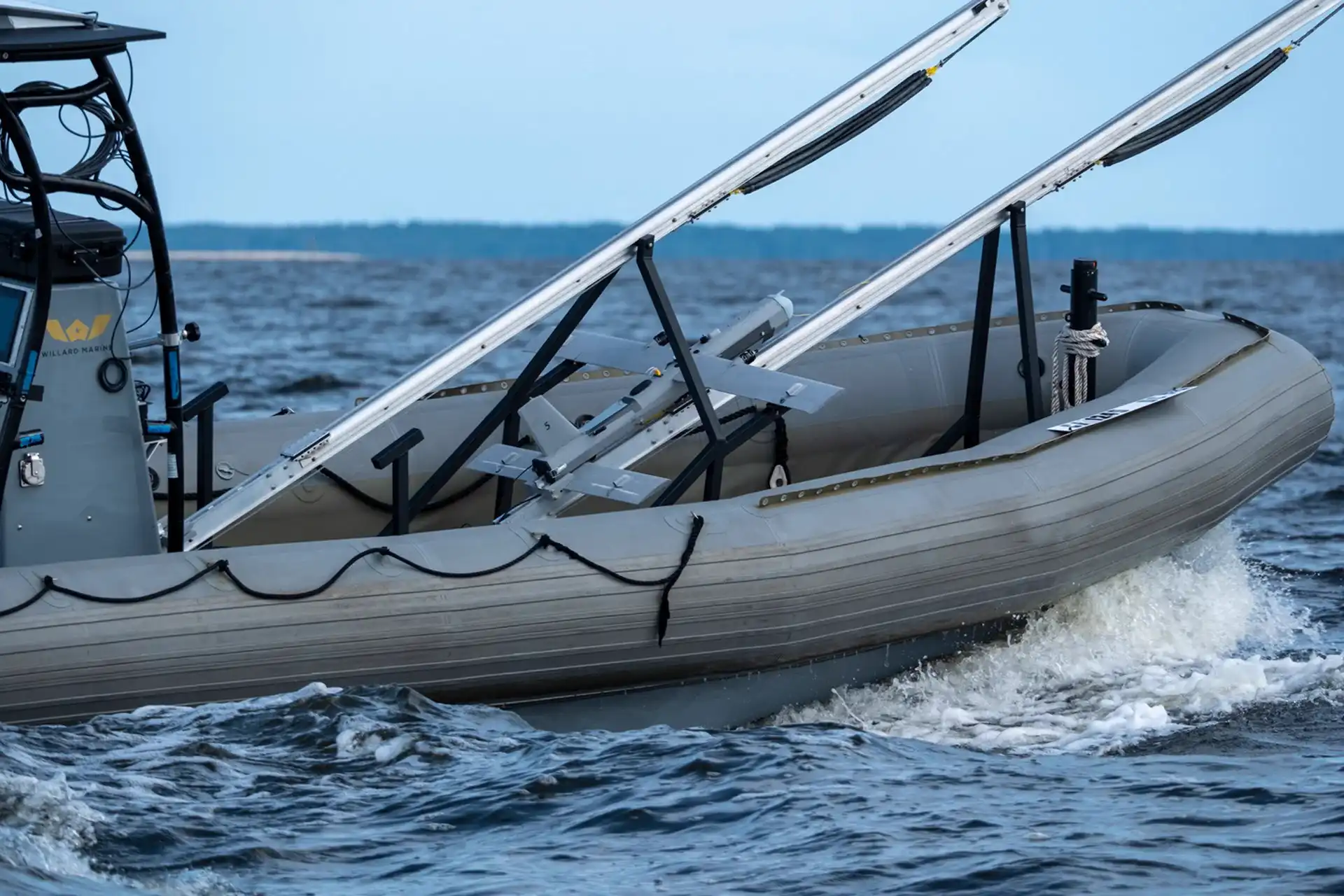
Blue Sky Horizon is a maritime variant of the company’s broader Blue Sky conversion, which Powerus says turns crewed commercial boats, workboats and naval craft into remotely operated or fully autonomous vessels “with no new vessel procurement.” The Horizon configuration adds bow launch rails and is pitched as a crewless launch and recovery platform for long-range drones at sea. Powerus says the vessel launches drones forward of shore infrastructure to extend intelligence, surveillance and reconnaissance (ISR) range, endurance and persistence.
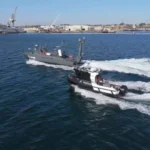
Company imagery shows a gray rigid-hull inflatable boat fitted with two parallel rails angled up and forward over the bow, with a small fixed-wing drone mounted on one of them. “Every drone has a limited range,” Powerus said. “The boat carries it most of the way, so it can fly further inland than it could from shore.”
Powerus has not disclosed converted hull types, autonomy architecture, communications links, transit range, launch weight limits, compatible drones or pricing. No customer or contract has been announced. The company is better known for air defense: its Guardian interceptor drone took part in a U.S. Air Force test against a simulated Shahed-type attack drone, and Powerus claims thousands of intercepts with the Guardian line.
Ukraine’s Barracuda Unit Tests the Concept Under Fire
According to the 40th Separate Marine Brigade, its Barracuda unit used uncrewed boats to carry heavy drones a long distance toward Russian rear areas, while other boats delivered first-person-view (FPV) attack drones to their launch points. Footage shows a boat carrying a heavy drone across open water before launch, then strikes on buildings in a settlement. The brigade said the strikes hit Russian shelters and logistics targets but gave no date or location. It credited the operation to Barracuda alongside the “12 Friends of Ocean” unit and the International Legion of Ukraine’s Defense Intelligence.
The Barracuda unit designed its own naval drone for riverine and coastal fighting along the Dnipro, and the brigade has released several videos of FPV drones launched from its boats against Russian positions in the Kherson region, including strikes near Zaliznyi Port that the brigade reported on July 19, 2026. Ukrainian reporting on that operation said Russian forces destroyed one Barracuda vessel with Lancet loitering munitions, while the remaining boats reached their launch point.
Analysis: Blue Sky Horizon’s pitch rests less on the boat than on the arithmetic of standoff. A converted hull acts as a reusable first stage, letting inexpensive drones with limited endurance reach targets they could not reach from shore. Ukraine’s marines have shown the tactic works in contested littoral and riverine terrain, but also that carrier boats are attritable targets. Conversion could let navies add launch nodes without new shipbuilding, but its military value hinges on undisclosed details: link resilience under electronic warfare, sea-state limits for rail launches from small hulls, and whether recovery at sea has been demonstrated.
The next indicators to watch are a public demonstration, published specifications for the rail system and compatible drones, and any government contract or trial. In Ukraine, the 40th Brigade’s continued use of boat-launched drones remains the operational benchmark for commercial offerings like Blue Sky Horizon.