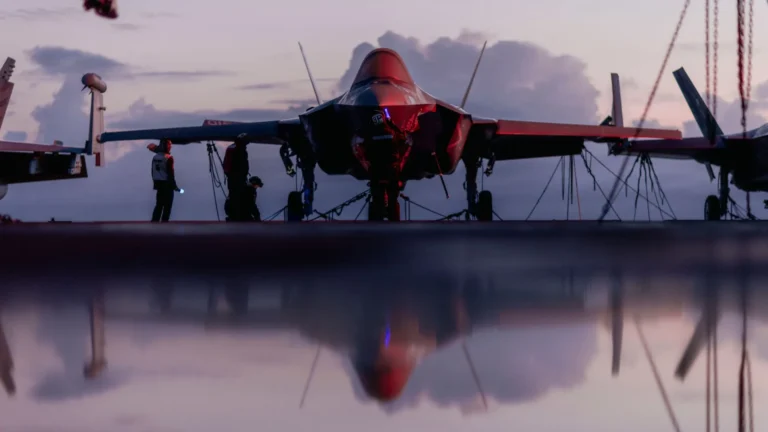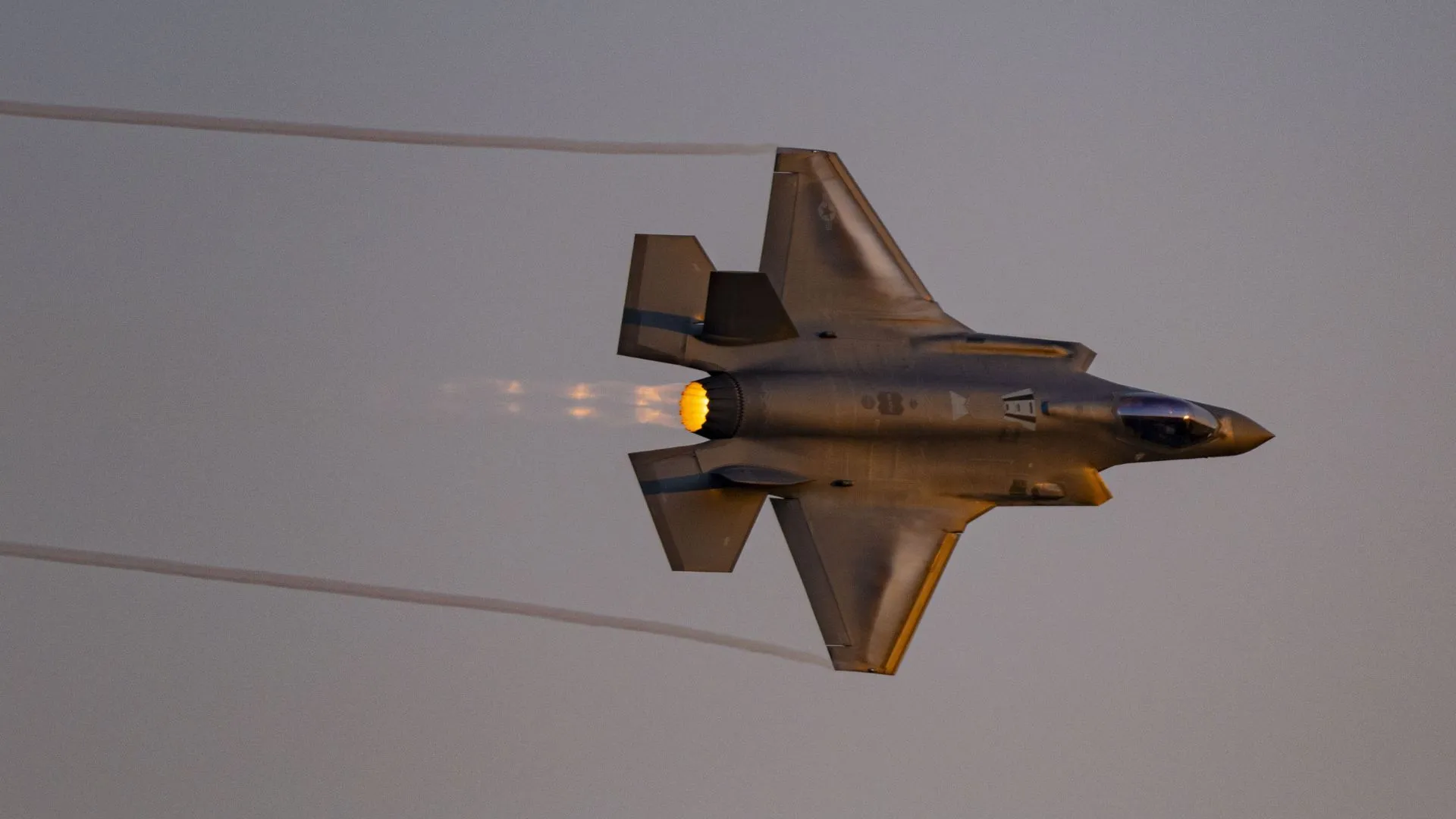
Pratt & Whitney received a $2.53 billion F135 sustainment contract from Naval Air Systems Command (NAVAIR) on November 25, 2026, to support the engines that power all three variants of the F-35 Lightning II. The RTX Corp. business, headquartered in East Hartford, Connecticut, was awarded the sole-source $2,525,033,340 undefinitized contract action under contract N0001926C0112, according to the Pentagon’s November 25 contract announcement. NAVAIR at Patuxent River, Maryland, is the contracting activity, and work is scheduled for completion in November 2027.
The award lands as the F-35 enterprise works to close a persistent gap between engine demand and repair capacity. A 2022 Government Accountability Office (GAO) review tied inadequate depot capacity to F-35s grounded without a serviceable engine, and GAO has warned that F135 sustainment may pose the program’s greatest sustainment risk. The new ceiling is roughly 58% higher than the $1.6 billion undefinitized sustainment action Pratt & Whitney announced on December 2, 2025, although the Pentagon has not published a line-by-line scope comparison between the two awards.
How the $2.5 Billion F135 Sustainment Contract Is Structured
The contract combines four pricing structures: cost-plus-fixed-fee, cost-plus-incentive-fee, cost, and fixed-price-incentive-fee line items. That mix typically lets the government apply firmer cost discipline to predictable work, such as spare-part replenishment, while keeping cost-reimbursable vehicles for engineering and repair tasks whose volume depends on flight hours and failure rates.
The scope covers the full sustainment stack: global unit-level and depot-level maintenance, repair, engineering, logistics, software sustainment, technical-data updates, support-equipment management, training, and replenishment spares. The technical-data line carries weight, since GAO has repeatedly cited insufficient technical data as a barrier to building organic depot repair capability across the F-35 enterprise.
Only $436,665,062 is obligated at award, about 17% of the ceiling. Fiscal 2027 operations and maintenance (O&M) funds account for $147,485,965 from the Air Force, $80,458,659 from the Marine Corps, and $33,905,531 from the Navy. F-35 cooperative program partners contribute $99,431,792 and Foreign Military Sales (FMS) customers $75,383,115. International money therefore totals $174.8 million, or 40% of the initial obligation. The Marine Corps share is more than double the Navy’s, consistent with a Corps that operates both the F-35B short takeoff and vertical landing variant and F-35C squadrons. Because the action is undefinitized, final price, fee, and terms remain under negotiation. Defense acquisition rules generally cap obligations before definitization at 50% of the not-to-exceed price, rising to 75% once a qualifying contractor proposal is in hand.
F135 Variants and the Global F-35 Engine Repair Network
The F135 is an afterburning turbofan derived from the F119 that powers the F-22 Raptor. Publicly available specifications indicate roughly 28,000 pounds of thrust dry and 43,000 pounds in afterburner. It comes in three versions: the F135-PW-100 for the F-35A, the F135-PW-400 for the carrier-based F-35C, and the F135-PW-600 for the F-35B, which drives the shaft-coupled lift fan. Pratt & Whitney reports more than 1,500 production engines delivered to customers in 20 allied nations.
Domestic sites absorb 86% of the work. East Hartford leads with 40%, followed by Oklahoma City at 21%, home of the Oklahoma City Air Logistics Complex at Tinker Air Force Base, the primary US F135 depot. Indianapolis takes 12%, a share that aligns with Rolls-Royce North America’s role on the F-35B LiftSystem. West Palm Beach, Florida, and Windsor Locks, Connecticut, each receive 6%, and Fort Worth, Texas, where Lockheed Martin builds the F-35, receives 1%.
The remaining 14% is spread across allied operating locations: Brekstad, Norway (4%), home of Ørland Air Station; Leeuwarden, Netherlands (3%); Marine Corps Air Station Iwakuni, Japan (3%); Williamtown, Australia (2%); Cameri, Italy (1%), site of Italy’s F-35 final assembly and check-out facility; and Marham, United Kingdom (1%). The geography mirrors where the jets fly daily: Iwakuni hosts forward-based Marine Corps F-35B squadrons, Williamtown is the main Royal Australian Air Force F-35A base, and Marham anchors British F-35B operations.
Analysis: The contract confirms that sustainment, not production, is now the center of gravity of the F135 business. The current engine already runs beyond its original bleed-air design assumptions to cool F-35 avionics, and Block 4 will add power and thermal demands. With GAO projecting Engine Core Upgrade (ECU) production no earlier than 2031, every year of delay is bought with sustainment dollars like these. Repeated sole-source, undefinitized actions also concentrate leverage with the original equipment manufacturer, a dynamic GAO has urged the Department of Defense to rebalance through greater organic depot capacity and government access to technical data.
The next milestone is definitization, which will fix pricing and fee across the four contract types. Officials have not disclosed how much of the ceiling will ultimately flow to partner and FMS customers, or whether the November 2027 end date precedes a longer-term performance-based arrangement. On the modernization side, the ECU cleared its Risk Reduction Design Review in September 2026, with ground testing planned for late 2027 and flight testing around 2030.