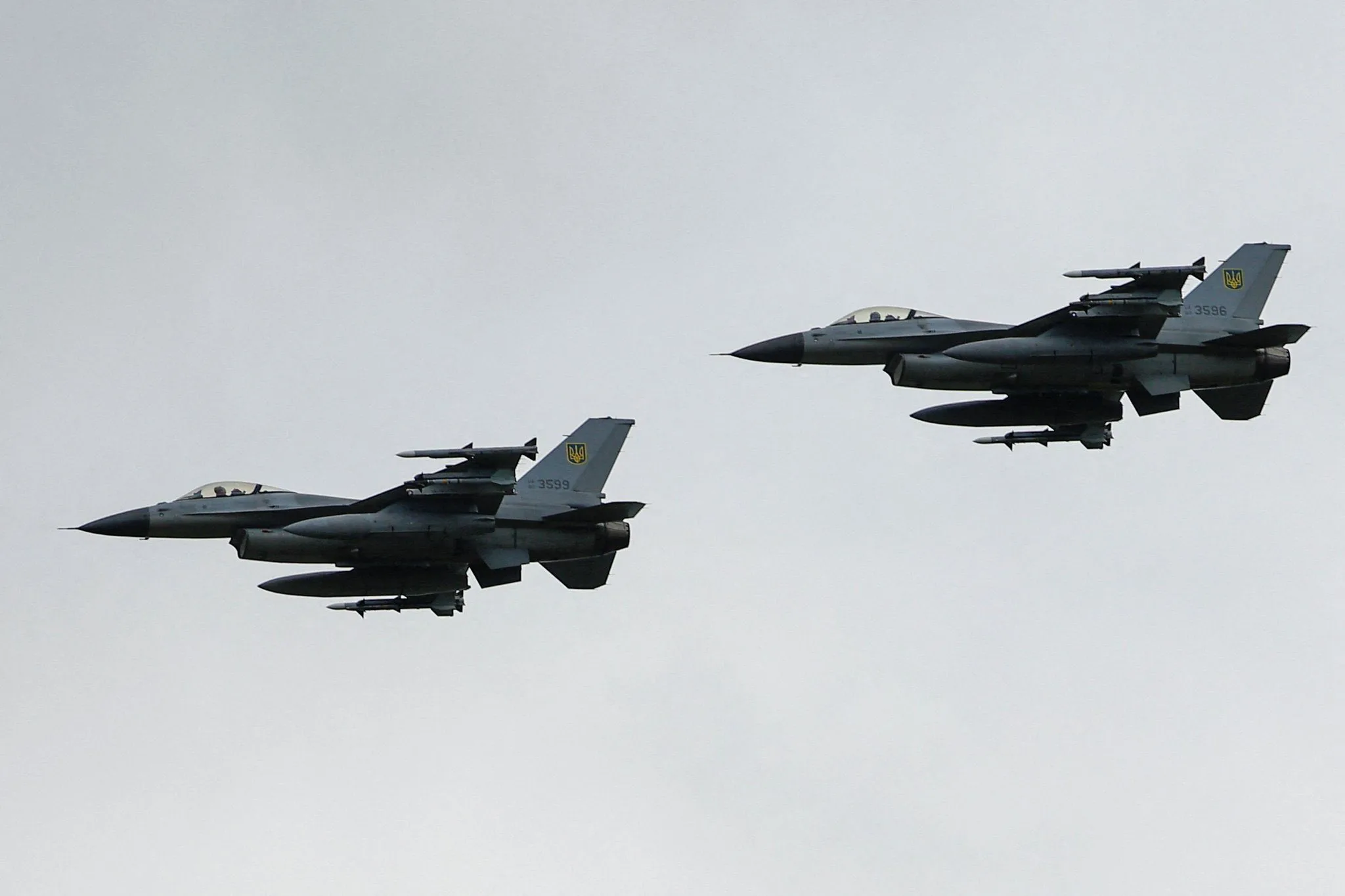
The U.S. State Department on November 25, 2026, approved a possible Foreign Military Sale (FMS) of F-16 aircraft sustainment and related equipment to Ukraine at an estimated cost of $621.9 million. The purchase will be financed entirely through Joint Ukraine Multinational Program-Services, Training and Articles Rapid Timeline (JUMPSTART) contributions from Belgium, Denmark, the Netherlands, and Norway, and the notification, Transmittal 26-98, states that no U.S. funds are associated with the transfer.
The package is the third congressionally notified F-16 support case for Kyiv, after a $266.4 million sustainment services sale cleared on December 10, 2024, and a $310.5 million training and sustainment sale cleared on May 2, 2025. Together, the three notifications total nearly $1.2 billion. The four financing nations are also the four F-16 donors: the Netherlands completed delivery of its 24 aircraft on May 26, 2025, Denmark pledged 19, Norway formally transferred six, and Kyiv announced on September 29, 2026, that Belgium would transfer its first three operational F-16AM/BM fighters before the end of the year.
What the $621.9M Ukraine F-16 Sustainment Package Covers
According to the State Department, Ukraine requested three categories of support: Cartridge Actuated Devices and Propellant Actuated Devices (CAD/PAD), laboratory equipment, and transportation support. The items will be added to a previously implemented FMS case whose value fell below the congressional notification threshold. Under the Arms Export Control Act, a sale of defense articles or services to a non-NATO partner such as Ukraine requires notification once its value reaches $50 million, so the amendment pushes an existing administrative case into formal congressional review.
CAD/PAD items are explosive and propellant-driven components that fire critical aircraft functions in a fixed sequence. On the F-16, publicly available information indicates they power the ACES II ejection seat sequence, including the ejection initiator, rocket catapult, drogue gun, and harness release cartridges. These components carry finite shelf and installed service lives that run on the calendar, not on flight hours, and once they expire an aircraft must be grounded unless a service life extension is granted, which makes them a recurring sustainment cost rather than a one-time buy. For a fleet assembled from four separate European inventories, keeping these life-limited items current across every airframe is a direct condition of keeping aircraft flight-eligible.
The release does not specify the type of laboratory equipment, its intended function, or its location. Transportation support is a practical requirement in its own right, as explosive components are subject to hazardous materials shipping rules. The notification also omits a split between Major Defense Equipment and other articles, quantities, and a delivery schedule. Principal contractors will be selected through competitive procurements conducted by the U.S. Government under the Federal Acquisition Regulation, no offset agreement is known, and no additional U.S. Government or contractor personnel will be assigned to Ukraine.
How JUMPSTART Funding Shifts F-16 Support Costs to Europe
Established in 2022, JUMPSTART allows NATO Allies and other partners to donate funds that finance Ukraine’s FMS cases. Under the program’s funding arrangement, donors are not parties to the Letter of Offer and Acceptance and do not take title to the articles; once committed, the money is treated as Ukraine’s own funds. The mechanism already helped finance an $825 million sale of 3,350 Extended Range Attack Munitions cleared on August 28, 2025, which Ukraine paid for with funding from Denmark, the Netherlands, and Norway, channeled through JUMPSTART and PURL according to Ukraine’s Ministry of Defence, alongside U.S. Foreign Military Financing. Belgium’s participation in the F-16 case extends that donor group to all four fighter-providing nations.
The money targets a fleet under operational strain. Open-source analysis by The War Zone suggests Ukraine has received 40 to 50 F-16s and lost about five, and the aircraft have become a key part of Ukraine’s air defense against Russian cruise missiles and drones. The Wall Street Journal reported in late September 2026 that more than half of the fleet was tied up in maintenance, with retired U.S. Navy Rear Adm. Mark Montgomery saying phase inspections, due every 300 flight hours and typically completed in two to six weeks in the United States, were taking as long as 40 weeks in Belgium. The Ukrainian Air Force has not released fleet status figures, but the reports frame the core problem: availability, not airframe count, now governs how many F-16 sorties Ukraine can generate.
Analysis: This case buys no new capability; it buys the right to keep flying existing jets safely. That distinction matters because CAD/PAD expiration can ground an otherwise serviceable F-16 just as effectively as a damaged engine. The financing structure is equally telling. European donors are paying for a U.S. supply chain through U.S. contracting, which keeps Washington in control of F-16 configuration and support while transferring the cost to the coalition. That model suits current U.S. policy and gives American suppliers competitively awarded work, but money alone does not fix depot throughput. If inspection backlogs persist, sustainment funding will improve readiness only at the margin.
Congress now has its 30-day statutory review window before the case can be amended and executed. Key unknowns include contract award timing, the breakdown of the $621.9 million across the three categories, and the specific laboratory capability being purchased. The next near-term marker is Belgium’s first F-16 transfer, due by December 31, 2026, which will add airframes to a support system that is already stretched.