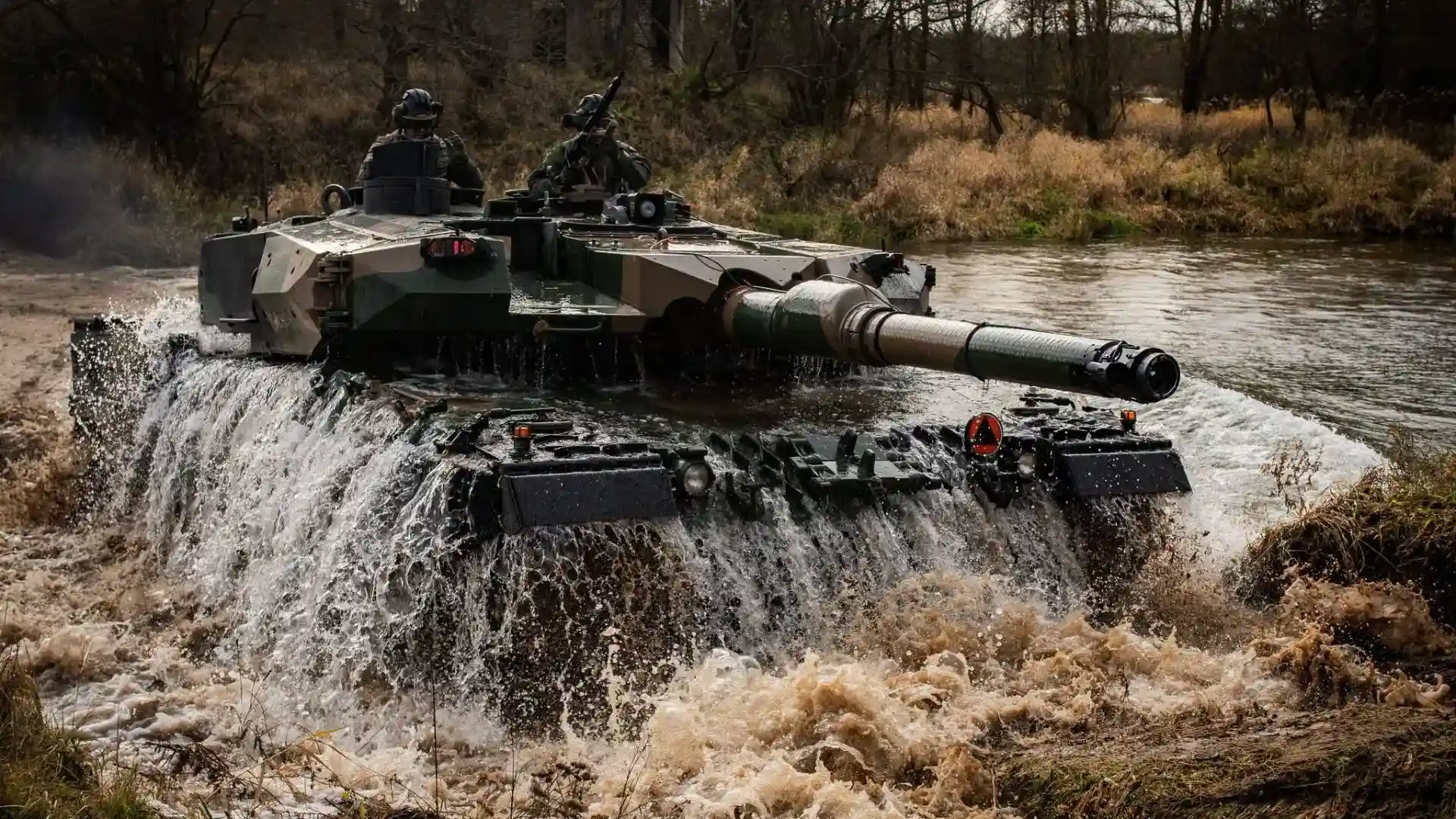
Four Leopard 2A7HU main battle tanks of the Hungarian Defence Forces (HDF) are training in Poland at Gallant Cheetah 2026, their first international exercise abroad, Hungary’s Ministry of Defence announced on November 24, 2026. About 30 soldiers from the HDF 25th Armoured Brigade “Klapka György” and one WiSENT 2 armoured support vehicle are taking part alongside troops from Poland, the Czech Republic and Slovakia. The Visegrád Four (V4) contingents are rehearsing tactical tasks, coordinated manoeuvres and live-fire drills until the final week of November.
The deployment comes less than a year after Hungary completed its tank recapitalization. The 44th and final Leopard 2A7HU was handed over at the brigade’s barracks in Tata on December 12, 2025, closing out a December 2018 contract with Krauss-Maffei Wegmann, now KNDS Deutschland. The Leopards replace Soviet-era T-72M1 tanks, and the HDF has stated that the fleet equates to a battalion-sized unit in the NATO Force Structure. The brigade itself reverted to its historical “25th” designation on September 1, 2026, after operating as the 1st Armoured Brigade since a January 2023 reorganization.
Leopard 2A7HU Specifications and the Hungarian Package
The Leopard 2A7HU is a Hungarian-specific derivative of the Leopard 2A7+. Its main armament is the Rheinmetall 120mm L/55A1 smoothbore gun, which the HDF credits with effective engagement ranges of up to 5,000 meters. Published specifications for the Leopard 2A7+ baseline give an MTU MB 873 Ka-501 V12 diesel rated at 1,500 hp, coupled to a Renk HSWL 354 transmission, a combat weight of about 67.5 tonnes and a top road speed of up to 70 km/h.
Hungarian-specific changes focus on survivability against top-attack threats and on commander’s situational awareness. Open-source reporting identifies reinforced turret roof protection, a fire control system with automatic target tracking, an FN Herstal remote weapon station, and the stabilized PERI RTWL commander’s sight. That roof protection is relevant to the top-attack threat from drones and loitering munitions seen in Ukraine.
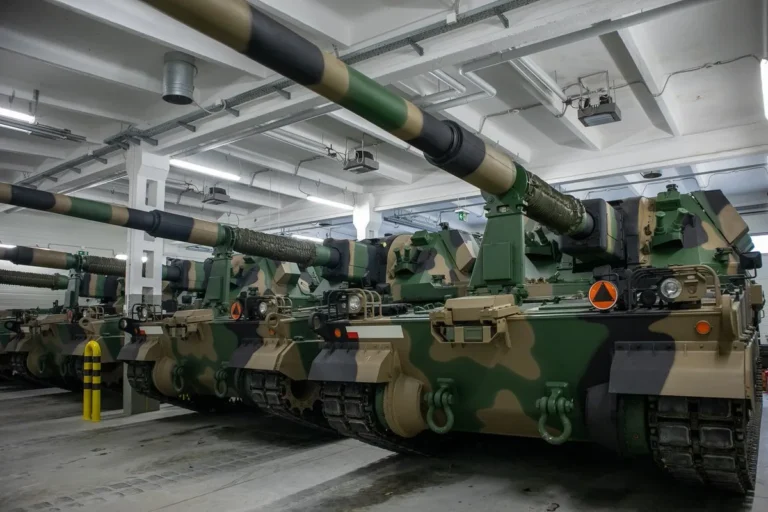
The accompanying vehicle, which the HDF describes as an engineering vehicle, is one of five WiSENT 2HU units built by Flensburger Fahrzeugbau Gesellschaft (FFG) on the Leopard 2 chassis. Hungary’s examples were ordered in the armoured recovery configuration with containerized engineer and demining kits, and the HDF states the platform can be converted from the recovery role to an armoured engineer vehicle within five hours. Canada and Norway also field the WiSENT 2. Hungary received its first unit in December 2024, and the type made its international debut at the Iron Bull 2025 recovery exercise in Garlstedt, Germany, in October 2025. Pairing a recovery asset on a common chassis with a four-tank element gives the detachment organic capacity to tow a disabled 67-tonne Leopard without relying on host-nation support.
Gallant Cheetah 2026 Scenario and V4 Leopard Interoperability
Gallant Cheetah 2026 is hosted by the Polish 10th Armoured Cavalry Brigade on training areas around Świętoszów in western Poland and runs for roughly ten days in the second half of November. The V4 armoured exercise rotates among member states annually, and Hungary hosted the previous iteration, Breakthrough 2025, at the Nullpont range in the Bakony Mountains, where a Slovak tank platoon fought alongside Hungarian Leopard 2A4 and 2A7HU tanks.
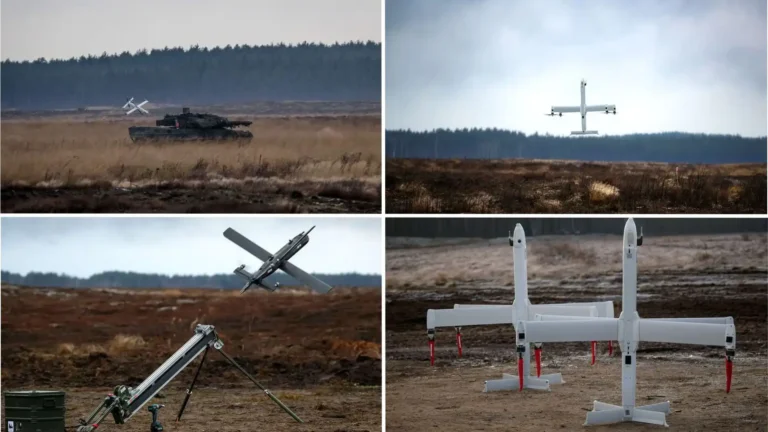
Czech reporting on this year’s event describes a river-crossing phase over the Bóbr, a defensive phase coordinating tanks, drones and aircraft, a chemical incident response with personnel and equipment decontamination, and rail transport of heavy vehicles. Polish Leopard 2PL tanks from the 10th and 34th Armoured Cavalry Brigades form the core of the friendly force, while the 9th Armoured Cavalry Brigade plays the opposing force with PT-91 Twardy tanks. Warmate loitering munitions, FlyEye and Bayraktar drones, Baobab-K mine-laying systems, F-16 fighters and W-3PL Głuszec helicopters are also reported in the exercise. The Hungarian MoD has not detailed its platoon’s role in each phase, although the images it released with the announcement show a Leopard 2A7HU fording a water obstacle.
The exercise brings several Leopard 2 generations onto the same ground. The Czech Republic fielded a 73rd Tank Battalion platoon on Leopard 2A4 tanks, Slovakia contributed BVP-2 infantry fighting vehicles, and Poland operates about 247 Leopard 2 tanks across 2A4, 2A5 and 2PL standards. Hungary arrived with the newest Leopard 2 build on the field.
Analysis: A four-tank platoon is a modest force, but the first out-of-country movement is the real test of a newly fielded fleet. Road and rail deployment, sustainment away from Tata, and recovery support on foreign ranges expose gaps that home-station gunnery cannot. A shared Leopard 2 baseline across all four V4 armies also creates practical commonality in recovery procedures, spares and crew training. That working-level commonality persists even as V4 governments remain divided over arms deliveries to Ukraine.
Gallant Cheetah 2026 concludes in the final week of November. Key unknowns include whether Hungary will disclose gunnery or readiness results from the deployment and how quickly the 25th Armoured Brigade scales from platoon-level participation to company or battalion deployments abroad. The next V4 rotation, and further combined-arms training between the Leopards and the HDF’s Lynx KF41 infantry fighting vehicles, which began in May 2025 and which the HDF called a first step toward combined-arms capability, will be the next indicators of how far Hungary’s armoured modernization has matured.