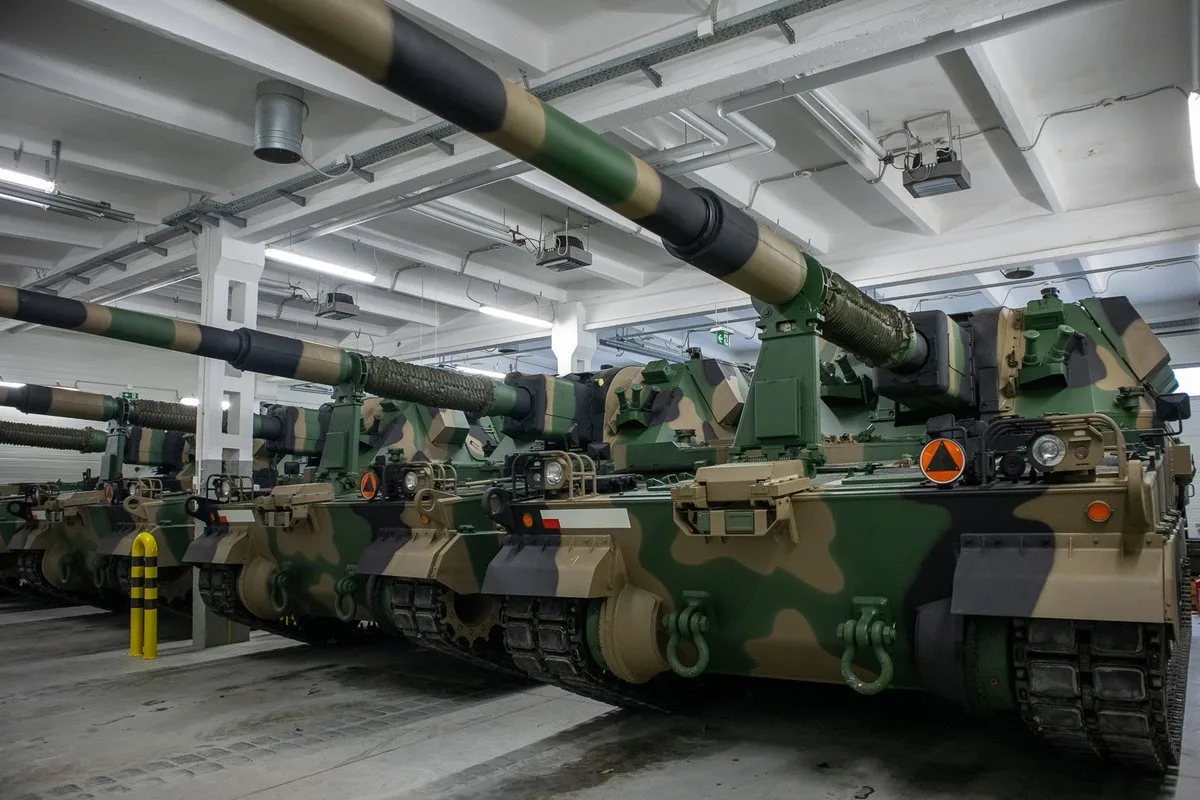
Poland’s Armament Agency said on November 18, 2026, that a new Krab howitzer battery is undergoing acceptance tests for the Polish Army’s 11th Lubusz Armored Cavalry Division, known as the “Black Division.” The battery belongs to a REGINA battalion-level fire module (Dywizjonowy Moduł Ogniowy, DMO), which pairs 24 Krab 155 mm self-propelled howitzers with command, ammunition and repair vehicles.
The announcement marks the division’s second Krab-related delivery in under three weeks. On October 30, 2026, the agency reported that command vehicles, ammunition vehicles, command-and-staff vehicles and Krab howitzers for REGINA had reached the division. The agency did not disclose how many howitzers are in the latest batch or which executive contract covers it. The deliveries continue Poland’s effort to retire Soviet-era 2S1 Gvozdika 122 mm guns in favor of 155 mm NATO-standard systems.
How the Krab Howitzer Battery Fits the REGINA Fire Module
Each REGINA module combines 24 Krab howitzers with three command-and-staff vehicles, eight command vehicles, six ammunition vehicles and one armament and electronics repair vehicle, according to manufacturer Huta Stalowa Wola (HSW). A full module is organized as three batteries of eight guns. The howitzers use WB Electronics’ Topaz fire control system.
The agency framed the delivery around that system logic. “This is a real boost to the firepower of Poland’s artillery,” it said, adding that the strength comes not only from the howitzers but also from the accompanying vehicles, command vehicles and logistical support. It said coordinated operation of the module improves the precision and firepower of Polish artillery.
Photographs released with the October 30 delivery showed Krabs in an upgraded configuration, with a new driver’s camera, additional smoke grenade launchers on the turret roof and an air-conditioning unit at the rear of the turret. The command vehicles ride on a new variant of the light tracked chassis with hydropneumatic suspension and a ZSMU A3B remote weapon station from Zakłady Mechaniczne Tarnów.
Krab Specifications: K9 Chassis, AS-90 Turret, 40 km Reach
The Krab mates a Polonized turret derived from the British AS-90 Braveheart with a 155 mm L/52 gun and a tracked chassis based on the South Korean K9 Thunder. Publicly available specifications indicate a combat weight of about 48 tonnes, a crew of five and a 1,000 hp MTU MT881Ka-500 diesel engine. The vehicle carries 40 rounds and reaches up to 40 km with base-bleed ammunition.
The automated loading system supports a burst of three rounds in under 10 seconds, six rounds per minute for three minutes and a sustained two rounds per minute. Poland has supplied dozens of Krabs to Ukraine since 2022, where they have been in combat against Russian forces.
Analysis: The agency’s emphasis on vehicles rather than guns reflects a lesson Ukraine has made plain: tube artillery’s survival and effectiveness depend on command, ammunition resupply and maintenance keeping pace with the howitzers. Two deliveries to the Black Division within three weeks also suggest HSW is converting its order backlog into fielded capability on NATO’s eastern flank.
The next benchmark is the December 23, 2024, contract for 96 Krabs in four REGINA modules, worth about 8.9 billion zlotys and including command, staff and ammunition vehicles. Deliveries run through 2029, with the final two modules due to receive an automated ammunition and charge loading system and a laser warning receiver. On May 30, 2026, the agency also signed a contract with HSW, financed through EU SAFE loans, for four more REGINA modules worth 7.9 billion zlotys net, with deliveries due by 2030. Open questions remain on the size of the current batch and when the Black Division’s module will reach full strength.