Poland and the United Kingdom signed an intergovernmental agreement on November 24, 2026, that sets the legal and financial framework for developing the CAMM-MR (Common Anti-Air Modular Missile, Medium Range), a surface-to-air interceptor expected to exceed 100 km in range, Poland’s Armament Agency (Agencja Uzbrojenia) said. Magdalena Sobkowiak-Czarnecka, secretary of state at Poland’s Ministry of National Defence, signed for Warsaw, while UK defence procurement minister Luke Pollard signed for London.
The deal turns an industrial concept into a government-to-government program. MBDA and state-owned Polska Grupa Zbrojeniowa (PGZ) signed a letter of intent on CAMM-MR at the MSPO defense exhibition in Kielce in September 2023, and the UK government said the Security and Defence Partnership Treaty the two countries signed on May 27, 2026, would include co-production of a next-generation medium-range air defense missile. The Armament Agency calls it the first air and missile defense interceptor that Poland is jointly developing under an international government-industry formula. Poland’s CAMM buys came first: a £1.9 billion Pilica+ short-range air defense contract in April 2023, then a deal worth more than £4 billion in November 2023 covering over 1,000 CAMM-ER missiles and more than 100 iLaunchers for the Narew program.
How the CAMM-MR Missile Agreement Structures Development
The document is a programme arrangement between the two governments, designated P&A by the Armament Agency. Its stated purpose is to create the legal and financial conditions needed to contract the missile’s detailed design, referred to in Polish as the executive design project. Both governments commit to securing the funding required for work arising from the arrangement. Neither side disclosed a program cost, a development budget, or an industrial work-share split.
The agency describes a multi-stage program sized to the industrial and development capacity of both partners. Under the schedule agreed with London, the next step is an executive contract between the Armament Agency, acting for the Polish State Treasury, PGZ S.A., and MBDA UK. That contract would cover the detailed design and define the division of competences and tasks between the Polish and British sides. The agency said detailed analysis and research, including simulations, are needed for further work on the missile.
A separate supply contract would follow, timed to coincide with the end of deliveries of the Polish Navy’s three Miecznik-class multirole frigates. The agency said that sequencing would allow smooth integration of the new missile on ships already in service with trained crews, and alignment with the Narew program. No dates were given for either contract.
Schedule risk is already on the record. In September 2026, Deputy Defence Minister Paweł Bejda, answering parliamentary interpellation No. 18387, said the missile’s readiness and its integration on Miecznik depend on the pace of development, adding that another CAMM-family missile was under consideration as a bridging option if needed.
Where CAMM-MR Fits in Poland’s Layered Air and Missile Defense
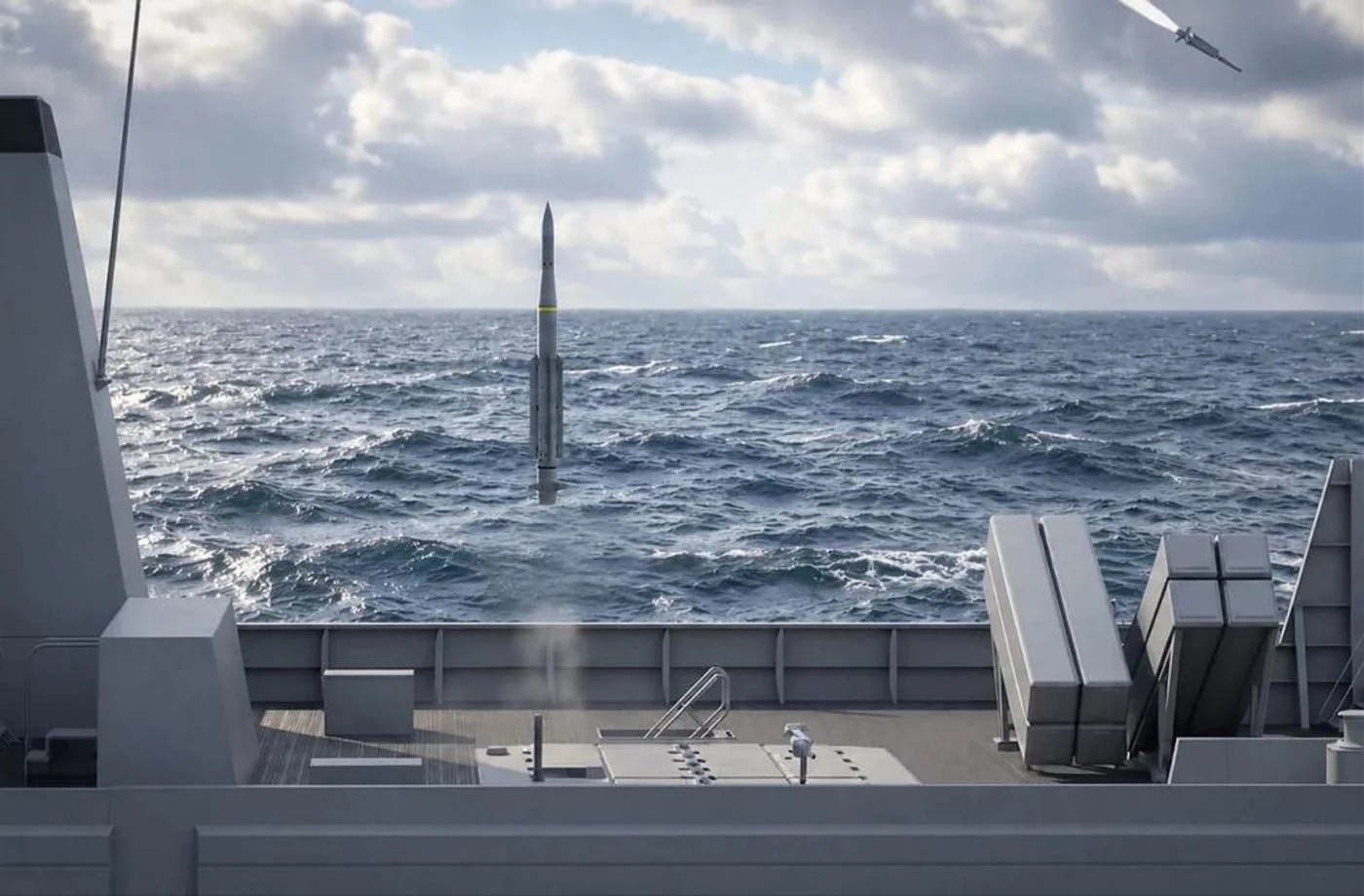
The Armament Agency describes CAMM-MR as a new-generation missile that draws on production and operational experience across the CAMM family. Its expected range of more than 100 km would, combined with the multilayer air defense systems Poland is acquiring, allow area defense of Polish territory, the agency said. It positions the missile as an additional option alongside the CAMM and CAMM-ER rounds Poland operates or has on order, not as a replacement.
That envelope would more than double CAMM-ER’s. Publicly available specifications credit the baseline CAMM with a range of more than 25 km and CAMM-ER with more than 40 km, both using soft vertical launch and an active radar seeker. MBDA and the Armament Agency have not released CAMM-MR figures for dimensions, weight, propulsion, seeker, or maximum engagement altitude.
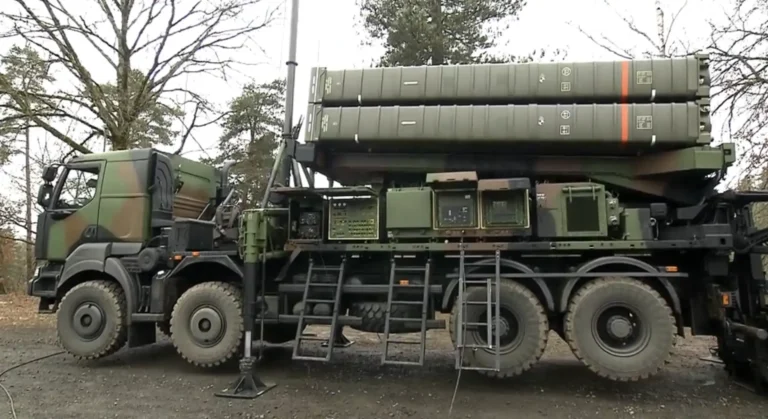
At sea, the missile is tied to Miecznik, a design derived from Babcock’s Arrowhead 140. Lead ship ORP Wicher was launched in Gdynia on August 13, 2026, and is scheduled for delivery in 2029, followed by ORP Burza and ORP Huragan, with program completion planned around 2031 under published schedules. MBDA said in 2023 that fitting CAMM-MR to the frigates was part of the Polish requirement. On land, Narew pairs CAMM-ER with Polish radars, Jelcz vehicles, and Northrop Grumman’s Integrated Battle Command System (IBCS). In the same parliamentary answer, the Defence Ministry said land-based CAMM-MR is intended for Poland’s IBCS-based integrated air and missile defense, without detailing how the missile will be integrated.
Analysis: CAMM-MR is aimed at the gap between CAMM-ER and the Patriot-based Wisła upper tier. A co-developed medium-range interceptor, with technology and skills transferred to Polish industry, would extend the technology transfer already under way for CAMM-ER and could reduce Warsaw’s reliance on US-made Patriot interceptors for that tier. The constraint is time. Tying the supply contract to the end of Miecznik deliveries leaves a short window to move from detailed design to a qualified missile, and the bridging-option comment shows Warsaw is hedging. London has not announced a plan to field the missile with British forces, although PGZ said in 2023 that the aim was a common munition for Polish and British forces. That decision would shape production volumes and unit cost.
The next milestone is the executive contract between the Armament Agency, PGZ, and MBDA UK, which should reveal the work share, the design budget, and the test schedule. Still unknown are the program’s total cost, whether a Polish production line will be established, and the date of a first guided flight.