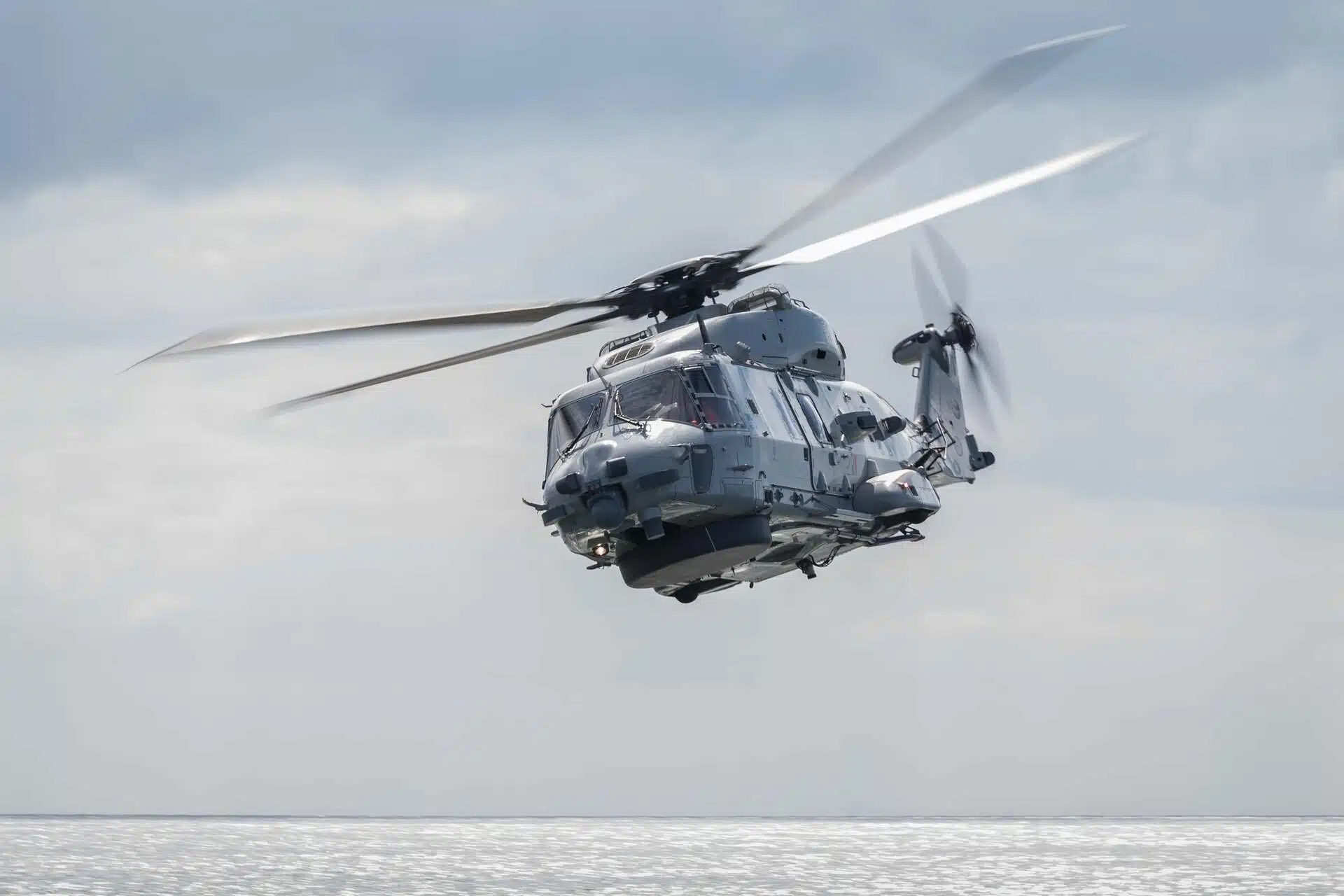
The Netherlands is moving to buy two more NH90 NATO Frigate Helicopters (NFH) by exercising a contract option that expires at the end of 2026. Minister of Defence Dilan Yeşilgöz-Zegerius and State Secretary Derk Boswijk confirmed the plan in written answers sent to the House of Representatives on November 20, 2026. An incidental supplementary budget for the Defence Materiel Budget Fund, submitted on November 9 as Kamerstuk 37057, funds the purchase. The bill raises the fund’s 2026 commitment budget by €105.6 million to acquire the additional NH90s in time, without changing 2026 expenditure. It would lift the Dutch maritime NH90 fleet to 24 helicopters.
The two aircraft are the option attached to the contract that the NATO Helicopter Management Agency (NAHEMA) signed with NHIndustries (NHI) on December 9, 2025, for three new NFHs due in 2030. That order followed the Defence White Paper 2024, which identified growing demand for NH90 capacity. No money was available for the option at signature; according to the ministry, extra funding from the current coalition agreement now covers it, preserving what it calls favorable contract terms. In the bill’s explanatory memorandum, the ministry links the extra helicopters to NATO capability targets assigned to the Netherlands and to national tasks in the Caribbean.
Why the NH90 NFH Option Cannot Be Extended Beyond 2026
The ministry told lawmakers that extending the option is not possible because of the large number of parties involved in the contract. The NH90 is an international program developed by the Netherlands, Germany, France and Italy. NAHEMA acts as the executing agency, and NHI, the joint venture of Airbus Helicopters, Leonardo and GKN Fokker, is the prime contractor. Partners coordinate closely on acquisition and production, but the additional aircraft are planned for the Netherlands alone.
That structure explains the compressed timeline. The ministry describes calling the option in 2026 as a precondition for rapid delivery, and the House Defence Committee scheduled a legislative consultation on the bill for November 25. The written answers do not give a unit price or a delivery date for the two additional airframes.
The ministry also stressed commonality: partner nations aim to keep their NH90 fleets as close to identical as possible, which the ministry says improves availability and simplifies sustainment.
Block 1 Standard and the Path to a 24-Helicopter Fleet
The Netherlands ordered 20 NH90s in 2000 to replace its Westland Lynx fleet and lost one in a 2020 accident in the Caribbean. The 19 remaining aircraft, operated by the Defence Helicopter Command, are scheduled for a mid-life update (MLU) budgeted in 2023 at €661.6 million. The three aircraft ordered in 2025 will be assembled by Leonardo in Italy and delivered with Block 1 features, also known as Software Release 3. The existing fleet is to reach the same level through the MLU, carried out during the same period as new production.
Publicly available specifications indicate the NFH is an 11-tonne-class twin-engine helicopter powered by two RTM322 turboshafts. Its anti-submarine warfare (ASW) suite combines a 360-degree surveillance radar, dipping sonar, sonobuoys, forward-looking infrared and lightweight torpedoes. Dutch NFHs also fly from ships on counter-narcotics operations in the Caribbean and support amphibious operations.
Analysis: The case for two more helicopters rests on ships as much as aircraft. The Royal Netherlands Navy is replacing its Karel Doorman-class frigates with new ASW frigates developed jointly with Belgium, and the Defence White Paper 2024 added plans for two more ASW frigates. A fleet of 24 NFHs spread across a larger surface force, NATO commitments and Caribbean tasks leaves limited margin once maintenance and training are counted. Exercising the option now, instead of negotiating a new multinational order later, preserves current terms and keeps the new aircraft in the common configuration that the partner nations rely on for sustainment. It also signals Dutch confidence in the NFH after reliability problems led Norway to cancel its NH90 order in 2022.
Parliamentary approval of Kamerstuk 37057 is the next milestone, and the option must be called before it expires at the end of 2026. Key unknowns remain the contract price of the two aircraft, which the budget figure does not disclose, their delivery slot relative to the three helicopters due in 2030, and how fleet availability holds up during the MLU. The ministry has said the three aircraft already on order are meant to absorb the capacity gap the upgrade creates in the current fleet.