The Saab-led MANGROVE consortium has completed Phase 1 of NATO’s Allied Underwater Battlespace Mission Network (AUWB-MN), Saab announced on November 17, 2026. The phase delivered the architectural, technical and governance foundations for a secure, interoperable mission network intended to let allied navies connect crewed and uncrewed systems operating beneath the surface.
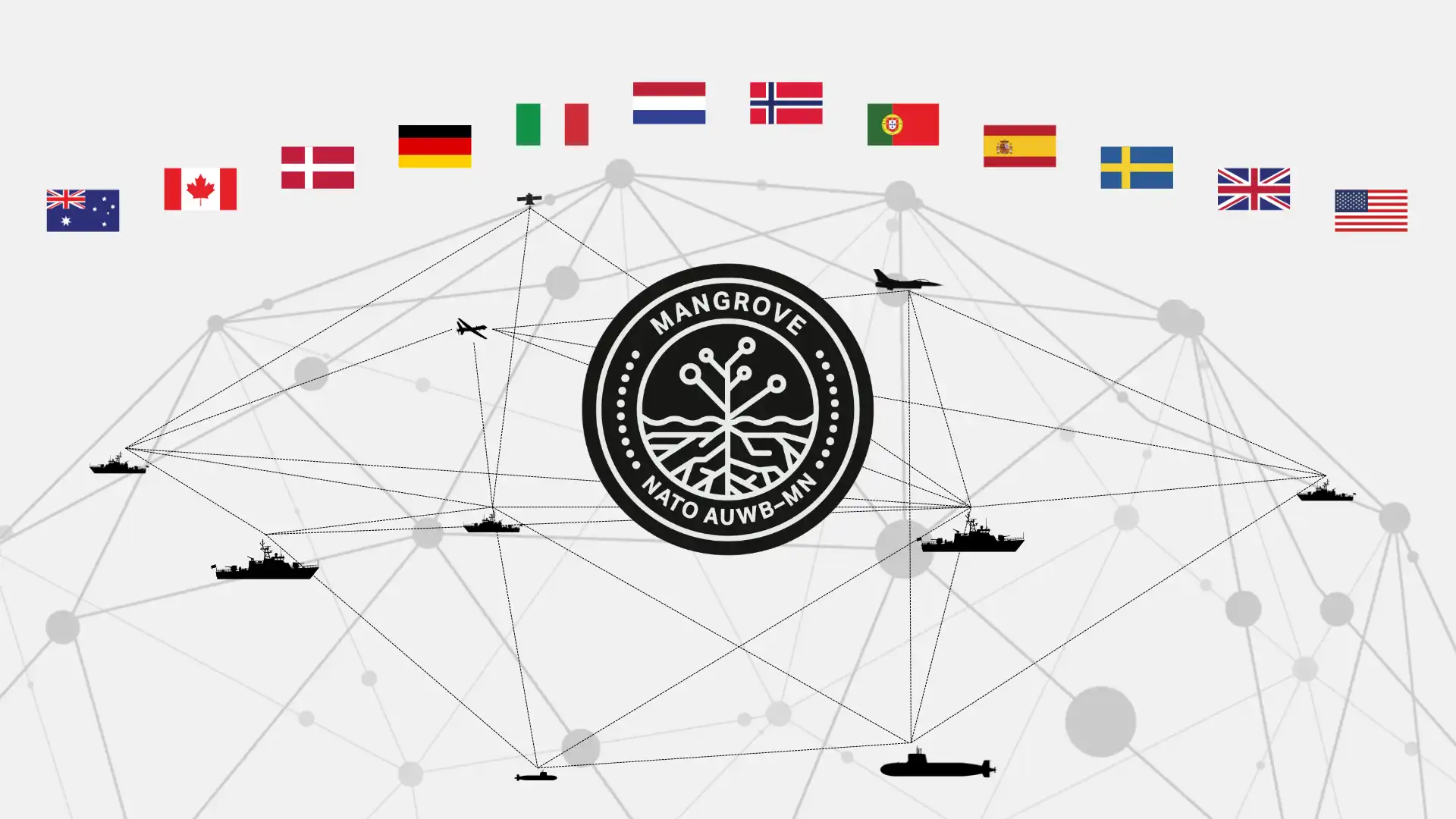
The effort sits within NATO’s Anti-Submarine Warfare (ASW) Barrier Smart Defence Initiative (SDI), a UK-led framework focused on exploiting maritime uncrewed systems for anti-submarine warfare, and the Alliance’s broader Digital Ocean initiative. Twelve nations sponsor the project: the United Kingdom as lead nation, alongside Sweden, the United States, Australia, Spain, Germany, Italy, Portugal, Canada, the Netherlands, Denmark and Norway. The consortium was selected on July 16, 2025, and formally began work on September 1, 2025, under a 12-month mandate. Sponsor nations committed at the outset to adopting the standard that emerges from the project.
What Phase 1 Delivered for the Underwater Battlespace Mission Network
A mission network, in NATO usage, covers more than communications hardware. It bundles the data architecture, security rules, procedures and standards that allow platforms from different nations to exchange information and operate under common command and control (C2). AUWB-MN applies that model to the undersea domain, where acoustic bandwidth is scarce, latency is high and links to surface, air and satellite bearers remain a persistent integration challenge.
The core design choice is to replace bespoke, system-by-system integrations with common standards and security principles. Under that approach, a submarine, a frigate’s sonar suite, an autonomous underwater vehicle (AUV) or a seabed sensor from any vendor could join the network by complying with a shared specification, rather than through custom interfaces negotiated platform by platform. The stated goal is to let nations share information, coordinate assets and operate as an integrated force regardless of the underlying technology.
The network’s intended scope, as described by the ASW Barrier SDI in a 2021 NATO publication, covers reliable underwater communications, interfaces to above-water radio frequency and satellite links, effective C2 delivery, and a conduit for data harvesting, fusion and exploitation. Saab has not publicly detailed which protocols, data models or acoustic communications standards the Phase 1 reference architecture specifies, nor the security classification of the deliverables or the contract value.
David Burton, Project Director of the NATO ASW Barrier Smart Defence Initiative, said NATO “must be able to connect platforms, systems and nations through a common operational framework,” adding that Phase 1 establishes “the architectural foundations for a future mission network.”
From Reference Architecture to a Test and Reference Environment
Phase 1 also laid the groundwork for a future Test and Reference Environment, which will anchor the next stage of AUWB-MN. According to Saab, the environment will support experimentation, capability development, compliance assessment and operational exercises. The compliance function is the most consequential: it would give sponsor nations a common benchmark to verify that new platforms and payloads conform to the network standard before they are fielded.
The consortium is led by Saab’s Naval business area and includes CETENA and IDS of the Fincantieri Group, FlySight, GraalTech, Miraya, Saab UK, S2IX and the University of Plymouth. The mix of a prime contractor, Italian naval engineering and C2 specialists, small and medium-sized enterprises and academia reflects the program’s focus on architecture and standards rather than on any single sensor or vehicle.
Dr Frida Lindberg, Co-Chair of the MANGROVE consortium and a Business Director at Saab, described the result as groundwork for a network that is “resilient, scalable and technology-agnostic.”
Analysis: The binding constraint on allied undersea operations is increasingly integration rather than platform count. Navies are fielding uncrewed underwater systems to extend ASW coverage, yet connecting them to other platforms still relies largely on bespoke, system-by-system integration, the very approach AUWB-MN is designed to replace. A shared standard backed by 12 sponsor nations, paired with a compliance test environment, could turn AUWB-MN into a de facto entry requirement for vendors seeking to sell into allied undersea networks. That would shape procurement well beyond the consortium itself, and it gives Saab an early position in defining the rules.
Saab has not disclosed a timeline, budget or contracting vehicle for the next phase. Key milestones to watch include the stand-up of the Test and Reference Environment, the first compliance assessments of national systems, and whether NATO formalizes the architecture as an Alliance standard. How quickly sponsor nations translate their adoption commitment into procurement requirements will determine whether AUWB-MN becomes an operational network or remains a reference design.