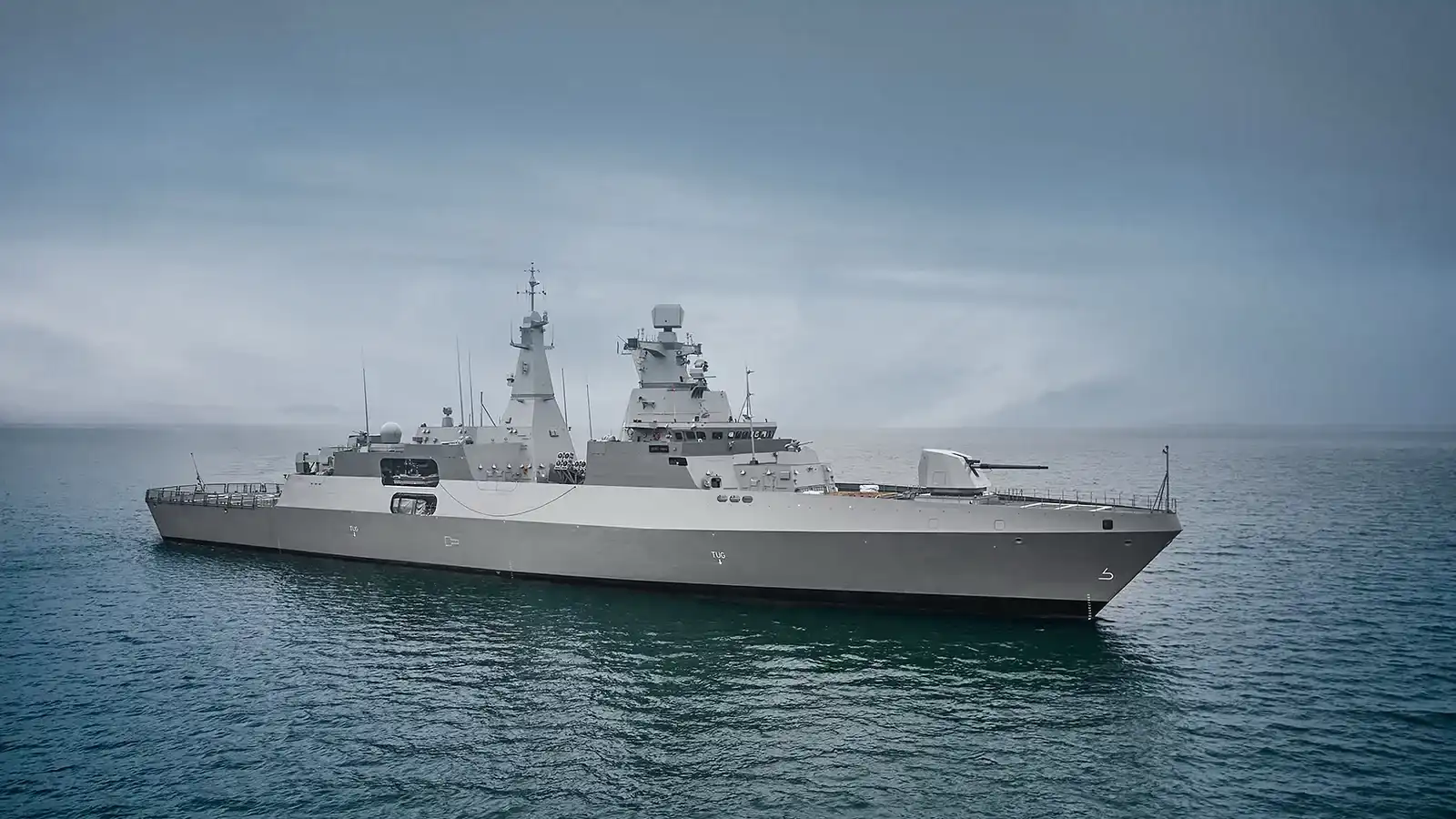
TKMS and Germany’s procurement agency BAAINBw signed a contract on November 17, 2026, for four additional MEKO A-200 DEU frigates, doubling the German Navy’s planned buy to eight ships. The agreement implements the follow-on procurement that the Bundestag Budget Committee approved in October and, according to TKMS, is the largest surface vessel order in the company’s history. The first of the 3,950-tonne anti-submarine frigates, designated F128, is due for delivery at the end of 2029.
The contract closes a rapid pivot in German naval procurement. The Federal Ministry of Defence (BMVg) terminated the F126 frigate program on June 24, 2026, after Damen Naval signaled it could not deliver within the agreed schedule or budget; continuing with Naval Vessels Lürssen (NVL) as the new prime would have pushed total financial requirements above €18 billion, per the ministry. Berlin turned instead to the MEKO A-200 DEU, designated F128 in German service, as a dedicated anti-submarine warfare (ASW) platform. The Budget Committee approved the first four ships on July 8, 2026, together with an option for four more exercisable through the end of 2026.
Contract Scope and Cost of the Eight MEKO A-200 DEU Frigates
TKMS did not disclose the value of the follow-on contract. Government figures put construction of ships five through eight at about €5.3 billion, rising to roughly €5.6 billion once project support and a management reserve are included. The first batch cost about €6.3 billion, a figure that also covered one-time development and adaptation of the design to German requirements. Construction contracts for the class therefore total around €11.6 billion, with operating costs for the four option ships projected at €1.55 billion through 2045.
Section fabrication for the lead ship began in Bremerhaven in February 2026 under a preliminary agreement that TKMS and the Federal Office of Bundeswehr Equipment, Information Technology and In-Service Support (BAAINBw) signed on February 3, and the keel was laid in May, according to the Bundeswehr. TKMS states that work on the first two frigates of the initial batch is underway and that the lead ship remains on schedule for delivery at the end of 2029, with the remaining hulls following at short intervals. No hull-by-hull schedule has been published; earlier planning pointed to roughly one delivery every nine months.
The four option ships will reuse the production structures and supply chains of the first batch. TKMS will keep its existing partnerships, including with the Heinrich Rönner Group, and spread work across Germany’s maritime industry.
“With the order for the four option vessels, we can secure ongoing series production for the long term. The additional ships will be built using the production structures already in place,” said Oliver Burkhard, chief executive officer of TKMS.
Sensors, Sonar and Propulsion: Inside the F128 Anti-Submarine Design
The MEKO A-200 DEU derives from the export MEKO A-200 family that TKMS has delivered to South Africa, Algeria and Egypt. Publicly available specifications indicate a full-load displacement of about 3,950 tonnes, a length of 121 meters and a beam of 16.4 meters, less than 40 percent of the displacement of the 10,550-tonne F126 it replaces. Its CODAG-WARP propulsion pairs a gas turbine of about 20 MW driving a centerline waterjet with two diesel engines of about 6 MW each driving controllable-pitch propellers, for a top speed above 29 knots and a range of more than 6,500 nautical miles at 16 knots. The core crew numbers 125, with accommodation for 49 additional personnel.
The ASW fit is built around a towed array sonar, lightweight torpedoes, reportedly MU90, and an embarked NH90 Sea Tiger helicopter; the sonar supplier has not been officially announced. Saab holds an SEK 8.7 billion contract, signed in July 2026, to supply composite superstructures, the 9LV combat management and fire control system, the Sea Giraffe 4A Fixed Face long-range radar, the Sea Giraffe 1X multi-mission radar and passive sensors for the first four ships, with deliveries from 2029 to 2032. That agreement carries an option for additional hulls; its exercise for ships five through eight has not been announced. The final missile and gun configuration has not been released.
Analysis: Berlin has traded capability for schedule. The F128 gives up the size, endurance and mission flexibility of the F126 in exchange for a mature hull and a Saab combat system that the German Navy is also integrating on its F123 Brandenburg-class upgrade, which reduces training and logistics friction across its ASW frigate force. Ordering eight hulls in a single class before the first one floats gives TKMS and its suppliers a stable workload and gives NATO a credible timeline for German ASW coverage of the North Atlantic, the Baltic and the High North, where Russian submarine activity drives demand. The risk has shifted from design maturity to integration and throughput: a compressed build cadence leaves little margin if the lead ship slips.
The next milestones are the lead ship’s launch and sea trials ahead of its end-2029 handover, and confirmation of the delivery cadence for hulls two through eight. Open questions remain on the final weapons fit, on whether Saab’s option extends to the second batch, and on the roughly €4.7 billion in payment and indemnity claims Damen has raised against the German government over the F126 termination.