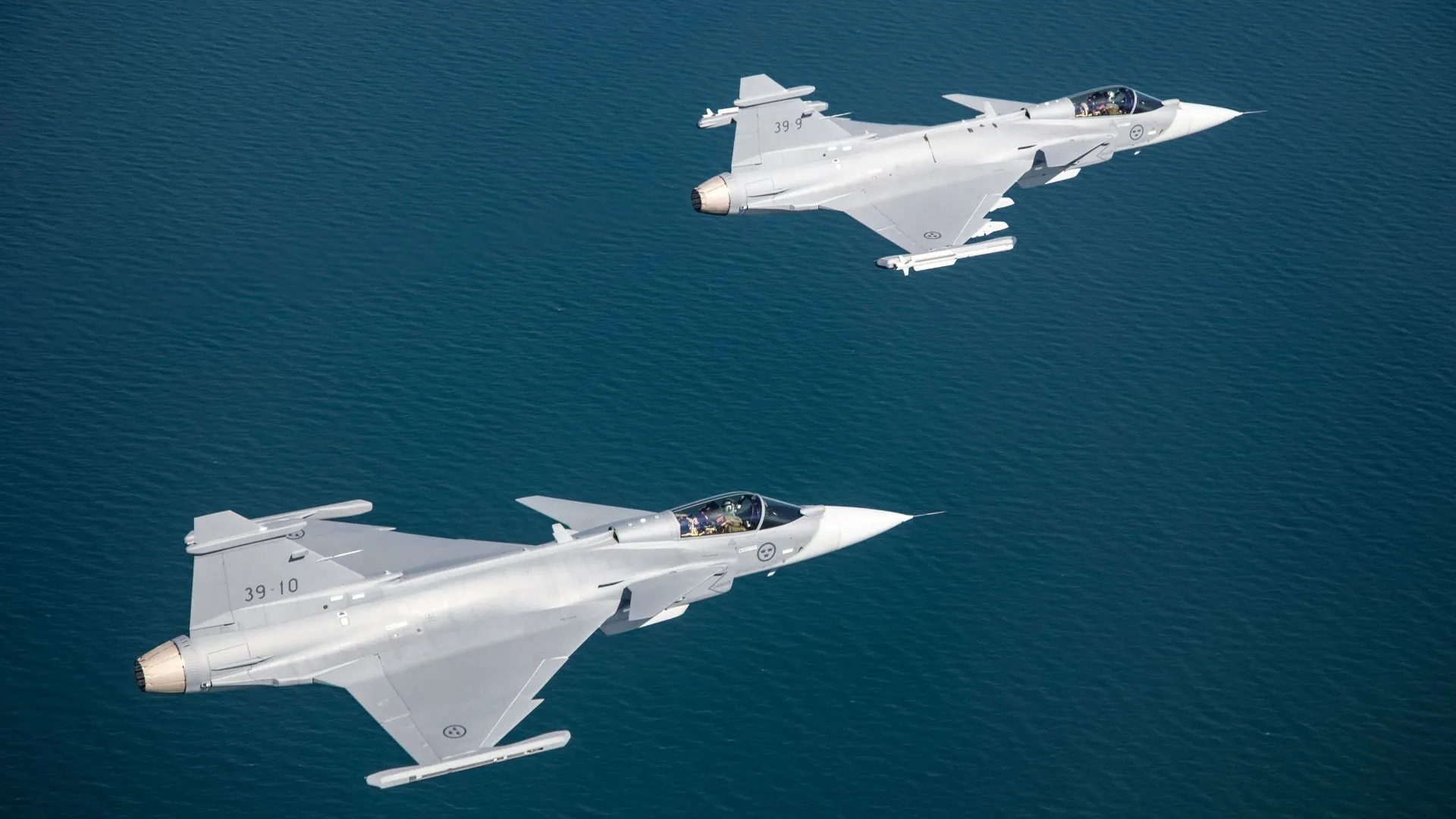
On November 25, 2026, Royal Thai Air Force (RTAF) chief Sakesan Kantha proposed one order for Thailand’s remaining eight Saab Gripen E/F fighters, in a 12-jet program worth about 60 billion baht ($1.77 billion). Speaking in Bangkok after a press conference marking the RTAF’s 90th anniversary, Air Chief Marshal Sakesan said the plan would fold the final two phases of the Gripen program into a single procurement. He said he had given Prime Minister Anutin Charnvirakul an initial briefing and that the air force’s budget committee would present detailed plans to the government, with budget preparation due in 2027.
The proposal responds to a hard deadline. The Lockheed Martin F-16A/Bs flown by 102 Squadron, Wing 1, at Korat Royal Thai Air Force Base in Nakhon Ratchasima province are due to retire in 2028, and the four Gripen E/Fs ordered so far cannot fill a squadron on their own. Sakesan said combining the phases would reduce the risk of a capability shortfall as older fighters leave service and would simplify negotiations over industrial offsets. He first floated buying all eight remaining aircraft at once in July 2026.
Thailand Gripen Procurement Timeline Moves Forward Two Years
The RTAF’s 2025 white paper set out three overlapping phases for the F-16 replacement. Phase two was to run from 2028 to 2032 and phase three from 2030 to 2034, with four aircraft in each. An RTAF spokesperson confirmed to Janes on November 26 that “Phases 2 and 3 of the Gripen procurement will be combined into a single project, with budget preparation in 2027 and project commencement in 2028.” The merger brings the start of the third tranche forward by two years.
Phase one is already under contract. Thailand signed for three single-seat Gripen Es and one two-seat Gripen F on August 25, 2025, after selecting the type in 2024 over the F-16 Block 70/72. Saab valued that order at approximately SEK 5.3 billion ($552 million), while the RTAF put the first phase at 19.5 billion baht ($601 million). If the 60 billion baht figure covers all 12 aircraft, the eight additional jets would account for roughly 40.5 billion baht, though no phase-level breakdown has been released.
Delivery dates remain unsettled. In June 2025, the service planned to field eight Gripen E/Fs by 2032 and all 12 by 2034. In May 2026, RTAF spokesperson Air Marshal Jakkrit Thammawichai said the first aircraft would arrive in 2029, with the full squadron in service by 2037, subject to funding. The RTAF has not said whether a single order would advance that date.
Gripen E/F Capabilities and the Wing 1 F-16 Replacement
The Gripen E/F is a generational step beyond the 11 Gripen C/Ds that Wing 7 already operates from Surat Thani. Saab specifications show the E is powered by a General Electric F414G turbofan producing about 98 kN with afterburner, against roughly 80 kN for the C/D’s RM12. The airframe carries about 40% more internal fuel, adds two hardpoints for a total of 10, and raises maximum takeoff weight to 16,500 kg, extending both combat radius and time on station.
The sensor suite carries the operational case. The E/F pairs the Leonardo ES-05 Raven active electronically scanned array radar, mounted on a repositioner that widens its field of regard, with the Skyward-G infrared search and track sensor and the Arexis electronic warfare suite. Set against the legacy radars of the F-16A/Bs at Korat, that combination brings a step change in detection range and resistance to jamming, especially with the MBDA Meteor beyond-visual-range missile, which Thailand is also acquiring.
Commonality and industrial collaboration also shaped the 2024 selection. Thailand’s Gripen C/Ds already operate with Saab 340 Erieye airborne early warning aircraft and the national Link-T tactical datalink, giving the E/F an established logistics and network backbone. The new proposal adds 10 further economic offset measures, which Sakesan expects to return benefits worth more than 100% of the program’s value. He did not say what those measures involve.
Analysis: Merging the phases is a budget-risk play as much as a capability one. Two four-aircraft tranches would have exposed the program to two rounds of budget scrutiny and two offset negotiations, in a country that has changed prime ministers repeatedly since 2023. A single eight-aircraft buy locks in funding for the full squadron as the F-16A/Bs retire and gives Saab a larger package to structure offsets around. The trade-off is a heavier commitment that must clear Thailand’s budget process intact, and unless the merger compresses deliveries, the gap between a 2028 retirement date and a 2037 full-squadron target leaves Korat facing years of reduced fighter strength.
The next decision point is the fiscal 2028 budget, with project preparation starting in 2027. Sakesan also said the RTAF must maintain three main fighter squadrons and that another squadron will need replacement aircraft within five years. The Lockheed Martin F-35 Lightning II remains among the candidates, although Washington turned down Thailand’s request in 2023 and no decision has been made. “Buying equipment is straightforward. What matters more is sustaining that capability so the aircraft can carry out their missions throughout their service lives,” Sakesan said. The RTAF is also selecting an armed drone system under its fiscal 2027 plan.