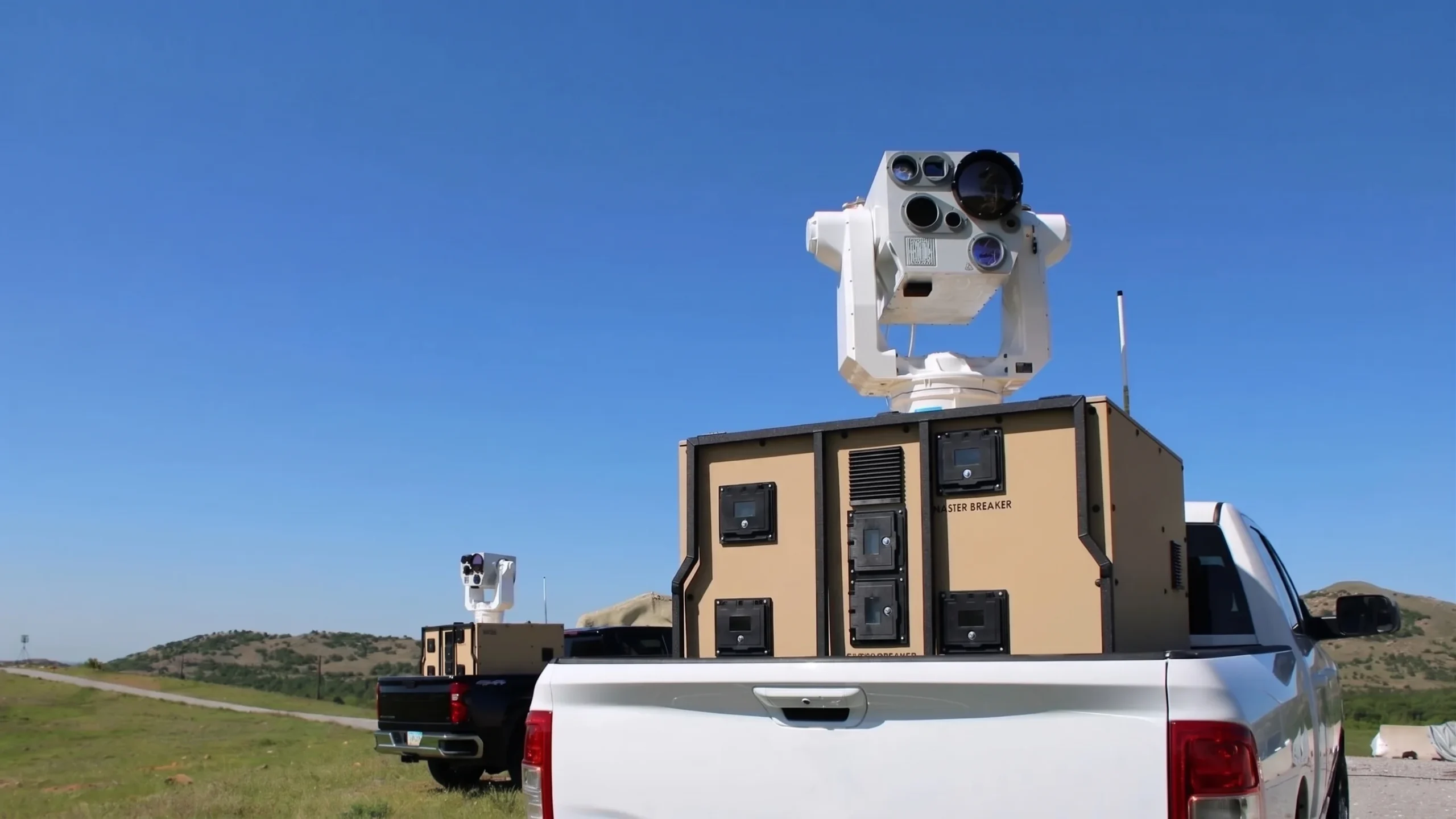
The U.S. Department of War has invited seven industry teams to Phase II of its Directed Energy Counter-Unmanned Aerial Systems (C-UAS) technology evaluation, setting up a live-fire shoot-off of high energy laser (HEL) weapons at Dugway Proving Ground, Utah, in mid-December. The Office of Research and Engineering (R&E) and Joint Interagency Task Force 401 (JIATF 401) announced the selections on November 16, 2026, after a competitive review of 13 technical white paper submissions.
The shoot-off is the second track of a JIATF 401 push to move directed energy into base defense. On October 5, the task force named four systems for a year-long counter-drone pilot at U.S. installations mandated by the Fiscal Year 2026 National Defense Authorization Act: AeroVironment’s Palletized High-Energy Laser, Boeing’s Compact Laser Weapon System, Kord Technologies’ FIREFLY and the Epirus Leonidas high-power microwave. The Phase II field is wider and entirely laser-based. “Scaled Directed Energy is one of the Department’s six critical technology areas,” said Emil Michael, Under Secretary of War for Research and Engineering, citing the need for “a low cost per shot defense capability.”
Seven High Energy Laser Systems Advance to the Dugway Shoot-Off
The teams and platforms invited to Phase II are:
- Allen Control Systems: BULLFROG HEL
- Aurelius Systems: ARCHIMEDES
- AeroVironment (BlueHalo): LOCUST X1
- Kord Technologies: FIREFLY
- Lockheed Martin (IPG): Crossbow system
- Thor Dynamics: LASER ARMOR HEL system
- Yrikka: TALOS drone-based HEL system
FIREFLY is the only system named on both lists. Kord, the KBR subsidiary, integrated the Army’s 50 kW-class Directed Energy Maneuver-Short Range Air Defense (DE M-SHORAD) Stryker prototype. Company data describes FIREFLY as a self-contained, palletized system offered in 10 kW and 20 kW configurations, with a 100 mm aperture, a continuous-wave source in the 1,030 to 1,080 nm band and integrated power, thermal management, radar and electronic warfare subsystems.
AeroVironment, which acquired BlueHalo in 2025 and supplies the pilot’s palletized LOCUST, enters the LOCUST X1. Publicly available specifications describe the LOCUST family as a 20 kW-class weapon with a 15 cm aperture, and the Army awarded AeroVironment a $464.8 million production contract for the 30 kW LOCUST X3 under the Enduring-High Energy Laser program in September. How the X1 differs has not been disclosed. Lockheed Martin fields IPG Photonics’ Crossbow fiber laser, the effector in its Sanctum C-UAS architecture; IPG markets the compact Crossbow Mini in 3 kW and 8 kW HEL versions, and Lockheed’s Dugway power class is undisclosed.
Thor Dynamics rates LASER ARMOR at up to 20 kW in a man-portable form, while Aurelius Systems describes ARCHIMEDES as an autonomous turret built to defeat Group 1 and Group 2 drones beyond one kilometer. Allen Control Systems, known for its gun-armed Bullfrog autonomous weapon station, stood up a directed energy division on November 10. Yrikka’s TALOS is the only airborne entry; no specifications have been published in open sources.
Safety Certification and Live-Fire Timeline at Dugway Proving Ground
Throughout November, vendors must complete laser safety certifications and command-and-control (C2) architecture integrations. Before firing, each system will spend an intensive week at Dugway for technical safety reviews, communications verification and preliminary range readiness testing. Live-fire target vignettes are scheduled to begin by mid-December, with engagements against representative unmanned aerial targets in planned scenarios assessing tracking and defeat both above and below the horizon.
The below-horizon requirement matters for installation defense, where small drones approach low against terrain and a missed beam must terminate safely. Earlier this year, a counter-drone laser fired near Fort Bliss led to an airspace closure over El Paso; after a March live-fire demonstration at White Sands Missile Range, the Federal Aviation Administration (FAA) concluded on April 10 that the high-energy laser counter-drone system tested, with proper safety controls, did not pose undue risk to passenger aircraft. The C2 requirement is equally practical: a laser becomes a base defense asset only once it accepts external sensor cueing.
“We’re trying to structure the shoot-off in such a way that systems that perform effectively or successfully can immediately result in a purchase order that allows us to start building the production lines to get these systems into the field,” said Army Brig. Gen. Matthew Ross, Director of JIATF 401.
Analysis: Tying one test event to an immediate purchase order compresses an acquisition path that has kept most U.S. lasers in prototype status for years. Advancing seven of 13 white papers signals the Department wants competition across power classes, from compact fiber lasers to 20 kW-class pallets, rather than a single champion. That breadth suggests the discriminators at Dugway will be C2 integration, tracking under clutter and safety compliance, not raw output. The caveat is scope: a December vignette set will not capture sustained dwell against multiple targets or atmospheric degradation, so the one-year pilot remains the real suitability test.
Next come safety certifications and C2 integration in November, then the readiness week and live fire at Dugway by mid-December. The Department has not disclosed the value of potential purchase orders, quantities, contract vehicles or how Phase II results will be weighed against the four systems already in the installation pilot.