Shield AI will integrate its Hivemind mission autonomy software on Innovaero’s One-Way Loitering (OWL) family of precision munitions under a memorandum of understanding (MoU) announced October 6, 2026, on the opening day of the Land Forces 2026 exposition in Perth, Western Australia. The agreement aims to widen the strike options available to the Australian Defence Force (ADF) while keeping the development, testing and fielding of that autonomy under Australian control.
The deal arrives as the Perth-based manufacturer moves from development toward production. Its flagship OWL-B is in certification under Mission Talon-Strike, the Advanced Strategic Capabilities Accelerator (ASCA) program to field the first sovereign-designed and built precision loitering munition in ADF service, with entry into service targeted for 2027. Innovaero listed on the Australian Securities Exchange (ASX: INN) in September 2026 after an A$40 million initial public offering that will fund a new production site at Jandakot. Shield AI has expanded its Australian footprint since acquiring Melbourne-based Sentient Vision Systems in 2024 and opening a Port Melbourne headquarters in 2025.
How Shield AI Hivemind Integrates With the OWL-B Flight Vehicle
According to the companies, Hivemind is already installed on the OWL-B ahead of flight testing. Multi-agent coordinated strike missions are being simulated under dynamic conditions, with commands issued through the Android Team Awareness Kit (ATAK). Using ATAK as the command layer lowers the adoption barrier: a dismounted operator can task munitions from the same handheld environment used for blue-force tracking and fires coordination rather than from a dedicated ground control station.
Hivemind runs as an edge AI pilot on the air vehicle. It replans routes in flight, reacts to unexpected conditions, avoids obstacles and continues its tasks when communications are denied, degraded, intermittent or limited. Adam Hogan, Shield AI’s vice president of Hivemind for Australia, Asia and the Middle East, said the software will help the ADF plan missions faster, “coordinate multiple aircraft and operate when GPS or communications are degraded.”
Shield AI says Hivemind has piloted more than 40 vehicle classes, from F-16 testbeds and Group 5 Collaborative Combat Aircraft to drone boats, ground vehicles and one-way attack drones. Its most recent port, onto the Destinus Hornet multi-role counter-UAS and strike platform, achieved flight control in under two months, with Australia-based teams supporting flight tests in Segovia, Spain, earlier in 2026.
OWL-B Range, Warhead and Launch: Inside Australia’s Sovereign Loitering Munition
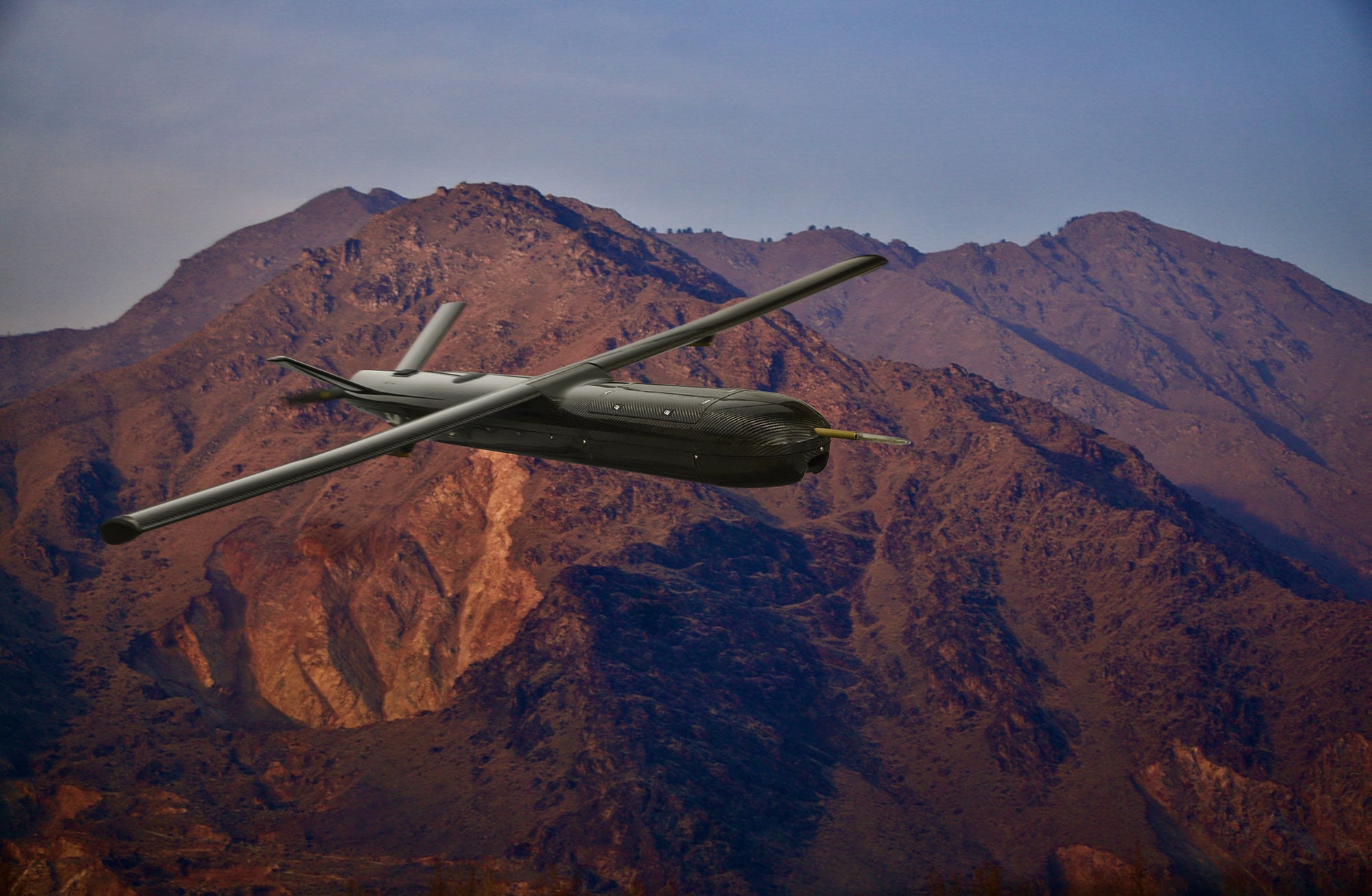
The OWL-B is an electrically powered, tandem-wing loitering munition designed and built entirely in Australia. Publicly available specifications indicate a gross weight of about 30 kg, a wingspan of roughly 1.85 m and a payload bay that accepts anti-armor or fragmentation warheads of up to 7 kg; Innovaero has previously likened the anti-armor effect to that of a Javelin missile. Open-source figures give a one-way range near 200 km, or about 30 minutes of loiter at 100 km, although a more conservative figure cited during 2025 trials sets maximum range near 100 km into a 20-knot headwind.
Targeting relies on an electro-optical/infrared (EO/IR) payload, described as GPS-independent, that can engage stationary and moving targets. The airframe launches from a catapult or, with wings folded, pneumatically from a 2 m canister. That profile places OWL-B well above the tube-launched AeroVironment Switchblade 300 that Australia ordered in 2024 and below the HIMARS-launched Precision Strike Missile, in the medium-range band ASCA defined for Talon-Strike.
In March 2025, Innovaero unveiled an upgraded OWL-B guidance package and the first OWL-X test demonstrator, a canister-launched variant, alongside the lighter OWL-A, rated at 45 km with a 1.5 kg warhead. OWL-B has also undergone maritime trials from the ADF training vessel MV Sycamore, opening a potential naval launch path.
Mission Talon-Strike Puts OWL-B on Track for 2027 Service Entry
ASCA launched Mission Talon-Strike in May 2025 around a single problem statement: striking land targets at medium range with low-cost, land-launched loitering munitions. In October 2025 it moved to delivery with an 18-month, A$20.8 million contract, excluding GST, for the OWL-B flight vehicle. The work covers refinement to a final operational configuration followed by test and evaluation in a multi-domain environment. ASCA describes it as the first time the ADF will certify and introduce into service a sovereign-designed and built precision loitering munition.
Innovaero reports 13 ADF contracts worth A$47.4 million over the past five years. Its Bibra Lake plant currently builds about 250 air vehicles a year by hand, a ceiling the Jandakot facility is meant to lift. Chief Executive Greg Tunny said Shield AI’s integration record made it a natural partner and that the collaboration accelerates an Australian-designed capability while preserving national control over critical defense technologies.
Analysis: The MoU targets the two variables that will determine whether OWL-B matters at scale: production volume and performance under electronic attack. Combat in Ukraine has shown that one-way munitions dependent on GPS and continuous datalinks degrade quickly once jamming matures, and the distances OWL-B is designed to cover in the Indo-Pacific make persistent links harder to sustain. Onboard autonomy that coordinates several munitions and keeps working without GPS moves OWL-B from a remotely piloted weapon toward a collaborative strike system. The sovereignty claim is the harder test. Hivemind remains U.S.-owned software, and its value to Canberra will depend on the code access, local test authority and data rights Australia secures. Those terms have not been disclosed.
Neither company has dated the first OWL-B flight with Hivemind installed. The Talon-Strike delivery contract runs into 2027, the year Innovaero targets for entry into service, and Department of Defence production orders remain its stated priority. Open questions include whether Hivemind will enter the certified OWL-B baseline or follow as a later increment, the value of any Shield AI workshare, how human authorization of terminal engagements will be handled in multi-agent attacks and whether the integration will extend to OWL-X and OWL-A.