The NATO Support and Procurement Agency (NSPA) has ordered additional vertical takeoff and landing (VTOL) uncrewed aircraft to expand the Greece V-BAT fleet, manufacturer Shield AI said November 9, 2026. The contract covers the Hellenic Army and Navy and includes spares, training, ground support equipment and long-term support. Shield disclosed no quantity, value or delivery schedule.
The order extends an intelligence, surveillance and reconnaissance (ISR) capability that began with a donation: two V-BAT systems totaling four aircraft, donated by the Athanasios K. Laskaridis Charitable Foundation, were handed over to the Hellenic Army on May 14, 2025. Shield announced a Hellenic Army follow-on agreement on June 2, 2026, and a Hellenic Parliament committee approved a V-BAT program for both services on June 11.
NSPA Order Expands Greece V-BAT Fleet Across Two Services
Greek defense reporting on the June approval described a €71 million program, executed through NSPA over four years, covering ten systems of two aircraft each. Six systems, or 12 aircraft, would go to the Hellenic Army and four systems, or eight aircraft, to the Hellenic Navy, with a two-year follow-on support package. Shield’s statement neither confirms those figures nor says whether this contract covers the entire approved program. If it does, Greek holdings would rise from four aircraft to 24, assuming no losses and no separate purchases.
NSPA awarded the contract under its Uncrewed Aerial Systems (UAS) Support Partnership, a legal framework that lets participating nations buy and sustain uncrewed systems across their full service life. The agency pools national requirements to shorten contracting and build shared logistics, while each nation keeps ownership and control of its aircraft. Its Alliance Ground Surveillance (AGS) and UAS Programme handles acquisition, spares, maintenance, training, upgrades and technical assistance.
For Greece, the structure puts both services on one aircraft type, one contracting channel and one support arrangement. James Lythgoe, Shield’s regional director for Eastern and Southeast Europe, said a common fleet would let the Army and Navy share training, logistics and operating experience, with NSPA streamlining acquisition and sustainment. The Army’s role reflects Greek geography: its Higher Military Command of Interior and Islands received the first aircraft, and Shield tied the June agreement to maritime domain awareness across the Aegean Sea, a mission that can be flown from shore sites as well as ships.
V-BAT Ducted-Fan Design, JP-5 Engine, and Aegean ISR Payloads
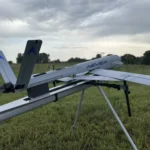
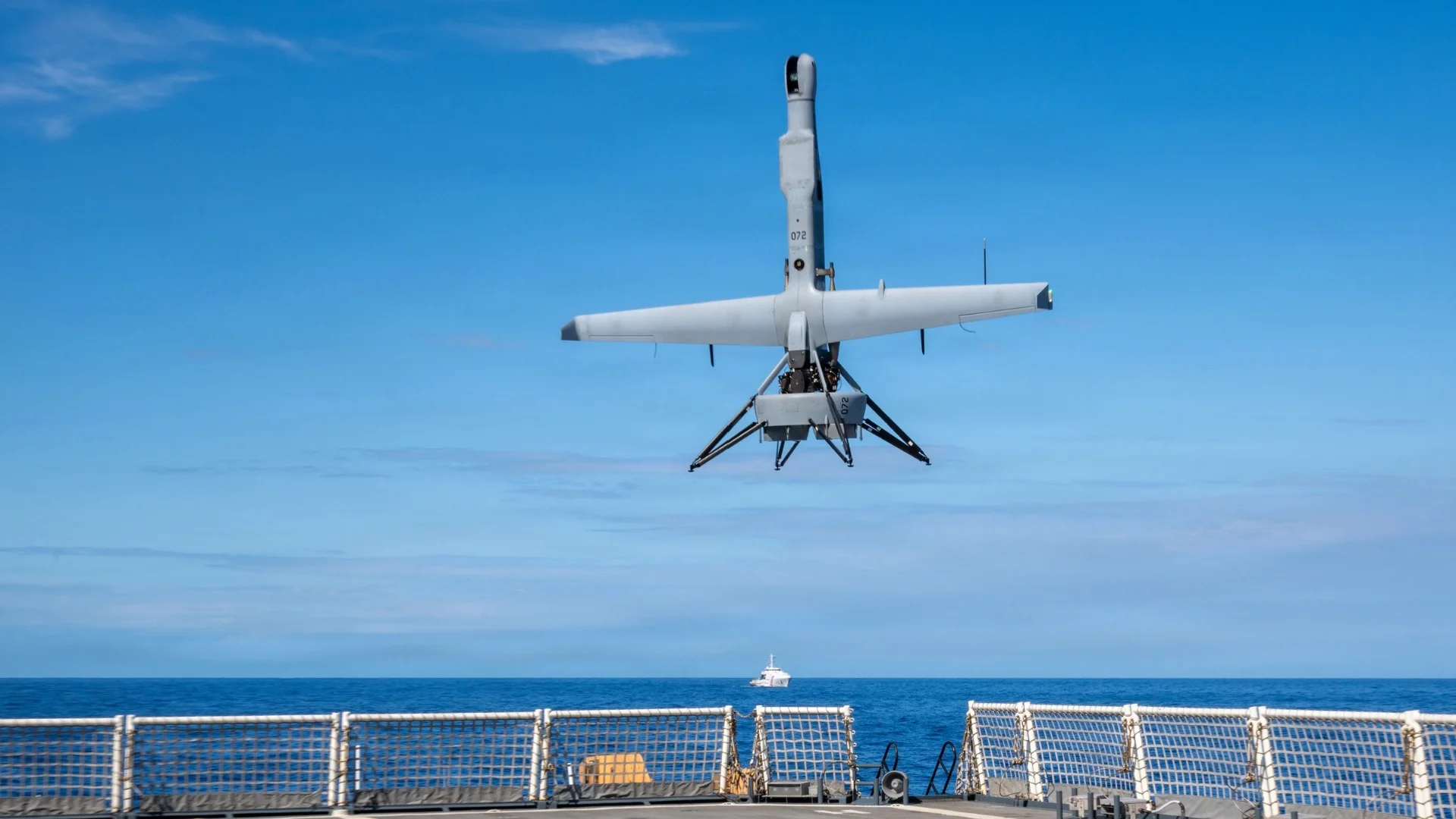
V-BAT is a tail-sitting aircraft built around a single enclosed ducted fan. Manufacturer specifications list a 3.8-meter wingspan, a 2.9-meter height, a 75-kilogram maximum gross takeoff weight and an 18.1-kilogram maximum payload. A heavy-fuel engine running on JP-5, the standard naval aviation fuel, provides more than 12 hours of endurance with an electro-optical/infrared (EO/IR) payload.
Shield lists a 4.6-by-4.6-meter landing zone, unassisted launch and recovery in winds up to 25 knots, and operations from ships moving at 10 knots. A two-person team can ready the aircraft in under 30 minutes. Those figures let a ship deck, island or coastal clearing serve as a launch site. Maximum range reaches 130 kilometers with an MPU5 radio and 180 kilometers with a C-band link, and satellite communications support beyond-line-of-sight missions.
Payload options include synthetic aperture radar, Automatic Identification System receivers, a laser designator and the passive Visual Detection and Ranging (ViDAR) search sensor, which Shield rates at 3,140 square nautical miles per hour and which frees the primary sensor to inspect individual contacts. The Greek sensor fit has not been disclosed.
The Hellenic Navy also contracted four Schiebel CAMCOPTER S-100 systems, each with two aircraft, for its three Kimon-class frigates and its Marathon training center. The 200-kilogram S-100 carries up to 50 kilograms and flies more than six hours with a 34-kilogram load, or more than 10 with an external tank. V-BAT’s takeoff weight is 125 kilograms lower and its rated endurance longer, but its payload is about 36 percent of the S-100’s.
Greek Industrial Agreements Link V-BAT, Hivemind, and X-BAT
The contract arrives alongside Greek industrial agreements that extend Shield’s work beyond the V-BAT airframe. Shield has opened a regional office in Athens, and on June 16, 2026, it partnered with EFA Group to develop artificial intelligence (AI) pilots using its Hivemind autonomy software as a baseline, with Greek sovereign control and sustainment over the product’s life cycle.
In July, Shield and Greek manufacturer ALTUS-LSA signed a strategic agreement to integrate the KMB Hunter interceptor and M3NTOR command-and-control system with V-BAT and Hivemind, through joint hardware integration and software development. The KMB Hunter is designed for both air-to-air and air-to-ground strike missions. Shield lists V-BAT as capable of carrying kinetic munitions, and its new statement says the July partnership aims to arm V-BAT with the KMB Hunter. It presents the order itself as an ISR expansion, however, and does not say whether the aircraft in this order will be armed.
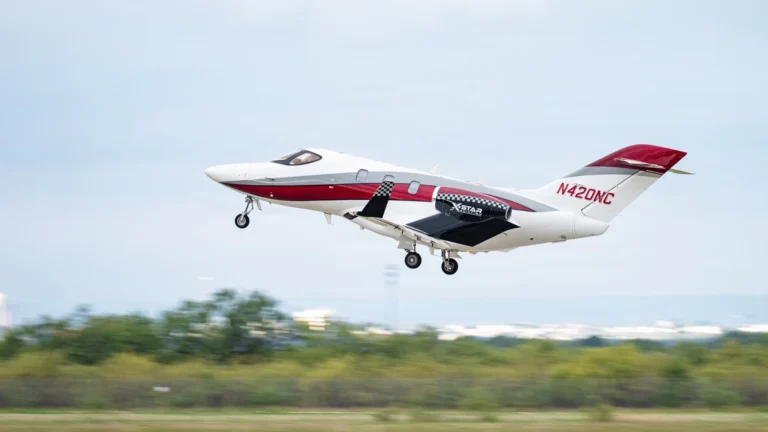
On October 8, Shield signed a memorandum of understanding (MoU) with GEK TERNA to pursue X-BAT parts production, aircraft integration and sustainment in Greece. Shield would lead the program and supply autonomy software and mission systems, while GEK TERNA would manage Greek suppliers and a local program office, and the partners want Greece to serve as a training, logistics and maintenance hub for Cyprus, the Balkans and Southeastern Europe. X-BAT, an AI-piloted VTOL jet, remains in development with production planned for 2029, and no Greek order has been announced.
Analysis: The order gives Greece a dispersed maritime ISR layer independent of runways. If each system keeps the two-aircraft structure reported in June, one site could sustain a near-continuous orbit with aircraft rated above 12 hours, before maintenance and weather losses. NSPA supplies contracting and sustainment, but not the Greek workshare Shield has promoted: no funded production contract has been announced.
Key unknowns include the aircraft count, contract value, delivery dates and Navy tasking alongside the S-100. Next markers are a contract breakdown from NSPA or the Hellenic Ministry of National Defence, first deliveries, KMB Hunter trials on V-BAT, and any binding X-BAT arrangement with GEK TERNA.