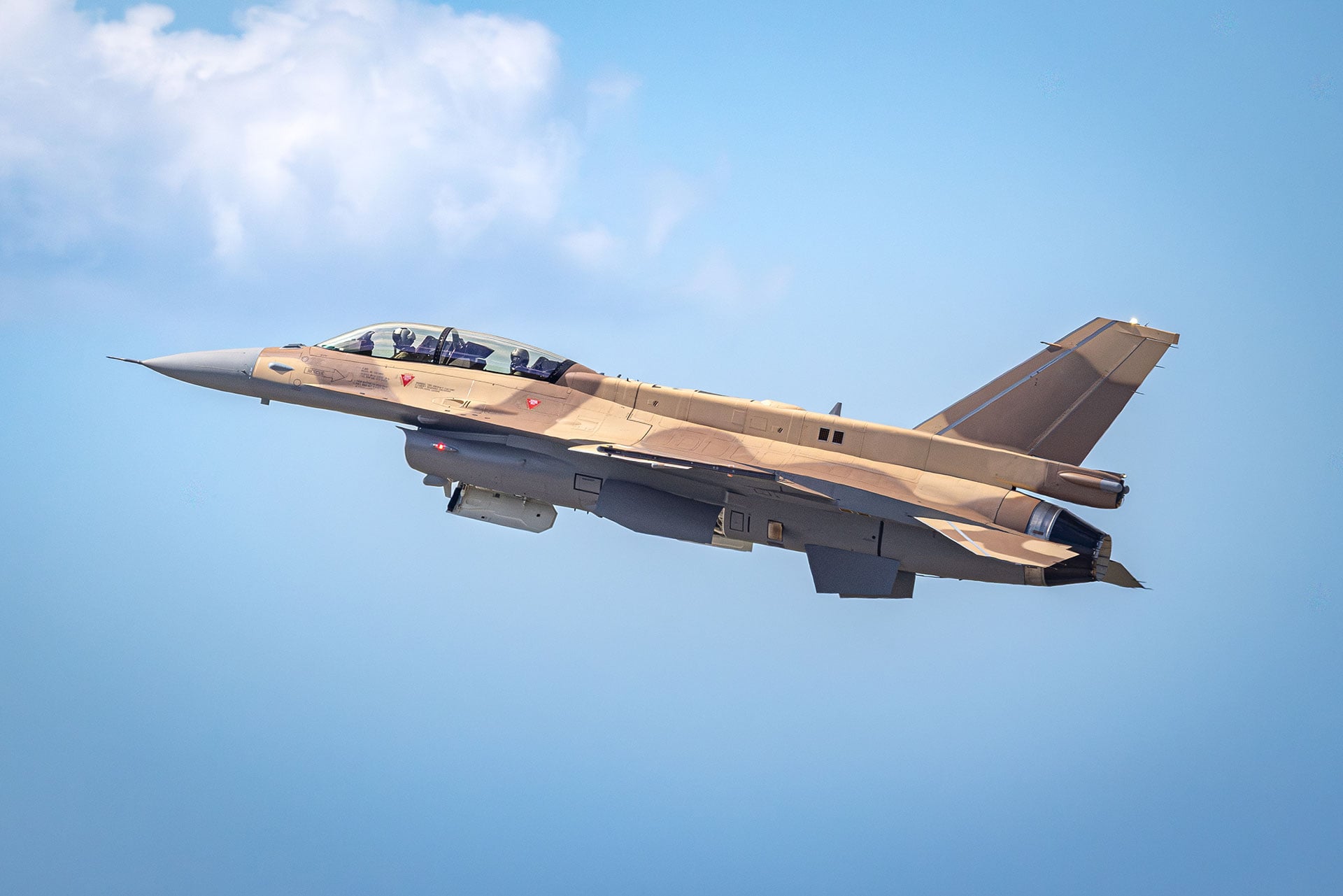
Lockheed Martin announced on October 6, 2026, that the Royal Moroccan Air Force’s (RMAF) first F-16 Block 72 has completed its first flight, moving it into the test campaign that precedes delivery. The company announced the milestone from Greenville, South Carolina, home of the F-16 production line, without disclosing the sortie date or a handover date. Mike Shoemaker, head of Lockheed Martin’s Integrated Fighter Group, called the flight “a critical step in strengthening Morocco’s future airpower.”
The milestone closes a long gap for Rabat. The U.S. State Department approved the possible Foreign Military Sale (FMS) of 25 F-16C/D Block 72 aircraft to Morocco on March 25, 2019, at an estimated $3.787 billion, alongside a separate $985.2 million package to bring 23 in-service F-16C/D Block 52+ jets to the F-16V standard. The jet flies after a year of Lockheed Martin charges and paused deliveries on the F-16 line, as neighboring Algeria fields Su-35s and, according to open-source imagery, its first Su-57E stealth fighters.
Morocco F-16 Block 72 Configuration: APG-83, Viper Shield, F100 Engine
The Block 72 designation identifies the Pratt & Whitney-powered branch of the F-16 Block 70/72 family, the newest Fighting Falcon production standard; Block 70 aircraft use the General Electric F110. The 2019 notification covered 29 F100-PW-229 engines, including four spares. Publicly available specifications rate the F100-PW-229 at roughly 29,000 pounds of afterburning thrust. Morocco’s Block 52+ fleet already flies on the same engine family, giving the RMAF a single engine logistics and depot chain across old and new airframes.
The sensor core is Northrop Grumman’s AN/APG-83 Scalable Agile Beam Radar (SABR), an active electronically scanned array (AESA) that Lockheed Martin says shares hardware and software commonality with the F-22 and F-35 radars. Compared with the mechanically scanned AN/APG-68(V)9 on Morocco’s Block 52+ jets, the APG-83 offers longer detection ranges, interleaved air-to-air and air-to-ground modes, high-resolution synthetic aperture radar mapping, and stronger resistance to jamming. The notified package also included 26 Modular Mission Computers, 26 Link 16 Multifunctional Information Distribution System Joint Tactical Radio System (MIDS-JTRS) terminals, the Joint Helmet Mounted Cueing System II, and 26 AN/AAQ-33 Sniper targeting pods.
Self-protection comes from the L3Harris AN/ALQ-254(V)1 Viper Shield, an internally mounted, all-digital electronic warfare suite built around digital radio frequency memory jamming. Morocco is one of five FMS customers, with Bahrain, Bulgaria, Slovakia, and Taiwan, covered by a $520.4 million contract modification for Viper Shield production. Internal carriage frees hardpoints otherwise taken by a jamming pod. The weapons package notified in 2019 listed 40 AIM-120C-7 AMRAAMs, 60 GBU-39/B Small Diameter Bombs, and 50 GBU-49 Enhanced Paveway II bombs. Lockheed Martin also cites a 12,000-hour structural service life, roughly 50 percent beyond earlier F-16 production lots.
From 2019 Notification to Greenville Flight Test: The Delivery Timeline
Morocco’s jets sit inside a production vehicle shared with Taiwan. In August 2020, the U.S. Air Force awarded Lockheed Martin a 10-year, $62 billion indefinite-delivery, indefinite-quantity contract for FMS F-16s, with an initial $4.94 billion delivery order for 90 aircraft: 66 for Taiwan and, by public accounts, 24 for Morocco, one fewer than the 25 notified in 2019. Work on that first order carried a completion date of December 31, 2026.
That schedule has slipped. During its second-quarter 2026 earnings call, Lockheed Martin’s chief financial officer said a flight test of a new F-16 variant had fallen short of company and customer expectations, forcing a redesign and a second test campaign before deliveries resumed. The company did not name the variant on that call, but a Lockheed Martin executive had earlier tied a new configuration to the Taiwan and Morocco production programs. Lockheed Martin delivered two F-16s in the quarter and reports 119 Block 70/72 aircraft in backlog and 41 delivered across seven customer nations.
Ground infrastructure is moving in parallel. On August 31, 2026, the Pentagon awarded CAE a contract worth up to $42.1 million for two F-16 Block 72 full mission trainers, each with a Block 72 cockpit, visual display system, and JHMCS II integration. Work is split between Arlington, Texas, and Sidi Slimane Air Base, which Morocco has been preparing for the new fleet, with completion set for April 30, 2029. Lockheed Martin also points to a planned Maintenance Aero Maroc facility at Benslimane, covering more than 8,000 square meters, that will start with C-130 Hercules heavy maintenance before expanding to the F-16.
Analysis: The Block 72 is not a low-observable fighter, but it gives the RMAF a sensor and electronic warfare edge over Algeria’s Su-30MKA fleet and a credible counter to the Irbis-equipped Su-35. An APG-83-cued AIM-120C-7 engagement chain, Viper Shield jamming, and Link 16 connectivity with U.S. and allied assets reinforce Morocco’s standing as a Major Non-NATO Ally able to plug into coalition air operations. The delay carries strategic weight: each quarter of slippage narrows the window for the 25 new jets to reach operational capability before Algeria’s Su-57E fleet matures, and strengthens the case for the F-35 access Rabat has reportedly explored.
Next come contractor and U.S. government acceptance flights, a formal handover, and the ferry flight to Morocco. Lockheed Martin has published neither a first delivery date nor a schedule for the full lot, and the status of the F-16V upgrade for the 23 Block 52+ jets remains undisclosed. The pace at which Greenville clears the shared Taiwan and Morocco lot will decide how many Block 72s reach Sidi Slimane before the simulators arrive in 2029.